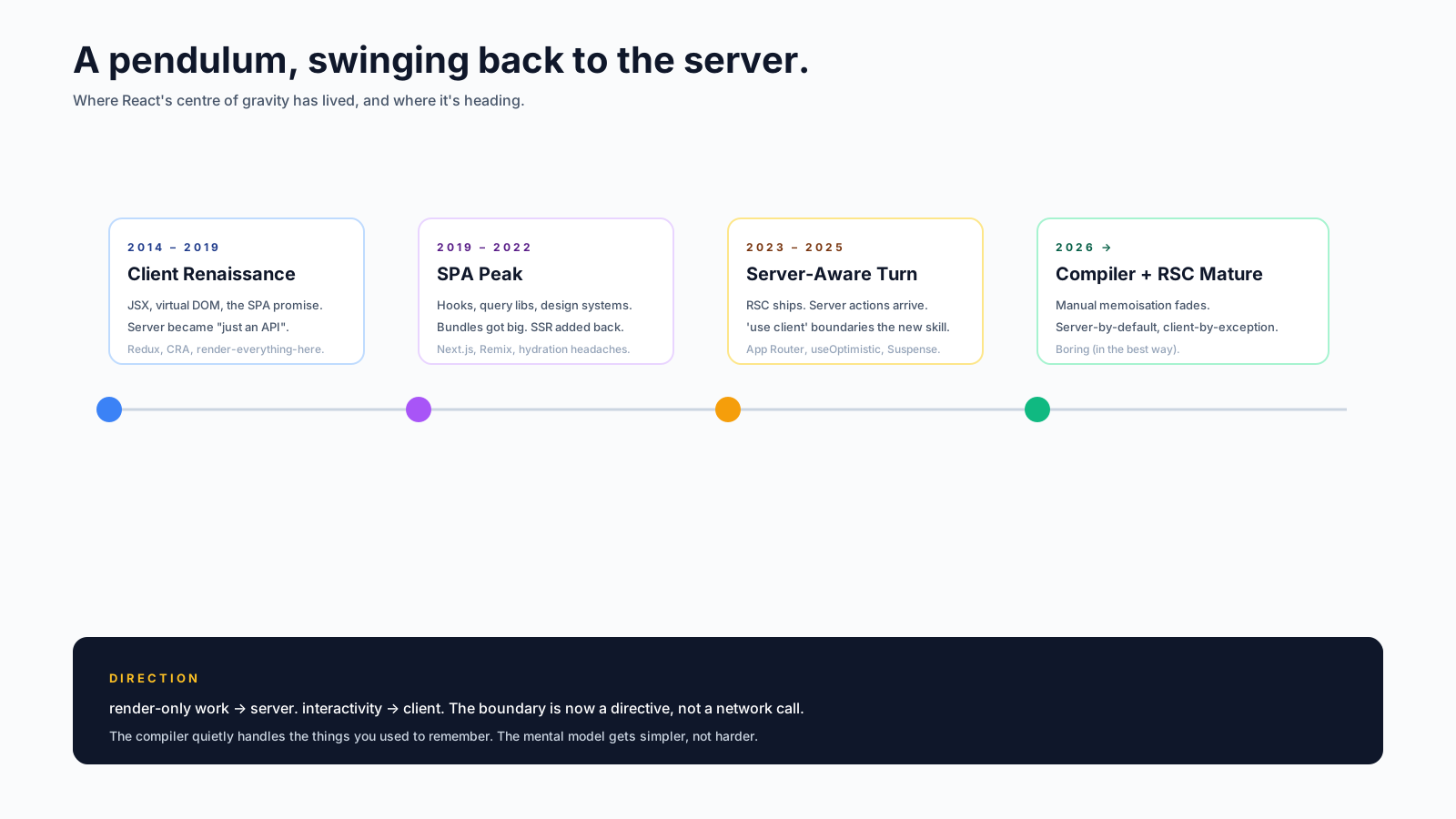
For most of React's history, the story was simple: the client does the work. Components ran in the browser, state lived in the browser, the server was a JSON pump. Then around 2023, the story started changing. Server Components became real. Server Actions appeared. Suspense for data fetching got stable. The React Compiler started taking over the manual useMemo work. By 2026, the trajectory is clear: React is becoming server-aware again, on purpose.
This article is the grounded version of that story. What's actually shipped, what's stable, what's still moving, and how to think about it without the marketing.
The Shift In One Sentence
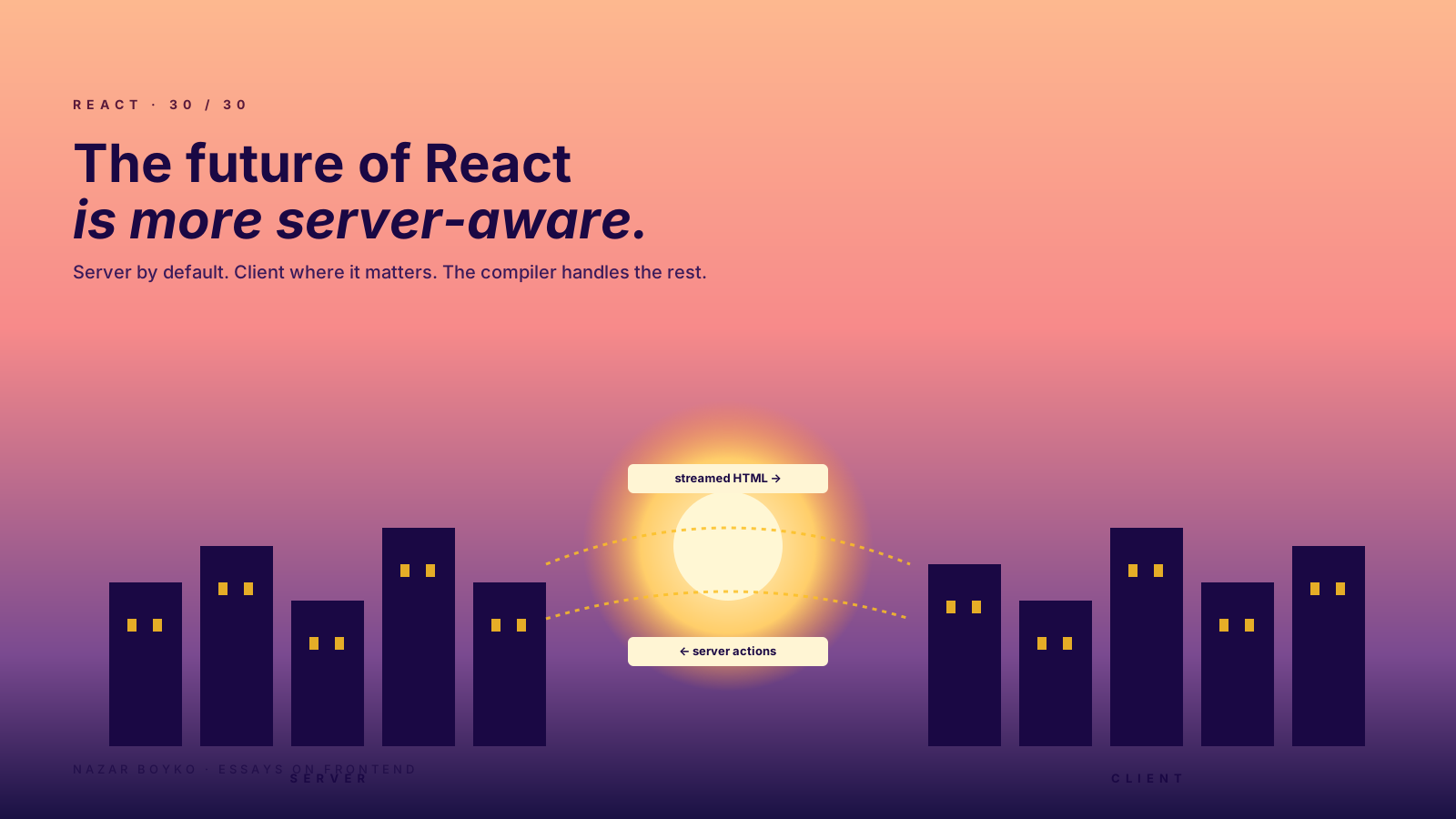
The last decade was about making the browser do more. The next era is about making the server do more of the right things — render-only work, secret-handling, data fetching — while keeping the client surface small and interactive.
That's not "React is becoming a backend framework". The interactive parts of the UI still run in the browser; that's where the user is. What's changing is which parts of UI work belong on which side — and the answer for a lot of work has become "server, by default".
What's Actually Stable Now
Three pieces of the new model are production-ready in 2026:
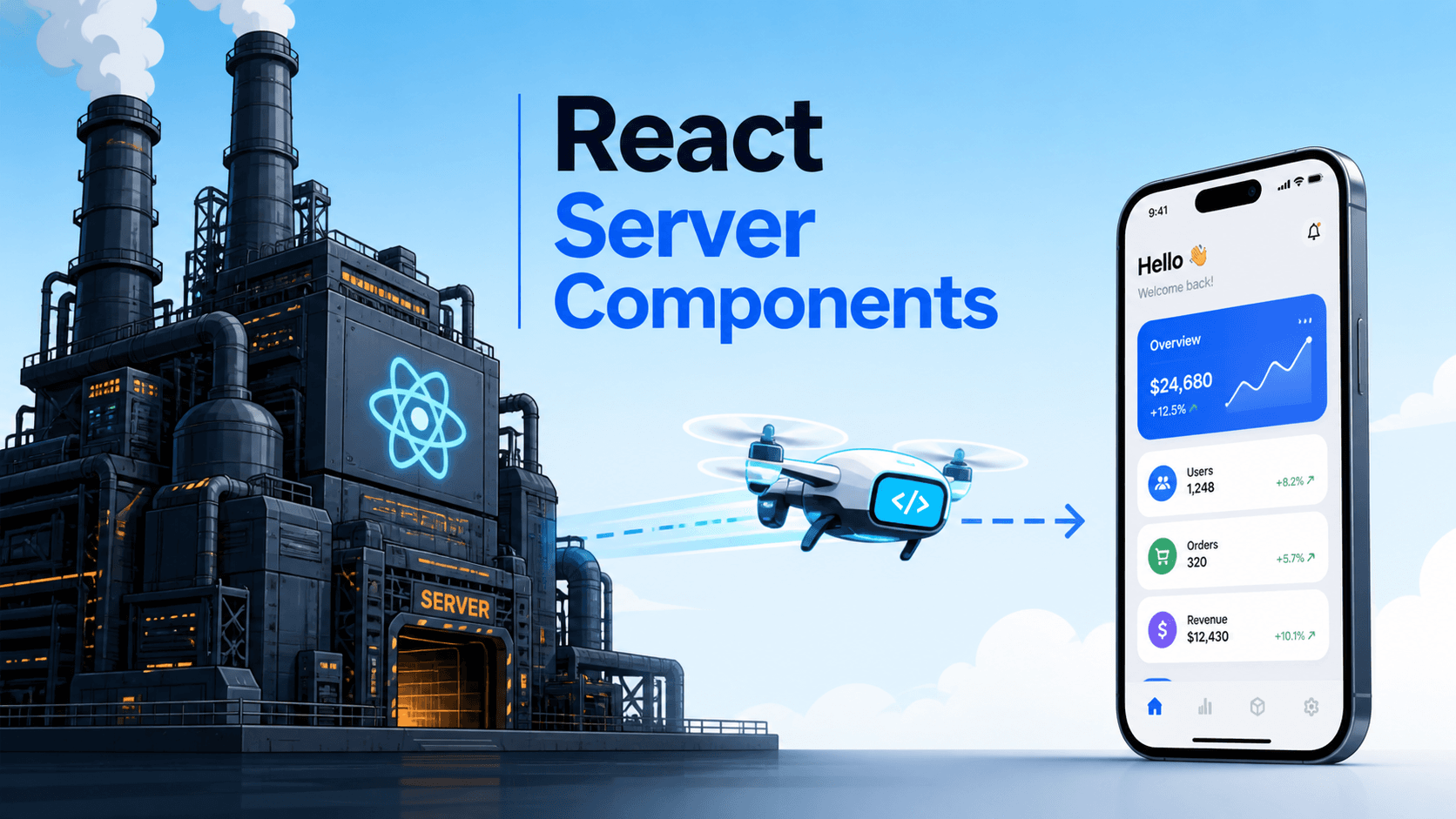
Server Components. Stable in React 19 (released December 2024); previously experimental in React 18. Mature in Next.js App Router and a handful of other frameworks. Components that render only on the server, ship zero JS, and can talk directly to your database. Covered in detail in the dedicated article.
Server Actions. Functions marked 'use server' that run on the server but can be called from the client. They replace most CRUD endpoints. The default for forms in Next.js App Router and similar frameworks.
useOptimistic (React 19). A built-in primitive for the optimistic-UI pattern, designed to integrate with Server Actions:
'use client';
import { useOptimistic } from 'react';

function CommentList({ comments, postId, addComment }) {
  const [optimistic, addOptimistic] = useOptimistic(
    comments,
    (state, draft) => [...state, { ...draft, sending: true }]
  );

  return (
    <form action={async (formData) => {
      addOptimistic({ id: crypto.randomUUID(), text: formData.get('text') });
      await addComment(formData);   // server action
    }}>
      <input name="text" />
      <ul>{optimistic.map(c => <li key={c.id}>{c.text}</li>)}</ul>
    </form>
  );
}
Notice the shape: a regular form, posting to a server action, with an optimistic update wrapping it. No useState for the comment list. No fetch boilerplate. The framework handles the wire format.
Stable enough for production today, with caveats around debugging and library compatibility. Most React-aware libraries (TanStack Query, react-hook-form, Radix) work — anything that touches window at import time needs a 'use client' wrapper.
What's Almost Stable
The React Compiler. Auto-memoises components and values that the compiler can prove are pure. No more manual useMemo, useCallback, or React.memo for the common cases. Released as stable in late 2025; widely adopted by mid-2026, but plenty of codebases are still validating it.
// before — the dance
const filteredOrders = useMemo(
  () => orders.filter(o => o.status === filter),
  [orders, filter]
);
const onSelect = useCallback((id) => setSelected(id), []);

// with the compiler — write the obvious thing, get the same perf
const filteredOrders = orders.filter(o => o.status === filter);
const onSelect = (id) => setSelected(id);
If the compiler delivers on its promises (and the early data is good), most of the React performance content from the last decade — the useMemo lectures, the "stable references" advice, the wrapping in React.memo — becomes obsolete. The "memoise after measuring" article in this series ages out within a year or two, in the best possible way.
What you'll still need to think about: data waterfalls, virtualisation, image optimisation, and bundle size. The compiler doesn't fix those.
Async client components. A long-rumoured feature that lets client components await directly during render (using use(promise)). React 19 ships the building block; React 19.x is filling in the rough edges.
What's Still Moving
A few areas where the API isn't done changing:
- Async transitions across the server boundary. The model for "this client interaction kicks off some server work, both sides should pause appropriately" is improving but not finished.
- Streaming SSR with rich interactivity. The shape of the server-rendered HTML is stable; the developer experience for "this part of the page is server-rendered, this part hydrates on demand" is still evolving.
- The official RSC bundler API. Next.js and Remix ship implementations; a stable cross-framework spec is in progress.
If you're choosing tooling in mid-2026, expect the high-level model to stay but the underlying APIs to get a bit more polished over the next year. None of this is reason to wait — the patterns are stable enough — but read the framework changelogs.
What's Probably Not Coming Back
A short list of trends that the last few years have walked back:
- All-client SPAs as the default for new projects. Still useful for very interactive apps (editors, design tools, dashboards with heavy local state). Increasingly rare for marketing sites, content sites, and B2B SaaS. The default has shifted to "server-rendered with client islands".
- Manual memoisation everywhere. With the compiler, this is mostly going away.
- Hand-rolled data fetching. TanStack Query / SWR / RSC make
useState+useEffectfor fetches feel like 2018. - CSS-in-JS that runs in the browser. Server-aware solutions (Tailwind, Vanilla Extract, Panda CSS, CSS modules) won the performance argument.
- Heavy client-side state stores for everything. A lot of state has moved to the URL, the cache, or the server. Stores still have their place — it's just smaller than it was.
What This Means For New Projects
If you're starting a React project in 2026, the boring-but-correct stack:
- Framework: Next.js App Router, Remix, or TanStack Start. (CRA is officially retired; Vite + React Router is fine for SPA-shaped apps that don't need RSC.)
- Server Components by default. Mark interactive islands as
'use client'. - Forms:
<form action={serverAction}>withuseOptimisticfor the UX. - Data: TanStack Query for client state, RSC for server reads, server actions for writes.
- Compiler: enabled. Stop writing
useMemo/useCallbackunless you measure a real need. - TypeScript: strict mode. ComponentProps + discriminated unions for component APIs.
- Styling: Tailwind or CSS variables. Avoid runtime CSS-in-JS.
- Testing: Vitest + RTL + MSW + Playwright.
For existing projects, you don't need to migrate everything. Most of the wins from RSC come from new pages built in the new style; converting old pages is a multi-month project that has to compete with feature work.
What This Means For Your Career
A few honest observations for engineers thinking about where to invest:
- Server-side knowledge matters more than it used to. Knowing how to design a database query, how to think about caching, how to debug a streaming response — these are now part of the React job, not just a separate "backend" skill.
- The boundary between "frontend" and "fullstack" is collapsing. Most React engineers in 2026 are at least adjacent to the data layer. Embrace it.
- Performance trivia is being automated away. The compiler, frameworks, and improved primitives are removing whole categories of advice from interview questions and blog posts. The remaining performance work is more about architecture (where data lives, how it streams) than micro-optimisation.
- Accessibility, types, and testing are still your edge. These haven't been automated and won't be soon. Engineers who do them well stand out.
A Note On Hype
Every framework cycle has a phase where the new thing is presented as "you must rewrite everything immediately". RSC went through that in 2023. The honest version: most of what made React great is unchanged. Components are still functions. State is still state. The mental model from the rendering article still applies. The new stuff is additive — a new way to render, a new place to put work, a new set of escape hatches.
If your existing app works, the right move is usually to learn the new patterns for new code and migrate the rest opportunistically. The framework's whole design rewards this — server and client components compose freely; they don't require an all-or-nothing flip.
A One-Sentence Future
React in 2026 is a framework where most rendering happens on the server, most interactivity on the client, the boundary between them is a directive instead of a network call, and the compiler quietly handles the things you used to have to remember. The mental model gets simpler over time, not more complex.
If that sounds boring, good. The exciting frameworks are exhausting; the boring ones are the ones you can ship features with for years.