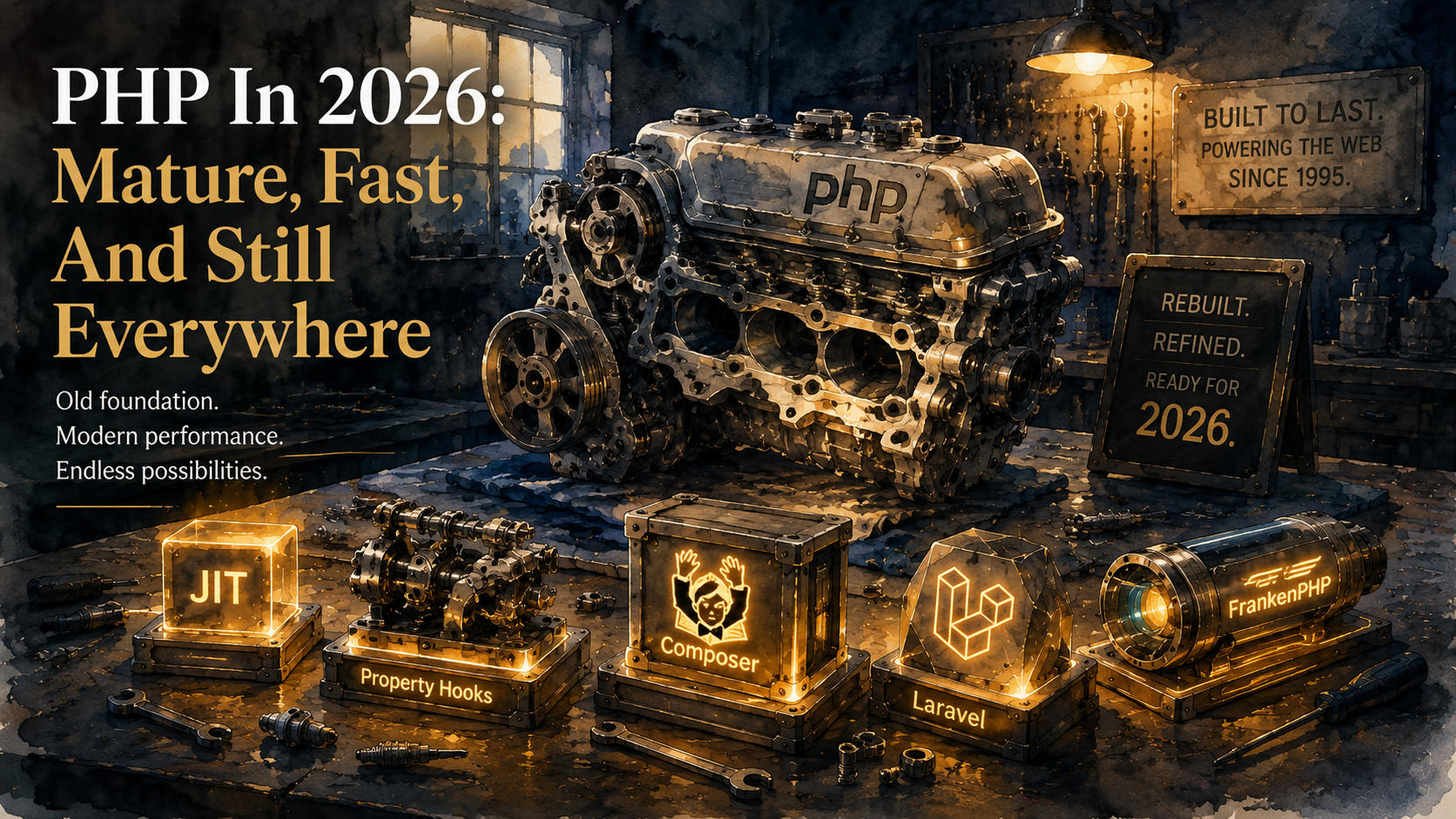
Have you ever told a junior developer that the language behind a large slice of the web is PHP and watched them squint like you just admitted you still drive a 1998 station wagon?
It happens a lot.
Somewhere on the internet, every six months, somebody publishes a new "PHP is dead" post. And every six months, half the new SaaS dashboards, e-commerce stores, CMS platforms, payment flows, and internal admin panels continue to be quietly written, scaled, and maintained in PHP. The gap between the meme and the codebase is wide, and in 2026 it's wider than ever.
Modern PHP isn't the PHP people remember from their first WordPress plugin in 2008. It's a typed, JIT-compiled, attribute-driven, framework-rich language that runs on long-lived application servers, ships with first-class enums and readonly classes, and has a static-analysis toolchain that catches more bugs than most dynamic languages can dream of.
Let's take a real look at where PHP actually is right now.
The Reputation Problem Is Older Than The Language Is Now
The PHP that earned the bad reputation was PHP 4 and early PHP 5. That language was forgiving in all the wrong ways. You could call any function on any value, mix logic and presentation in the same file, store state in superglobals, and silently swallow errors that should have crashed the request. That PHP shipped with mysql_query() and string concatenation as the recommended way to talk to a database, and that's how a generation of SQL injection vulnerabilities was born.
The thing is, that PHP stopped being the default years ago.
PHP 7 (2015) was a quiet revolution: a new engine that roughly doubled throughput, scalar type declarations, return types, the spaceship operator, the null coalescing operator. PHP 7.4 added typed properties. PHP 8.0 brought the JIT, named arguments, the match expression, attributes, and constructor property promotion. PHP 8.1 gave us enums, readonly properties, fibers, first-class callable syntax, intersection types. PHP 8.2 added readonly classes and DNF types. PHP 8.3 added typed class constants and the Override attribute. PHP 8.4 added property hooks and asymmetric visibility. PHP 8.5, the current supported branch, added the pipe operator.
That's a decade of disciplined evolution. Every release added something a typed language person would actually want, while keeping the language readable to someone who only wants to ship a feature this afternoon.
What Modern PHP Code Actually Looks Like
Here's a chunk of code that's perfectly normal in a 2026 PHP codebase:
<?php

declare(strict_types=1);

namespace App\Orders;

use App\Pricing\Money;

enum OrderStatus: string
{
    case Pending = 'pending';
    case Paid = 'paid';
    case Shipped = 'shipped';
    case Cancelled = 'cancelled';
}

final readonly class Order
{
    public function __construct(
        public string $id,
        public OrderStatus $status,
        public Money $total,
        public \DateTimeImmutable $createdAt,
    ) {}
}

final class OrderService
{
    public function __construct(
        private OrderRepository $orders,
        private PaymentGateway $payments,
    ) {}

    public function markPaid(string $orderId): Order
    {
        $order = $this->orders->find($orderId)
            ?? throw new OrderNotFoundException($orderId);

        if ($order->status !== OrderStatus::Pending) {
            throw new InvalidOrderTransitionException($order->status);
        }

        $paid = new Order(
            id: $order->id,
            status: OrderStatus::Paid,
            total: $order->total,
            createdAt: $order->createdAt,
        );

        $this->orders->save($paid);

        return $paid;
    }
}
Look at what's on the page. Strict types. Enums as first-class citizens. A readonly class that can't be mutated after construction. Constructor property promotion. Named arguments. The throw expression used inline with ??. Strong typing on every parameter and return.
You can read this once and know exactly what it does. The compiler, and a static analyzer like PHPStan, can read it too and tell you ahead of time if you've passed the wrong shape of money into the constructor or forgotten a transition case. That's not the PHP people roll their eyes at. That's a language that takes itself seriously.
The Performance Story Most People Missed
For most of its life, PHP ran on the request-per-process model. A request comes in, an interpreter boots, your code runs, the interpreter dies, the next request starts from scratch. That model is operationally simple (you can't have memory leaks across requests if there's nothing across requests), but it's also slow, because every request pays the price of rebuilding the world.
Modern PHP has options.
The JIT, added in PHP 8.0 and improved every release since, compiles hot code paths to native instructions. It's most effective on CPU-bound work like image processing, math, and parsers, and barely helps a typical request that spends most of its time waiting on the database. Useful, but not the headline.
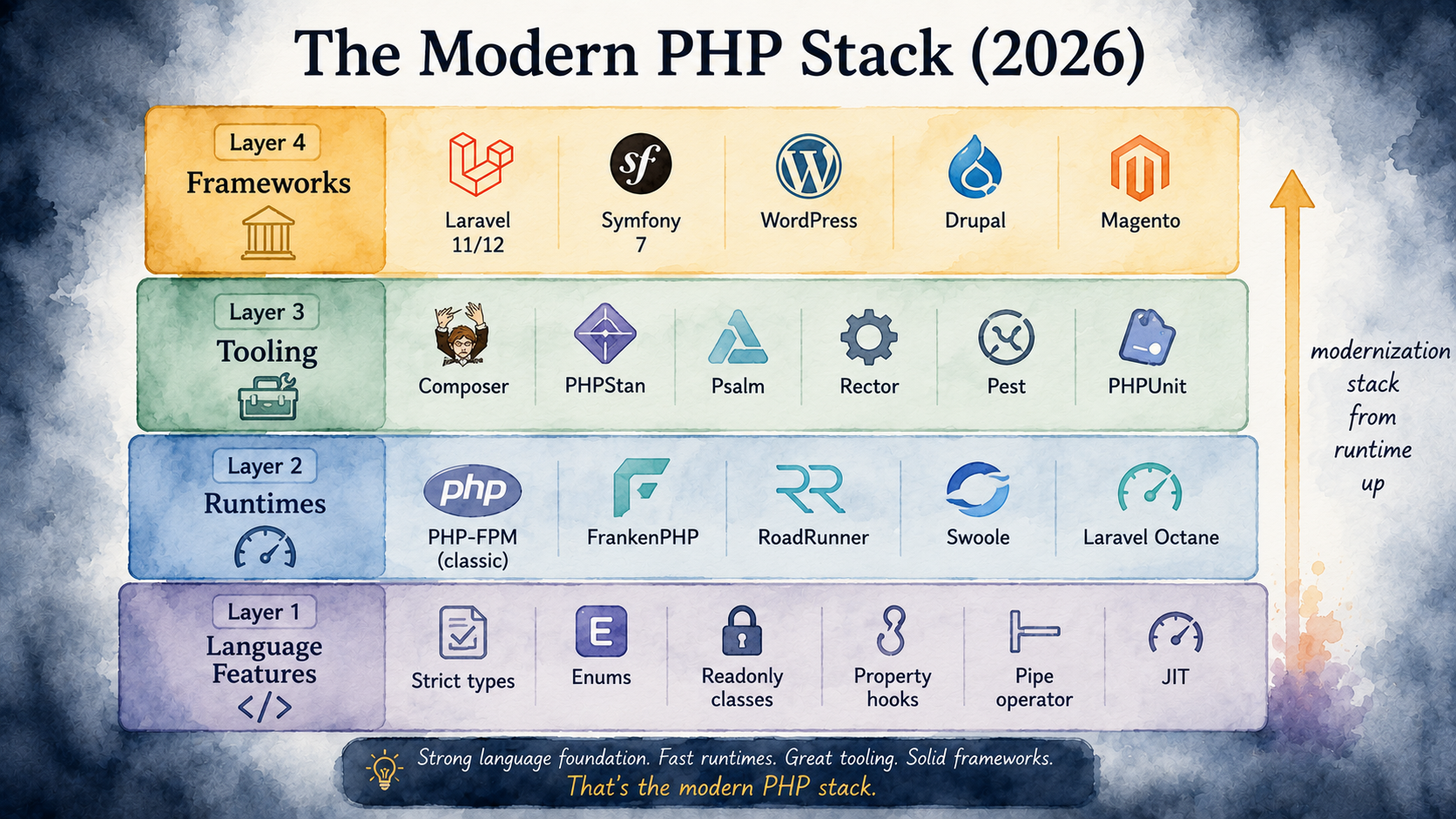
The bigger shift is application servers that keep the PHP process alive between requests. RoadRunner (Go-based), Swoole (a C extension that adds coroutines and an event loop), and FrankenPHP (the newer one, built on Caddy with HTTP/3 and early hints support out of the box) all let you boot the framework once, hold it in memory, and serve thousands of requests against the same warm runtime. Laravel calls its variant Octane.
The result, when you switch a well-written Laravel or Symfony app to one of these runtimes, is often a 3-5x throughput increase on the same hardware, sometimes more for small responses. You stop paying the cold-start tax on every request.
There's a catch, of course. Long-lived processes mean you can't write code that assumes a clean slate. Static state leaks across requests. Singletons keep growing. Connections need careful pooling. The PHP community has been writing patterns and tooling for this for several years now, and the major frameworks have first-class support for the "warm runtime" mode. But if you're going to deploy on FrankenPHP, you do need to write code as if your process is going to live for a week. Which, by the way, is how every Java, Go, and Node service has always worked.
The Ecosystem Is Not Just Laravel
If you mentioned PHP in a job interview in 2014, the follow-up question was probably "WordPress or Laravel?" In 2026, the menu is wider.
Laravel is the dominant framework in the PHP world, and it earned that position by being unreasonably pleasant to work with. The ergonomics (Eloquent, the queue system, broadcasting, the testing helpers, the artisan CLI) make small teams feel like big teams. Laravel 11 cleaned up the default app skeleton significantly; subsequent releases have continued to lean into reducing boilerplate. It's the default choice for greenfield product work.
Symfony is the long-running, "let's build something that's going to be here in a decade" framework. The components are battle-tested and reused everywhere. Drupal, Magento, parts of Laravel itself, Composer, and dozens of CLI tools all depend on Symfony components. If your codebase needs strict architectural discipline, you reach for Symfony.
WordPress still runs roughly two in five public websites. You can argue whether that's a good thing for the language's reputation, but you can't argue with the install base. The WordPress ecosystem has its own gravity, and it pays a lot of PHP developers.
Drupal and Magento continue to be relevant in enterprise CMS and e-commerce respectively, both running on Symfony components.
Behind the frameworks, the developer tooling has quietly become world-class:
- Composer is the package manager. It's been stable, reliable, and largely boring for years, which is the highest praise a package manager can earn.
- PHPStan and Psalm are static analyzers that, at the highest levels, will flag more bugs than the TypeScript compiler does on a comparable JavaScript codebase. Most serious PHP teams run them on every PR.
- Rector is an automated refactoring tool that can upgrade a codebase from PHP 7.4 to 8.4 in an afternoon: type hints, readonly properties, enums, the lot.
- Pest and PHPUnit cover testing. Pest is the friendlier, more modern surface; PHPUnit is the workhorse underneath.
That's a serious ecosystem. It's not a language barely hanging on; it's a language with the tooling depth of any other tier-one backend platform.
The Typing Story Is Real
The thing that makes 2026 PHP feel like a different language is the typing. Not because PHP became statically typed (it didn't, and probably never will, in the Java sense), but because the language now gives you enough type tools to enforce real contracts at runtime, and the static analyzers turn those types into compile-time guarantees in CI.
You can declare:
- Scalar types (
int,string,float,bool) and reference types (classes, interfaces). - Union types (
int|string) and intersection types (Countable&Iterator). - DNF types (
(A&B)|C): disjunctive normal form for compound constraints. - Nullable types (
?int) and the standalonenull,true,falsetypes. - Typed properties and typed class constants.
- Readonly properties and readonly classes.
- Enums with backing types (
stringorint). - Property hooks: custom getter/setter logic without writing the boilerplate.
- Asymmetric visibility: a property that's
publicto read butprivateto write.
Combine that with strict mode (declare(strict_types=1); at the top of every file) and you have a language that's pickier about types than Python. Combine it with PHPStan level 9 in your CI and you have a language that's pickier about types than most TypeScript codebases.
People who haven't looked at PHP since 2015 assume $x = 'cat'; $y = $x + 1; is still the language. It isn't, when you turn the switches on. And modern teams turn the switches on.
So Where Does PHP Actually Fit In 2026?
It's the same place it's always been, with better engineering inside.
PHP is the language you reach for when you need to ship a web application (content, commerce, SaaS, dashboard, marketplace, internal tool) quickly, with a small team, and have it remain maintainable in five years. Laravel makes the first month productive; the language features make the fifth year survivable.
It's not the right pick for everything. CPU-heavy workloads, real-time systems, anything that needs deep numerical libraries: you'd reach for Go, Rust, or Python depending on what you're optimizing for. Most teams that run PHP at scale also run a couple of services in another language for the parts where PHP isn't a fit. That's normal. No serious shop is monolingual in 2026.
But for the broad middle of "we need a server-side application that serves HTTP requests, talks to a database, sends emails, and runs background jobs," PHP in 2026 is genuinely one of the better picks. Cheap to host. Fast enough with a warm runtime. Big enough community that you can hire. Type system strict enough that big codebases stay coherent. Frameworks mature enough that you don't have to reinvent auth or queues or pagination.
The "PHP is dead" meme has been running since roughly the time PHP 5 came out. It outlived PHP 5, PHP 7, the entire PHP 8 series, the rise of Node, the rise of Go, the rise of TypeScript, the rise of AI-assisted coding, and a great many languages that were supposed to replace it.
The meme isn't going anywhere. Neither is PHP.