Have you ever opened an old Laravel 5 project and felt like you were walking into a house where every room was added in a different decade?
The app works. Mostly. There are controllers doing too much, service providers everywhere, old middleware patterns, maybe a random helper file nobody wants to touch. And yet, there's something familiar there: routes, Eloquent models, migrations, queues, Blade, validation, jobs.
That's the interesting part. Laravel didn't become a different framework. It became a more mature version of the same idea: give you clean defaults, remove boring decisions, and let you ship without fighting the plumbing.
Laravel 5 was like a solid toolbox in your garage. Modern Laravel is closer to a full workshop with power tools, safety checks, deployment rails, monitoring screens, and yes, even AI-aware workflows now. Same craft. Better equipment.
Laravel 5 Was The Foundation Era
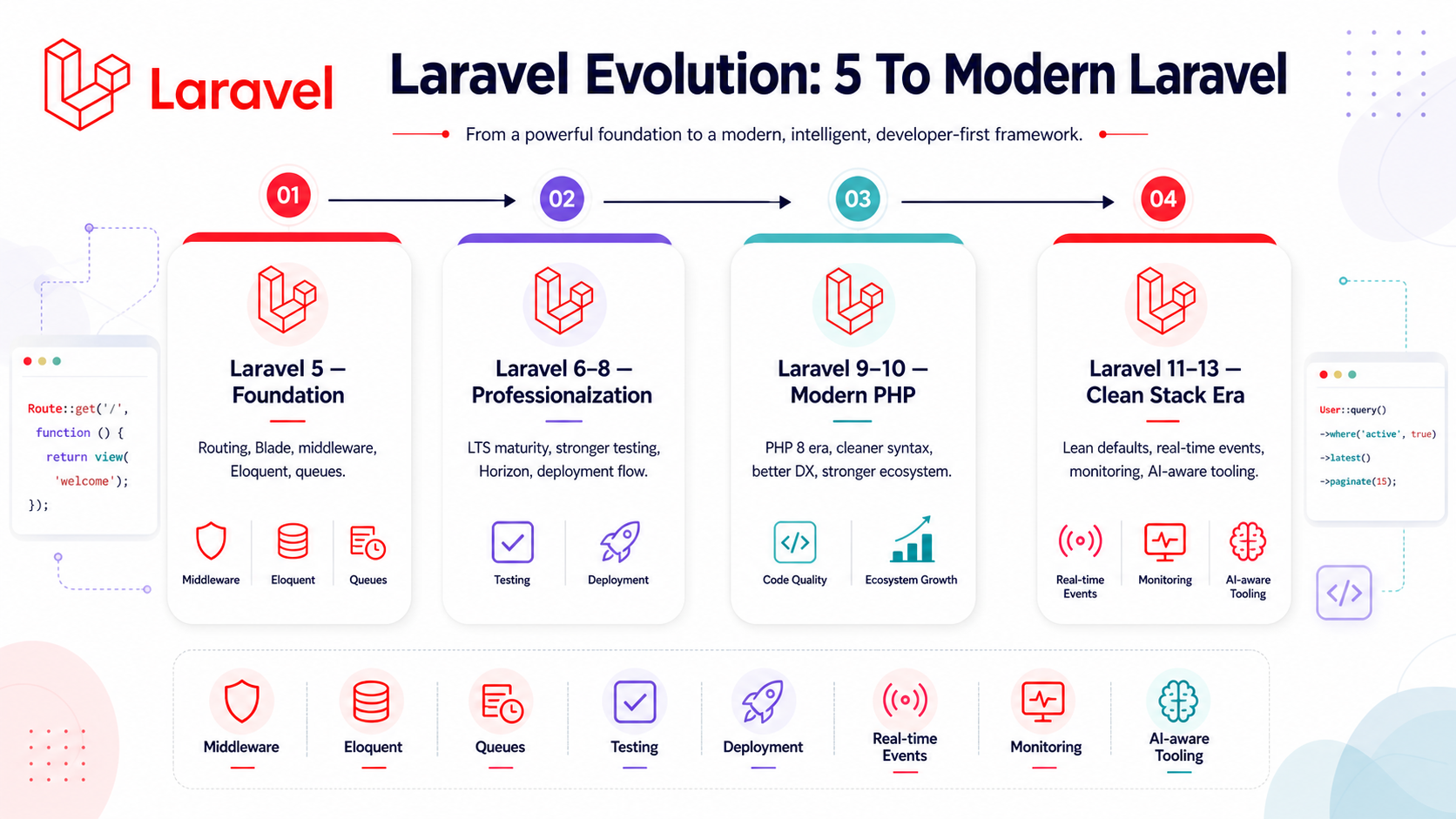
Laravel 5 was where many developers really started to treat PHP as a serious application platform again.
You had service providers, middleware, form requests, queues, events, commands, and a cleaner application structure. For a lot of teams, Laravel 5 was the moment PHP stopped feeling like "just scripts on a server" and started feeling like a real backend framework.
Think of Laravel 5 like the first good apartment you rent after college. Not perfect, maybe a little noisy, but it has rooms, doors, electricity, and a place for your stuff. Compared to older PHP apps with mixed HTML and SQL in the same file, that was a big deal.
What Laravel 5 Changed
- Middleware became the front door. You could handle authentication, CSRF, redirects, and request filtering before the controller even woke up.
- Form requests cleaned up validation. Instead of stuffing validation logic into controllers, you could move it into dedicated request classes.
- Jobs and queues became normal. Email sending, image processing, imports, exports, and slow tasks finally had a natural place.
- Eloquent matured into the default mental model. You didn't just write SQL; you modeled your domain through relationships and expressive queries.
Here's a small example of what Laravel made feel normal: move validation out of the controller and into a request class.
public function rules(): array
{
    return [
        'title' => ['required', 'string', 'max:120'],
        'body' => ['required', 'string'],
        'published_at' => ['nullable', 'date'],
    ];
}
The point isn't that this is fancy. The point is that Laravel pushed you toward structure before your app became a junk drawer.
Laravel 6 To 8 Was The Professionalization Era
Laravel 6 introduced semantic versioning and long-term support, which sounds boring until you maintain production apps for a living. Then it sounds like oxygen.
This period also gave you Laravel 7 and 8 improvements around routing, factories, jobs, components, and modern application structure. It was less "look at this one giant feature" and more "your daily work is smoother now." Like upgrading from a cheap office chair to one that doesn't destroy your back by Friday.
Laravel's release model matters here. Major releases arrive roughly yearly. Minor and patch releases ship whenever they're ready and don't break your app, which means your "Laravel upgrade" task isn't constantly on fire.
What Got Better In Real Projects
- Factories became easier to use. Test data started to feel less like boilerplate and more like part of the development flow.
- Blade components improved UI structure. You could stop duplicating the same card, modal, alert, and form markup everywhere.
- Job batching and queues got stronger. Background work became more observable and controllable.
- Laravel Sanctum made API auth simpler. For SPAs and token-based authentication, Sanctum became the practical default.
A common Laravel 8-style model factory reads almost like a sentence.
public function definition(): array
{
    return [
        'name' => fake()->name(),
        'email' => fake()->unique()->safeEmail(),
        'password' => bcrypt('password'),
    ];
}
That's the Laravel pattern in miniature: take something repetitive, make it readable, and let you move on.
Laravel 9 To 10 Was The Modern PHP Era
Laravel 9 and 10 leaned harder into modern PHP.
You started seeing more typed properties, better return types, cleaner dependency handling, improved testing workflows, and better alignment with modern Symfony components. This was Laravel saying, "Yes, PHP has changed, and we're going with it."
Modern PHP is like replacing a paper map with GPS. You can still get lost — trust me, I've proved this professionally — but the system gives you better signals before you drive into a lake.
Why This Era Felt Different
- Types became more natural. Your code could say more about what it expected and what it returned.
- Testing became less optional. Laravel's testing tools kept getting friendlier, which made test coverage feel less like punishment.
- Developer experience became a product feature. Artisan commands, starter kits, error pages, and local development all got more polished.
- The ecosystem became harder to ignore. Laravel wasn't just framework code anymore; it was deployment, monitoring, debugging, queues, auth, billing, search, and more.
Here's a simple service-style class that feels natural in modern Laravel.
final class InvoiceService
{
    public function markAsPaid(Invoice $invoice): void
    {
        $invoice->update([
            'paid_at' => now(),
            'status' => InvoiceStatus::Paid,
        ]);
    }
}
The big takeaway: Laravel grew with PHP instead of pretending PHP was still stuck in 2012.
Laravel 11 To 13 Is The Clean Stack Era
Laravel 11 cleaned up the application skeleton. Laravel 12 continued the yearly cadence with smoother upgrades and better starter kits. Laravel 13, released in early 2026, leans into AI-aware workflows, JSON:API resources, and semantic and vector search.
This era feels like moving from a big backpack to a well-organized carry-on. You're not carrying less capability; you're carrying less clutter.
Laravel also calls itself a "clean stack" for developers and agents now, with opinions across routing, queues, authentication, starter kits, AI tools, and a long list of first-party ecosystem packages. That wording matters. Laravel covers the full path from idea to production now, and MVC is only one piece of it.
What Modern Laravel Is Really Optimizing For
- Less ceremony in new apps. You get fewer default files and less configuration noise before your first real feature.
- Better defaults for teams. The framework nudges you toward maintainable structure without making every app feel enterprise-heavy.
- More first-party tools. Laravel keeps moving common production needs into supported packages and services.
- AI-aware development. Tools like Laravel Boost give AI agents access to version-specific Laravel ecosystem documentation and Laravel-maintained AI guidelines.
This is a big deal. AI coding tools are useful, but without framework context they can confidently generate yesterday's Laravel in tomorrow's app. That's how you get "almost correct" code, which is my least favorite kind of bug.
Popular Laravel Services You Should Actually Know
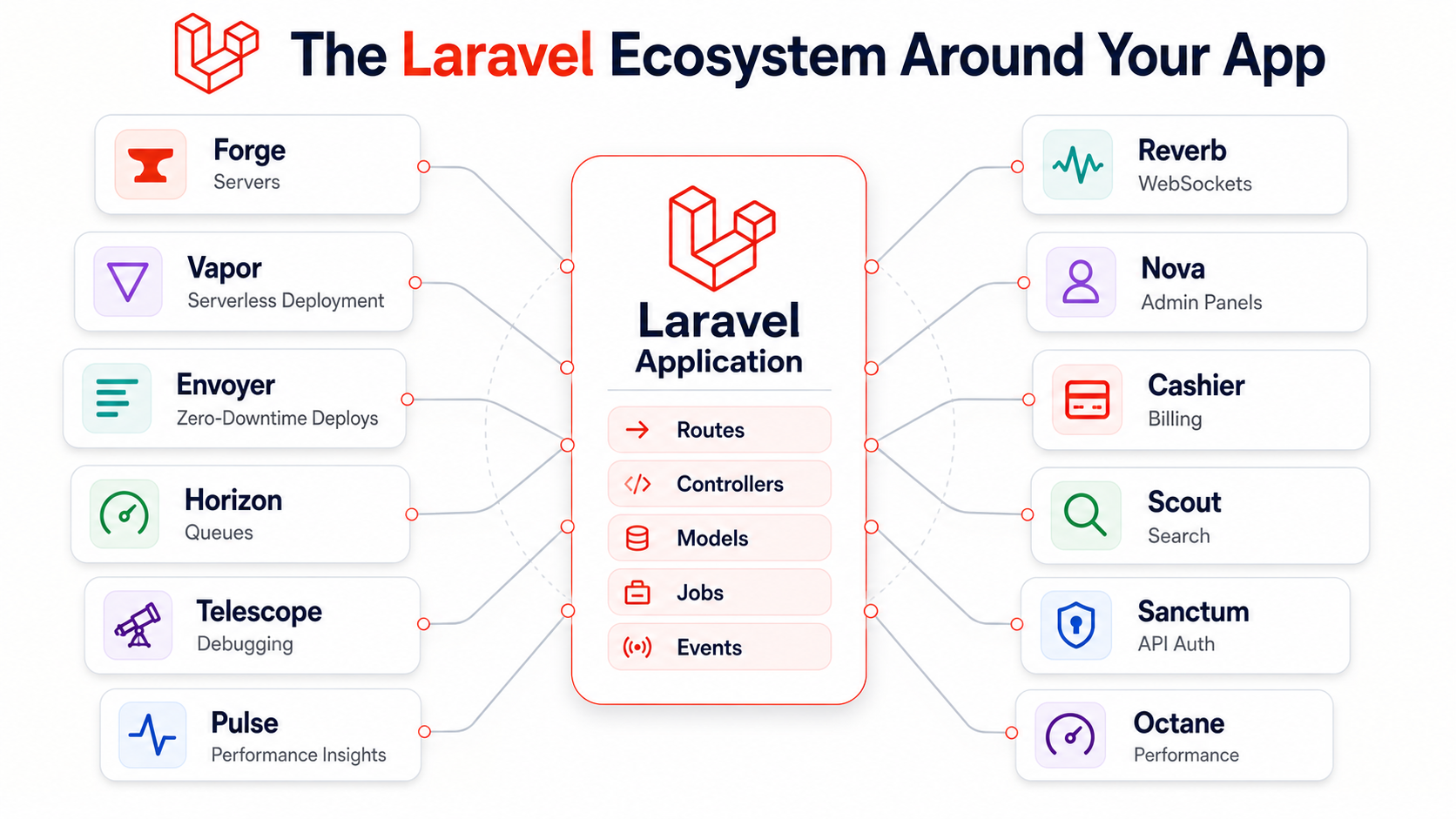
Now we get to the part that makes Laravel different from many frameworks: the services around it.
Laravel is like a city, not just a road. The framework is the main street, but the real value comes from the train station, power grid, hospitals, delivery routes, repair shops, and traffic lights. You don't need every service on day one, but you should know what exists.
Laravel Forge
Laravel Forge is server provisioning and deployment management.
You use it when you want to run Laravel apps on servers without manually configuring Nginx, PHP-FPM, SSL certificates, deploy scripts, queues, cron jobs, and environment files from scratch. Could you do all of that yourself? Absolutely. Should you every time? Please don't do that to yourself unless you enjoy pain as a hobby.
Forge is best when you want classic VPS-style hosting with control. It's the "I want my own kitchen, but I don't want to build the oven" option.
Laravel Vapor
Laravel Vapor is Laravel's serverless deployment platform built on AWS Lambda. It's an auto-scaling, serverless platform for Laravel that abstracts AWS Lambda, SQS queues, databases, Redis clusters, networks, CloudFront, and more.
Vapor is for apps where scaling matters and you don't want to babysit infrastructure. It's like moving from owning a delivery van to using a logistics network that automatically adds trucks when demand spikes.
The trade-off is complexity. Serverless is powerful, but you need to understand cold starts, queues, storage, file uploads, and runtime constraints.
Laravel Envoyer
Laravel Envoyer handles zero-downtime deployment.
If Forge is about managing servers, Envoyer is about making deployment safer. It lets you deploy without your users seeing broken pages while files are changing underneath them.
The analogy is simple: Envoyer is like changing the tires on a car while it's still moving, except less terrifying because software gives us symlinks.
Laravel Nova
Laravel Nova is a premium admin panel for Laravel apps.
You use Nova when your business needs internal tools: manage users, orders, subscriptions, content, products, reports, or support workflows. Could you build a custom admin from scratch? Sure. But Nova saves you from spending three weeks building tables, filters, actions, metrics, and forms nobody outside the company will ever see.
Nova is like scaffolding around a building. It's not the final architecture, but it helps the people doing the work move faster and safer.
Laravel Horizon
Laravel Horizon is a dashboard and configuration system for Redis queues.
If your app sends emails, processes videos, imports CSV files, syncs APIs, or runs background jobs, queues become part of your production heartbeat. Horizon helps you see what's running, what failed, what's waiting, and how your workers are behaving.
Without Horizon, queues can feel like mailing a package into a black hole. With Horizon, you at least get tracking numbers.
Laravel Telescope
Laravel Telescope is a debugging assistant for local and non-production environments.
It shows requests, exceptions, logs, database queries, queued jobs, mail, notifications, cache operations, and more. For development, it's like having security camera footage for your application.
You don't guess what happened. You look.
Laravel Pulse
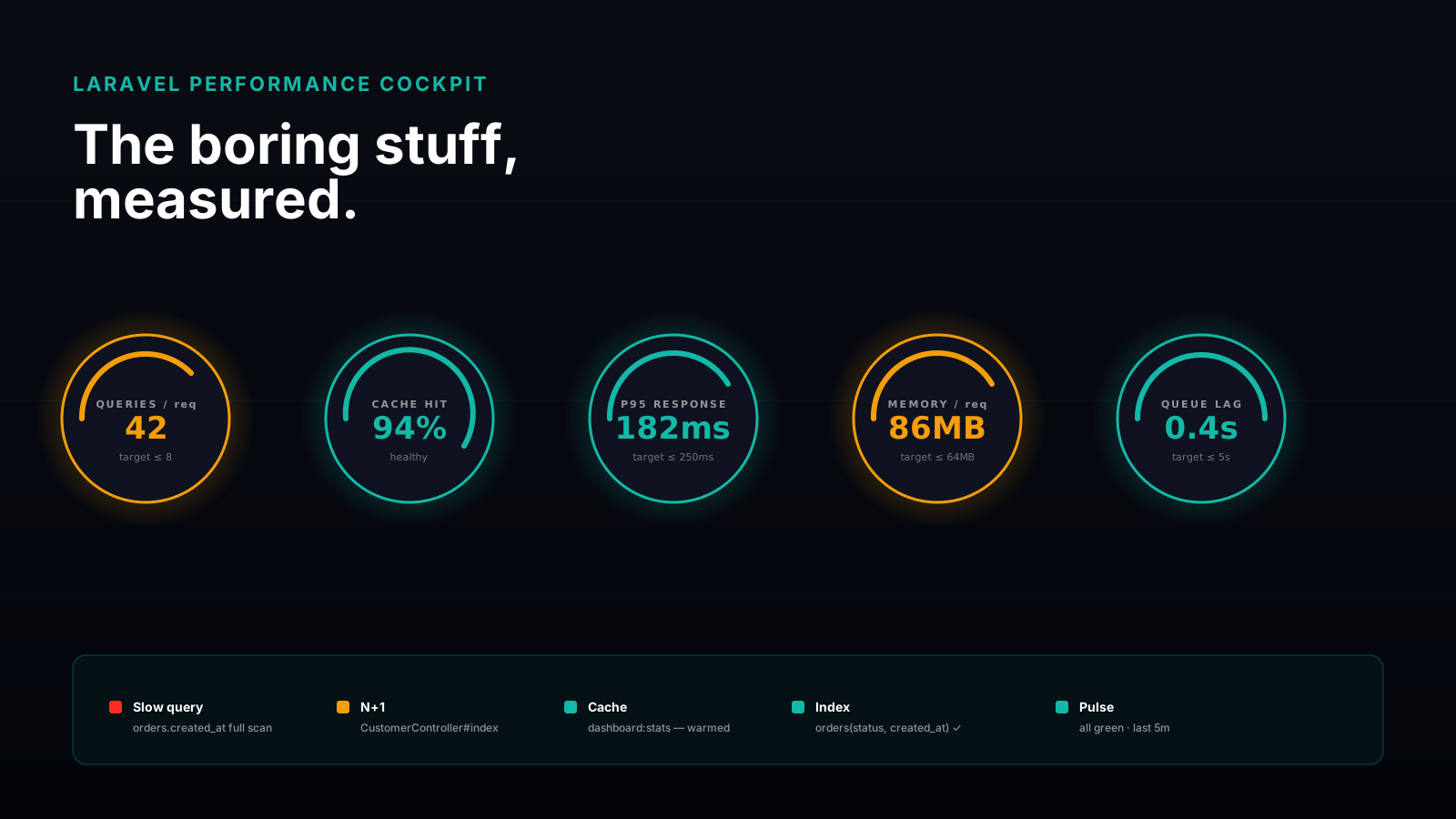
Laravel Pulse gives at-a-glance performance and usage insights. It tracks bottlenecks like slow jobs and endpoints, finds active users, and helps you understand application behavior.
Pulse is not the same as full observability with Datadog or New Relic. It's more like the dashboard in your car: speed, fuel, warning lights, and enough signal to know when something needs attention.
Laravel Reverb
Laravel Reverb is Laravel's first-party WebSocket server.
It plugs WebSocket support directly into your app and hooks into Laravel's event broadcasting tools. You use it for chats, notifications, dashboards, live updates, presence, and anything that needs to feel real-time.
Before Reverb, real-time Laravel often meant reaching for third-party services quickly. Reverb makes the Laravel-native path stronger.
It's like adding a walkie-talkie channel to your app. Instead of refreshing the page and asking, "Anything new?", the server can say, "Yep, here it is."
Laravel Cashier, Scout, Sanctum, Passport, Pennant, And Octane
These packages are the practical ones you'll meet again and again.
- Cashier handles billing. It gives you subscription billing patterns so you're not reinventing Stripe logic at 1 a.m.
- Scout handles search. It gives Eloquent models a clean path into search engines and searchable indexes.
- Sanctum handles lightweight API auth. It's usually the friendliest option for SPAs, mobile apps, and personal access tokens.
- Passport handles OAuth2. It's heavier than Sanctum, but useful when you really need a full OAuth2 server.
- Pennant handles feature flags. It lets you roll features out gradually instead of throwing code into production like a coin into a fountain.
- Octane boosts long-running performance. It uses high-performance application servers so your app doesn't boot the full framework on every single request.
This is where Laravel feels less like "just a framework" and more like a product platform.
Common Laravel Upgrade Problems
Upgrading Laravel is usually not the hard part. Upgrading your assumptions is.
A legacy app is like an old house with beautiful hardwood floors and suspicious wiring behind the walls. The visible code might look fine, but the real work is in packages, custom helpers, service providers, events, queue workers, and deployment scripts.
What Usually Hurts
- Old packages block the upgrade. Your Laravel version may be ready, but one abandoned package can hold the whole app hostage.
- Hidden framework overrides surprise you. Custom exception handlers, auth providers, macros, and service container bindings can behave differently after upgrades.
- Frontend tooling becomes a second migration. Mix, Vite, old Vue versions, jQuery, Blade assets, and build scripts can create more work than PHP code.
- Tests reveal the truth. If your app has weak tests, every upgrade becomes archaeology with production risk.
Pro Tips
- Upgrade one major version at a time. Jumping from Laravel 5 to 13 in one move sounds brave, but so does juggling chainsaws.
- Start with Composer constraints. Your dependency graph will tell you where the real blockers live.
- Add tests around business-critical flows first. Payments, user access, invoices, imports, subscriptions, and admin actions deserve protection before refactoring.
- Read the upgrade guide, not just release notes. Release notes sell the story; upgrade guides tell you where the floor creaks.
Wrapping It All Up
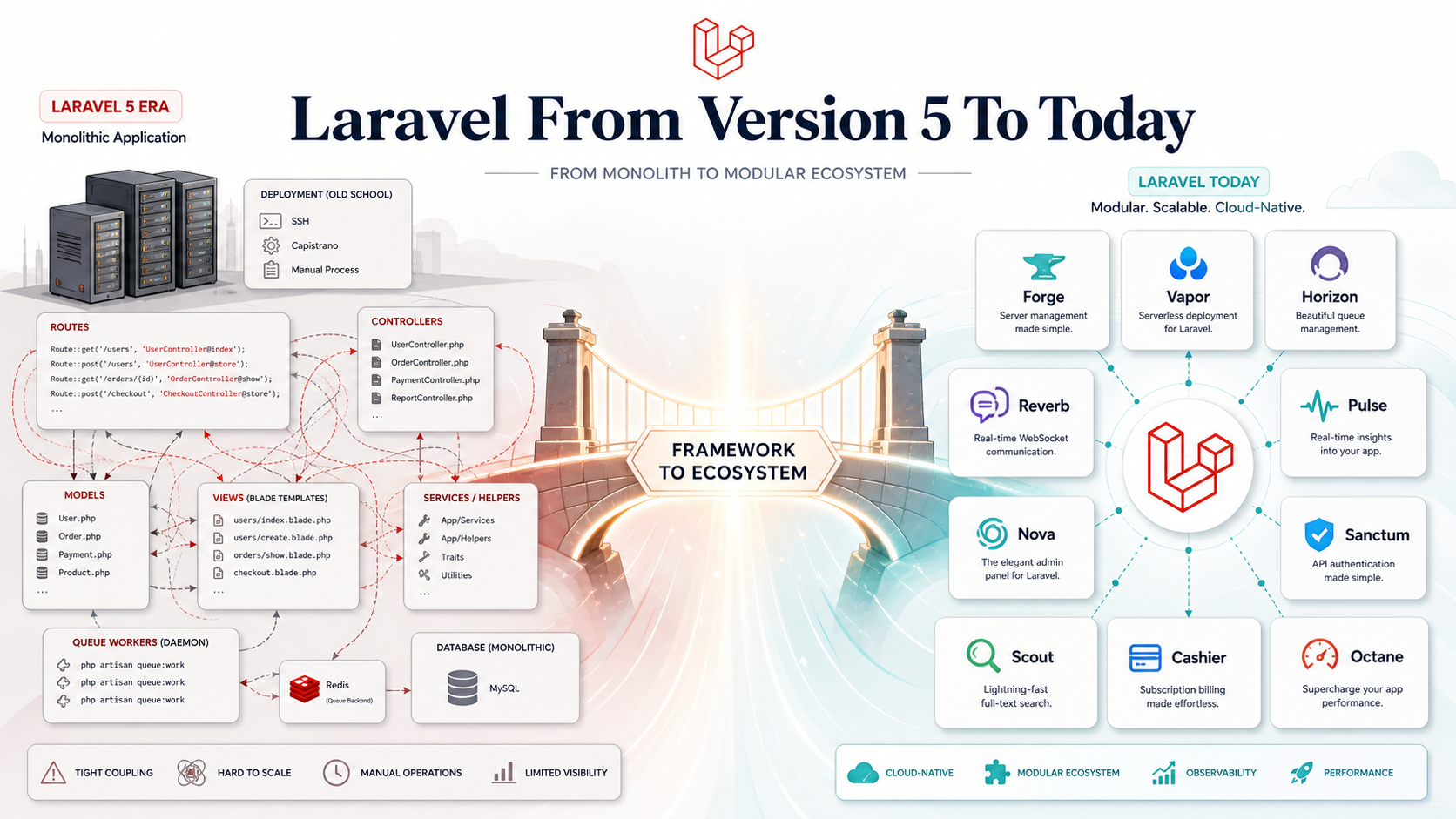
Laravel's biggest change from version 5 to today isn't one feature.
It's the shift from framework to ecosystem. Laravel 5 helped you organize PHP applications. Modern Laravel helps you build, test, deploy, monitor, scale, debug, authenticate, bill, broadcast, search, and increasingly work with AI-aware development tools.
That's a different level of leverage.
The framework didn't become perfect. No framework does. But Laravel stayed unusually good at one thing: making common web development decisions feel boring in the best possible way.
And boring infrastructure is beautiful. It means your energy goes into product logic, not wiring.
Final Tips
I've worked in enough legacy PHP codebases to know one thing: the framework version is rarely the whole problem. Sometimes the old Laravel app is messy because the business was messy, the team was moving fast, and nobody had time to make it elegant. Been there. No judgment :)
My advice: don't look at Laravel 5-to-13 modernization as a "rewrite everything" mission. Treat it like renovating a house while people still live in it: stabilize the foundation, replace risky wiring, improve one room at a time, and don't knock down walls just because you bought a new hammer.
Laravel keeps moving toward cleaner defaults, stronger services, and smarter tooling. Your job is to use that momentum without losing the business logic that made the app valuable in the first place.
Good luck with your next Laravel upgrade — go ship it 👊