Have you ever opened a Laravel project and realized you're not just looking at routes, controllers, models, and Blade files anymore?
You're looking at queues, dashboards, WebSockets, deployment scripts, serverless config, admin panels, metrics, workers, caches, and probably one or two things someone added at 2 a.m. and never documented. Classic.
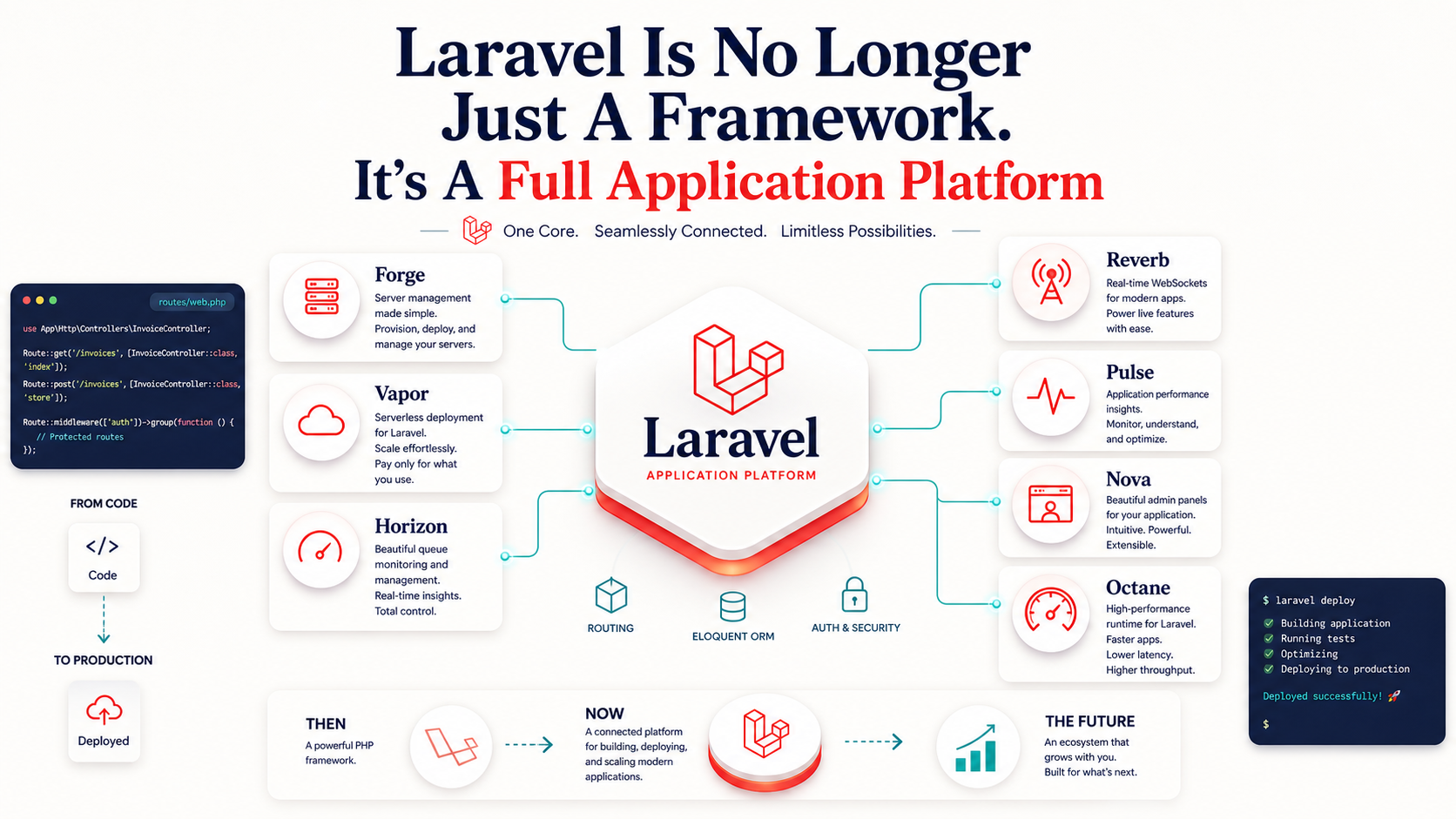
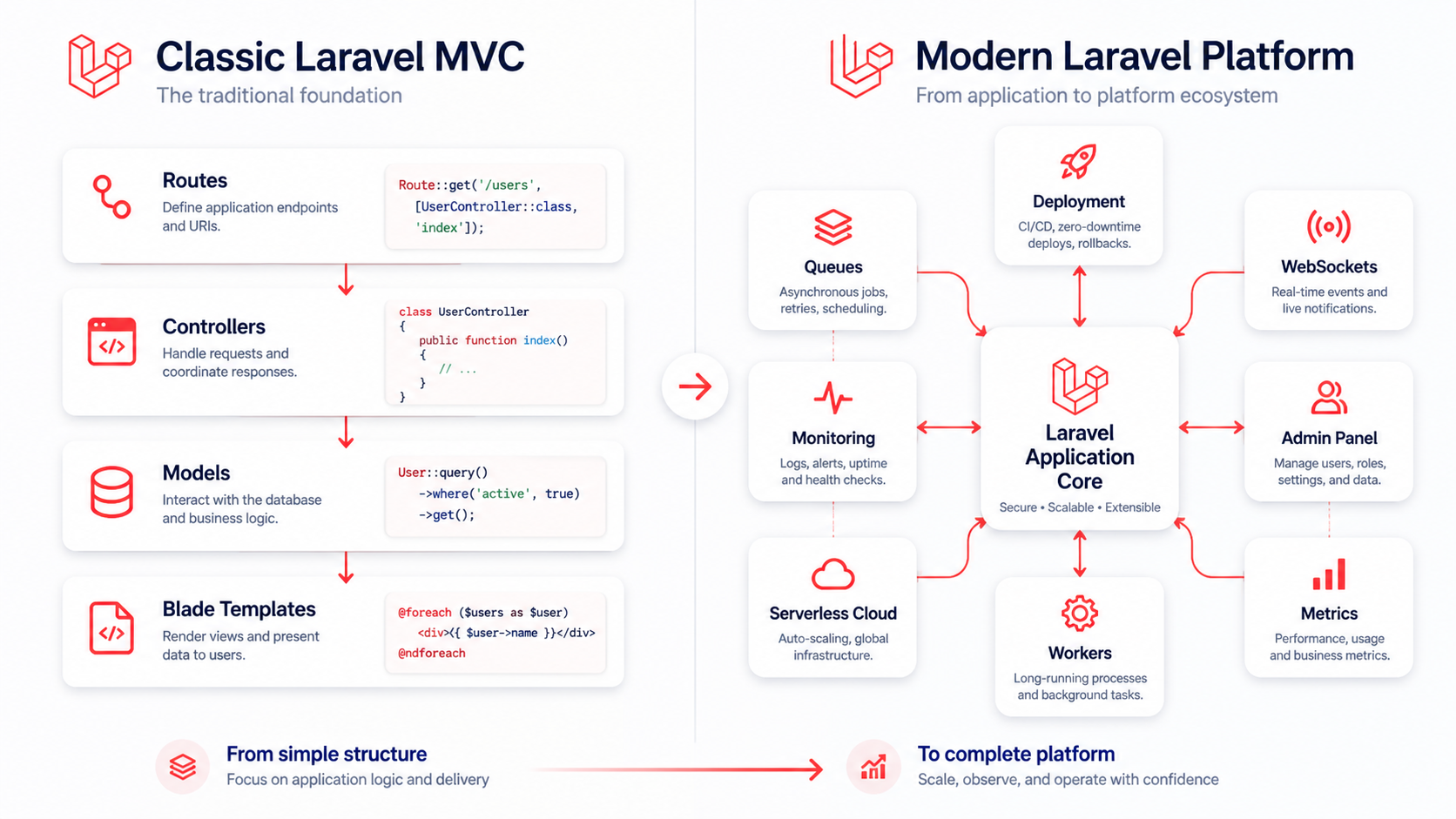
That's the real story of modern Laravel. It started as a developer-friendly MVC framework, but today it behaves much more like a full application platform. You don't just write code in Laravel. You can build the product, deploy it, monitor it, scale it, inspect it, and operate it from a connected ecosystem.
Laravel Started As A Better Way To Build Web Apps
Laravel's original magic was not that it invented MVC. It didn't. Its magic was that it made common web development feel pleasant again.
Think of early Laravel like a well-organized toolbox. You had routing, controllers, Blade, Eloquent, validation, sessions, migrations, and queues. Nothing too exotic, but everything was where your hand expected it to be.
The real win was developer experience. You could build a feature without fighting the framework for every small decision.
The MVC Foundation Still Matters
Laravel's core still gives you the same reliable mental model:
- Routes receive the request. You define clear entry points into your application.
- Controllers coordinate the action. You keep request handling away from business logic when the app grows.
- Models represent data. Eloquent gives you an expressive way to work with database records.
- Views or APIs return the result. Blade, JSON resources, Inertia, Livewire, or pure API responses all fit naturally.
That foundation is still important because platforms are only useful when the core doesn't collapse. A skyscraper still needs a boring concrete base. Laravel's MVC layer is that base.
Here's a tiny example of the classic Laravel shape:
use App\Http\Controllers\OrderController;

Route::post('/orders', [OrderController::class, 'store'])
    ->middleware(['auth', 'verified']);
This doesn't look revolutionary, and that's the point. The route is readable, the middleware is visible, and the intent is obvious.
The Ecosystem Changed The Conversation
At some point, Laravel stopped being only the thing inside your app/ directory.
The ecosystem became the bigger story. Forge, Vapor, Horizon, Reverb, Pulse, Nova, and Octane all solve different parts of the application lifecycle. That matters because real software isn't only code. Real software is deployment, observability, operations, failure recovery, internal tools, and performance.
Laravel became less like a screwdriver and more like a garage. You can still use just one tool, but the value is in having the whole workspace ready.
Forge: Deployment Without Becoming A Full-Time Sysadmin
Laravel Forge helps provision and manage servers for PHP applications. You can configure sites, deployments, queues, scheduled tasks, SSL certificates, and Laravel-specific runtime concerns without manually stitching everything together.
That doesn't mean you never need infrastructure knowledge. You still should understand Nginx, workers, logs, memory, and deployment risk. But Forge removes a lot of repetitive server setup.
For many teams, that's a good trade. You don't want every product engineer spending half a day remembering which Nginx file needs one tiny change.
Vapor: Laravel On Serverless Infrastructure
Laravel Vapor moves Laravel deployment into a serverless AWS-style model. That can be useful when traffic is spiky, operations bandwidth is limited, or you want infrastructure that scales differently from a classic VPS.
Serverless is not magic. Cold starts, cost visibility, queues, storage, and logs still matter. But Vapor gives Laravel teams a path into that architecture without rewriting the whole application around cloud primitives.
It's like moving from owning a truck to using a delivery network. You still need to package things correctly, but you don't personally maintain the engine.
Horizon: Queues You Can Actually See
Laravel Horizon gives you a dashboard and configuration layer for Redis-backed queues. Instead of treating background jobs as invisible ghosts, you can inspect throughput, failures, retries, supervisors, and worker behavior.
This is huge in production. A queue without visibility is like a restaurant kitchen with no ticket screen. Orders may be cooking, burning, or lost behind the counter, and the customer only sees that dinner is late.
We'll go deeper on queues in another article, but the platform point is simple: Laravel didn't stop at dispatch(). It built operational tooling around the queue system.
Real-Time, Monitoring, And Internal Tools Are First-Class Now
Modern products aren't only request-response pages anymore. You need live events, admin workflows, background processing, and system visibility.
Laravel's ecosystem has moved directly into those areas.
Reverb: Real-Time Communication Inside The Laravel World
Laravel Reverb brings WebSocket communication into the Laravel ecosystem. You can build real-time features using Laravel broadcasting patterns instead of pushing all live behavior into a separate stack.
That's valuable because real-time code can become a second application by accident. You start with notifications, then add live dashboards, chat, activity feeds, and status updates. Suddenly half your product lives in a different mental model.
Reverb helps keep that closer to Laravel's existing event system.
A simple broadcast event might look like this:
final class OrderStatusChanged implements ShouldBroadcast
{
    public function __construct(public Order $order) {}

    public function broadcastOn(): array
    {
        return [new PrivateChannel('orders.' . $this->order->id)];
    }
}
The important part isn't the syntax. It's the architectural idea: business events can power real-time UI without inventing a completely separate communication layer.
Pulse: Application Health Without Guesswork
Laravel Pulse gives you visibility into application behavior such as requests, slow jobs, exceptions, database activity, cache usage, and other runtime signals.
Monitoring is often where teams mature late. Everyone wants features. Nobody wants dashboards until production starts whispering threats at midnight.
Pulse makes observability feel closer to the app. It's not a replacement for every external monitoring tool, but it's a strong way to make performance visible inside the Laravel workflow.
Nova: Admin Panels Without Rebuilding CRUD Forever
Laravel Nova is an administration panel for Laravel applications. It helps teams create internal tools for managing resources, actions, filters, metrics, and relationships.
Internal tooling is one of those areas where teams quietly burn time. You build a customer screen, then an order screen, then a refund screen, then a permissions screen, and suddenly you've built a second product only five people use.
Nova gives you a structured way to build that layer without writing every admin form from scratch.
Octane Changed How Laravel Can Run
Traditional PHP request handling is simple: boot the app, handle the request, throw the process state away. That model is clean and safe, but it has overhead.
Laravel Octane changes that by running Laravel on long-lived application servers such as RoadRunner, Swoole, or FrankenPHP. The application can stay booted between requests, which can improve throughput and reduce repeated startup cost.
This is like moving from cooking every meal from raw ingredients to keeping a professional kitchen prepped. Faster service, but you must be much more careful about what stays on the counter.
Long-Lived Processes Require Better Discipline
With Octane, you need to watch for state that accidentally persists between requests. Static properties, singletons, in-memory caches, and mutated services can create weird bugs.
Here's the kind of pattern you should avoid:
final class CurrentTenant
{
    public static ?int $id = null;
}
That looks harmless in classic request-per-process PHP. In a long-lived worker, it can become a trap because memory can live longer than one request.
A safer direction is to scope request-specific data to the request lifecycle, not global static state.
The Platform Mindset Changes How You Design Apps
Once you see Laravel as a platform, you start making different design decisions.
You don't ask only, "Can I build this feature?" You also ask, "How will this feature be deployed, monitored, retried, administered, and scaled?"
That is the grown-up version of framework thinking.
Common Platform-Level Questions
- Where does the work belong? Keep user-facing requests fast and push slow work into queues.
- How will failure be visible? Use failed jobs, logs, dashboards, alerts, and clear recovery paths.
- Who needs internal access? Use Nova or dedicated admin screens instead of database edits.
- Does this need real-time updates? Use broadcasting and Reverb when polling becomes wasteful.
- Can the runtime handle growth? Consider Octane, cache strategy, queue workers, database indexes, and deployment topology.
That's the difference between building a page and building a system.
Pro Tips
- Don't adopt every Laravel product at once. Add ecosystem tools when your application has the problem they solve.
- Treat queues as production infrastructure. A queue is not a junk drawer for slow code; it's a contract with your users.
- Use dashboards before you're desperate. Horizon and Pulse are much more useful before the incident.
- Respect infrastructure boundaries. Forge, Vapor, and Octane help, but they don't remove the need to understand servers, costs, memory, and failure modes.
- Keep your domain logic portable. The more platform services you use, the more important clean boundaries become.
Final Tips
I've seen Laravel apps that started as simple CRUD projects and slowly became payment systems, notification engines, reporting tools, and admin back offices. The ones that survived usually had one thing in common: the team stopped treating Laravel as just controllers and models.
They treated it like an operating environment for the whole product.
That's where Laravel shines today. You can start small, then grow into queues, real-time features, monitoring, serverless deployment, admin tooling, and high-performance workers without abandoning the ecosystem.
Use the framework when the app is small. Use the platform when the product becomes real. Go ship it 👊