
So someone on your team just suggested Lumen for the new service.
The pitch sounds reasonable. "It's slim, it's API-focused, it boots fast, it's still Laravel underneath. Why drag in the whole framework for a service that does three endpoints?"
You nod. You almost agree. Then a tiny voice in the back of your head asks: "Wait, is anyone still using Lumen in 2024?"
That little voice is doing real work. Listen to it.
Because the question "should we use Lumen for this microservice" in 2024 isn't really about benchmarks anymore. The benchmark argument got mostly settled years ago when Octane removed per-request boot from the table. The real question now is the boring one: the one nobody asks until two years in, when the service is still alive, the original author has left, and someone has to decide whether to upgrade it, patch it, or rewrite it.
Let's break it down through the three angles that actually bite you later: maintainability, team knowledge, and ecosystem.
A One-Paragraph Refresher
Lumen is a microframework Taylor Otwell carved out of Laravel back in 2015. Same Illuminate components underneath, same routing flavor, same service container, just with a lighter bootstrap, fewer default features, and a pitch aimed squarely at APIs and microservices. For the PHP-FPM world of 2015, that made sense. A leaner boot was a real number on every request. Skip ahead to today and the boot story is a footnote. The actually-interesting story is what happens to a Lumen service over the years you're going to own it.
The Maintainability Angle
Maintainability is the part nobody thinks about on day one of a new service. It's also the part that decides whether a team writes ten Lumen services or quietly burns out on the second one.
Here's the shape of it.
Laravel ships major versions on a steady cadence, historically yearly, with predictable LTS windows for some releases. Each version brings security fixes, deprecation paths, modern PHP support, and updates to first-party packages. The upgrade is rarely free, but it's documented, well-trodden, and the rest of the world is doing it with you. Search engines, AI assistants, and Stack Overflow are all loaded with people asking the same upgrade questions you're asking.
Lumen, in 2024, doesn't have that gravity. Its release cadence slowed years ago. Versions still come, but the energy around them is a fraction of Laravel's. The framework's own documentation recommends Laravel for new projects, even API-only ones. That's a meaningful signal: the maintainers of the thing are pointing at the other thing.
For a microservice, this matters in three concrete ways.
1. Security patches and PHP compatibility. When a new PHP version drops, Laravel gets first-party support quickly, with a release that runs cleanly on the new runtime. Lumen tends to follow with a delay. Sometimes small, sometimes long enough to matter. If your hosting provider bumps PHP and your Lumen service is two versions behind on framework support, you're either patching things yourself or pinning PHP per service. Neither is fun.
2. Dependency drift. A Lumen service typically pulls Illuminate components, validation, the container, the database layer, and a handful of community packages. Over years, those packages keep up with Laravel and occasionally drop or under-test their Lumen compatibility. You don't always notice on composer update. You notice later, when a package quietly deprecates its Lumen support and an edge case breaks in production.
3. Framework-level surprises. When Laravel changes a behavior (middleware shape, container resolution, request handling), that change usually lands in Lumen too, but not always in the same shape and not always at the same time. So your "it's just Laravel underneath" mental model springs small leaks. You read the Laravel docs, write code that should work, and trip over a Lumen-shaped variation that the docs don't mention.
None of these are crises individually. Stacked across five Lumen services, three years of operation, and two team handoffs, they add up to "we should rewrite this in Laravel" energy that takes engineering quarters you didn't budget for.
Here's an example of what "Lumen-shaped variation" looks like in practice. Imagine you want a JSON-only API with structured validation errors:
public function store(Request $request)
{
    $this->validate($request, [
        'sku'      => 'required|string',
        'quantity' => 'required|integer|min:1',
    ]);

    // The validate() helper throws a ValidationException
    // that Lumen converts to JSON by default in API routes.
    // The exact response shape differs slightly from Laravel's
    // newer FormRequest path, which trips people who learn one
    // and assume the other behaves the same.

    $order = Order::create($request->only(['sku', 'quantity']));

    return response()->json($order, 201);
}public function store(StoreOrderRequest $request)
{
// FormRequest validates before the controller runs.
// The error response shape is Laravel's standard one.
// Documentation, IDE tooling, and AI assistants all
// assume this shape — because almost nobody is writing
// greenfield Lumen code for them to learn from anymore.
$order = Order::create($request->validated());
return response()->json($order, 201);
}Both work. Both are "correct." The difference is that the second one matches every tutorial, every package readme, and every senior engineer's muscle memory in 2024. The first one is fine until someone new joins and quietly burns an hour learning why the patterns they expect aren't there.
The Team Knowledge Angle
This is the angle that surprises people the most.
In 2015, "do you know Lumen?" was a fine interview question. It was current, talked about, and a reasonable specialization to have. In 2024, "do you know Lumen?" lands somewhere between "do you remember Lumen?" and "how long have you been doing PHP?". That's not a knock on Lumen. It's just where the conversation has moved.
What that means for your team:
Hiring. When you post a job and list Laravel in the stack, you'll get hundreds of qualified candidates. When you list Lumen, most of them will know it well enough because they've used it for one service somewhere, but it's no longer a specialization anyone actively cultivates. New PHP engineers learn Laravel directly. Bootcamps teach Laravel. Tutorial sites lead with Laravel. Lumen is a footnote in the "history of microframeworks" paragraph of a video course.
Onboarding. A new engineer joining your team in 2024 has almost certainly used Laravel recently. There's a real chance they've never opened a Lumen project. The first time they git clone your service and ask "where's the Kernel? where's the providers list? why is the bootstrap so thin?", you'll spend a few hours showing them. Multiply that across five Lumen services and every onboarding becomes a small museum tour.
Code review and assistance. AI coding assistants and search engines lean Laravel-first because Laravel-first is where the public corpus lives. When your engineer asks for help refactoring a Lumen controller, the suggestion will be subtly Laravel-shaped a third of the time. Code reviews catch most of that. The cases they miss are the annoying ones: subtle differences in how middleware groups, route caching, or container resolution behave.
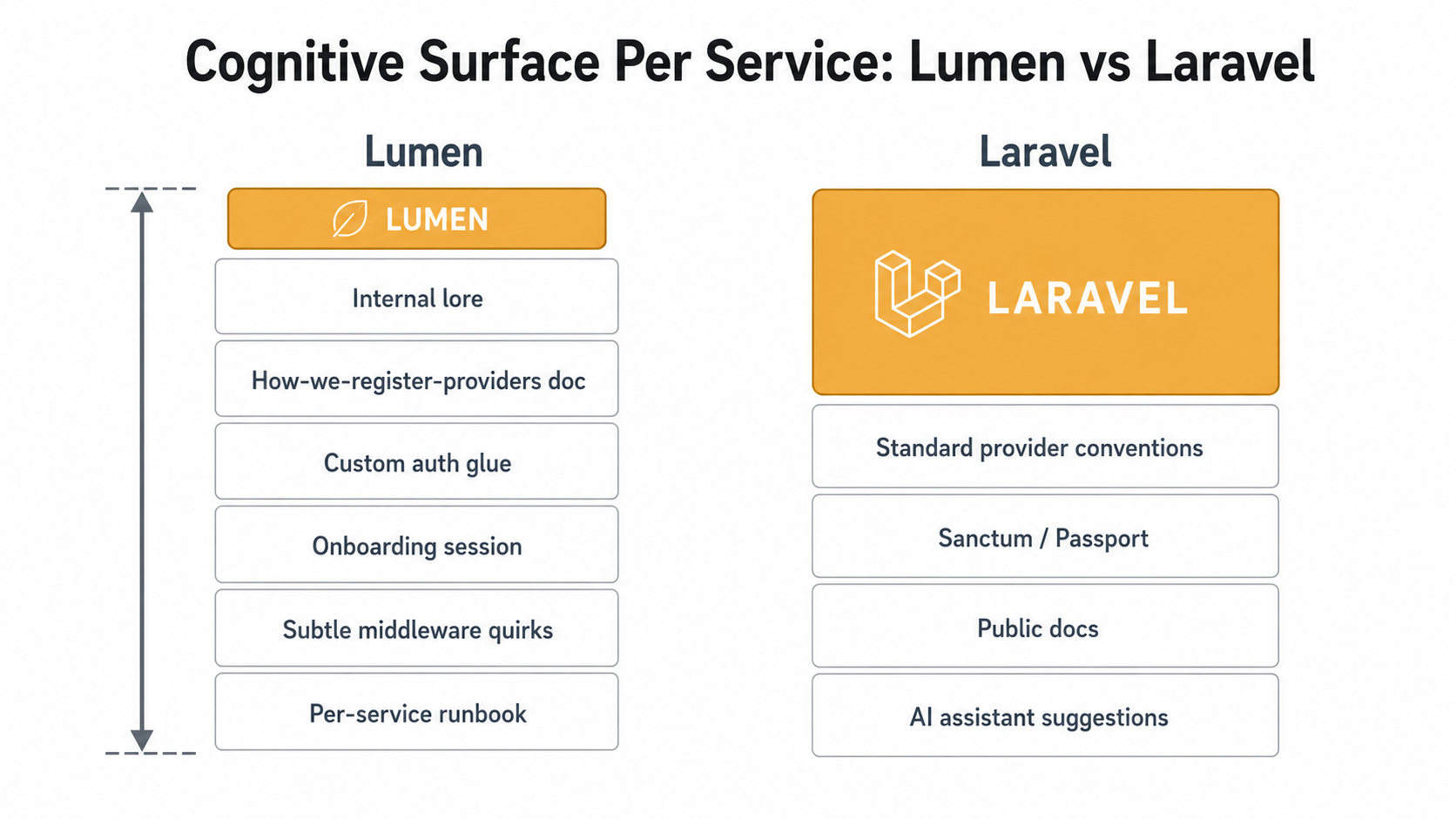
Internal documentation cost. Every Lumen-specific thing you decide to keep doing ("in our services we register providers like this", "in our services we use the IoC container like that") is a piece of internal documentation you now own. Laravel comes with a much larger pile of public docs that just work. Lumen comes with a smaller pile of public docs plus a homemade pile that grows as your team accumulates "how we do it here" lore. Lore is expensive. Especially when the person who wrote the lore leaves.
The composite effect of all of this is that the cognitive surface area per service is higher on Lumen than on Laravel, even though the framework itself is smaller. That sounds backwards, and it is. The smaller framework forces you to fill in the gaps with team knowledge that doesn't transfer in or out of the building cleanly.
For a single service maintained by the person who built it, that surface area is invisible. For a portfolio of services owned by a rotating team, it's the entire game.
The Ecosystem Angle
The third angle, and the one that compounds quietly.
In 2015, the Laravel ecosystem was strong but not overwhelming. Lumen could ride along on a sizable subset of it. Most packages worked with minimal friction. The first-party tools (Horizon, Telescope, Nova, Sanctum, Octane, Pulse, Reverb) hadn't all been announced yet, and the ones that existed were close enough to vanilla Laravel that the gap with Lumen felt manageable.
The ecosystem has moved a lot since then. Specifically:
- First-party packages target Laravel. Horizon, Telescope, Pulse, Reverb, Cashier, Nova, and Fortify all target full Laravel. Some of them can be made to work on Lumen with effort, but the supported path is Laravel. You're constantly the person asking "does this work on Lumen?" and reading GitHub issues to find out.
- Newer community packages skip Lumen support. When a new auth provider, queue driver, or LLM SDK ships a Laravel package, "works on Lumen" is increasingly a footnote, optional, or "yes but you'll have to register the service provider yourself." Sometimes Lumen support is in the README, sometimes it's absent, sometimes it's there but stale.
- AI ecosystem tooling assumes Laravel. If you're integrating an LLM into your service (RAG, agents, tool calling, prompt-driven endpoints), the SDKs and helper packages that have been growing in the PHP world assume Laravel by default. The integration paths are written with Laravel's container, Laravel's queues, Laravel's events. Adapting to Lumen is doable, but you're now permanently downstream of every example you read.
- Observability and tracing. APM agents and structured-logging packages all support PHP fine, but the Laravel-flavored helpers (auto-instrumenting jobs, middleware traces, query logging in a standard format) lean on Laravel-shape internals. Lumen mostly works. The polish is on the Laravel side.
The pattern is the same across every category: Lumen is a supported PHP framework, but not the one anyone in the ecosystem is building for first. You can do anything in it. You'll just do most things slightly off the well-paved road.
For one service, that's a manageable tax. For a microservices fleet, where the whole point is to compose many services that share infrastructure and patterns, "slightly off the well-paved road" is the road. Every Lumen service is a small piece of integration friction that doesn't go away.
When Lumen Still Earns Its Place
This isn't an "never use Lumen" piece. It's an "open your eyes" piece. There are still narrow cases where Lumen is a fine choice in 2024:
You already have Lumen services in production and they work. Don't migrate for the sake of it. "Working, boring, on-Lumen" beats "in-flight migration, half-broken, on-Laravel." The cost of moving a stable Lumen service rarely pencils out. Save the energy for the next service.
You're locked into a runtime where Octane isn't an option and per-request bootstrap is still a real number on your latency budget. Restrictive corporate hosting, certain shared environments, or strict container memory ceilings can still tilt this way. It's rare, but it happens.
You have a tiny truly-internal service that does one thing and will never grow. A token endpoint. A webhook receiver. A health-aggregator. Something where the framework footprint is genuinely overkill and you trust yourself to keep it small forever.
That's basically it. Three narrow cases. "Microservices in 2024" in the general sense isn't on the list. And notice that even when Lumen fits, the reasons are about constraint, not preference.
The Honest Answer For Greenfield Microservices
For a new microservice in 2024, the default answer is "reach for Laravel."
It's not because Lumen got worse. Lumen, the framework, is roughly the same shape as it was years ago. It's that the world around it changed: Laravel got leaner and faster, Octane removed the boot argument, the ecosystem stacked up on the Laravel side, the team knowledge stacked up on the Laravel side, and AI tooling normalized on Laravel as the assumed substrate.
The combined effect is that a Laravel service in 2024 has less friction across its entire lifecycle (write, deploy, observe, upgrade, hand off, rewrite) than a Lumen service does. The savings from a leaner bootstrap don't recover that gap.
If you're worried about the framework footprint specifically, asking "do I really need all of Laravel for this thing?", the better answer is to use Laravel with Octane and disable the parts you don't need, rather than to pick a framework that's frozen the wrong subset of choices in 2015.
If you're worried about boot cost specifically, the answer is Octane. If you can't run Octane, the answer is "why can't I run Octane on this platform?" That's the question worth pushing on.
So, Good Idea Or Legacy Trap?
It depends on which Lumen you mean.
The Lumen of "we already have it and it works" is not a trap. It's a stable thing that earned its place. Leave it alone, keep it patched, plan a migration path for when you actually want one, not before.
The Lumen of "let's pick this for a brand-new microservice in 2024" is the trap. Not because it'll break. Because two years from now, when the original author is gone, the team is rotating, the ecosystem keeps moving further away, and you're looking at a service that's a little harder to upgrade and a little stranger to onboard than every other service in the fleet, you'll wish you'd just used Laravel.
Microframeworks made sense in a world where boot cost was the dominant tax on a request. Octane retired that tax. The taxes left (maintenance, knowledge, ecosystem) all run in the opposite direction. Pick the framework that minimizes the taxes you'll pay every day for years, not the one that minimized a tax that no longer exists.