Symfony is not only a framework.
It is also a toolbox.
That distinction matters. You can use Symfony Components inside full Symfony apps, Laravel apps, legacy PHP systems, internal tools, CLIs, workers, SDKs, and small services. You do not have to buy the whole hardware store to use a good screwdriver.
That is one of Symfony's quiet superpowers.
Components Let You Build By Capability
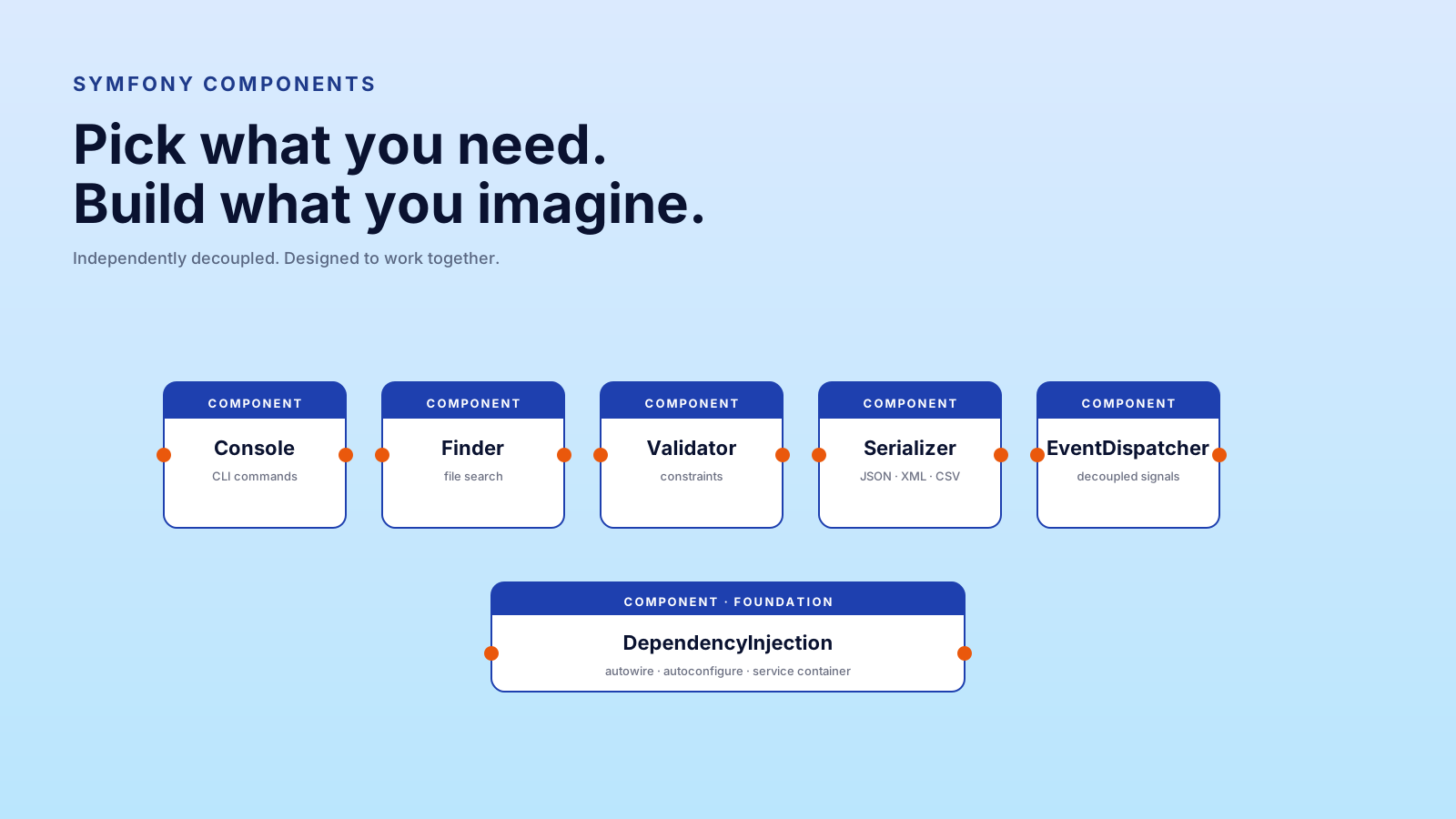
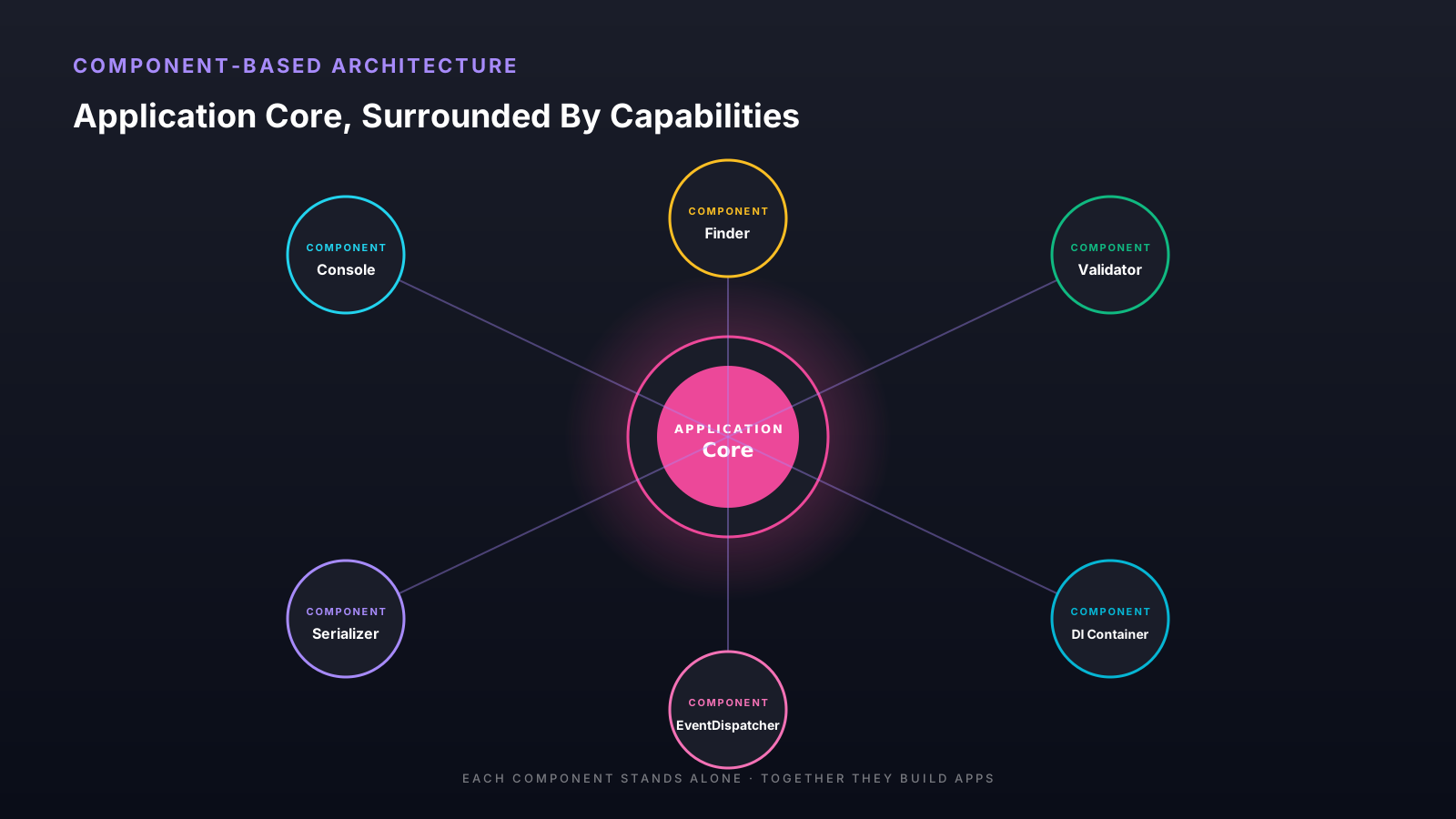
A component solves a focused problem. The Console component builds CLI commands. Finder searches files. Validator validates data. Serializer transforms objects and arrays. EventDispatcher decouples behavior. DependencyInjection wires services.
Each one can stand alone.
composer require symfony/console symfony/finderNow you can build a serious CLI tool without creating a full web application.
Console Turns Scripts Into Tools
A raw PHP script is fine until it needs arguments, options, help text, exit codes, and readable output.
The Console component gives structure to command-line work.
final class CleanExportsCommand extends Command
{
    protected function configure(): void
    {
        $this
            ->setName('app:clean-exports')
            ->addOption('dry-run', null, InputOption::VALUE_NONE);
    }

    protected function execute(InputInterface $input, OutputInterface $output): int
    {
        $output->writeln('Cleaning old export files...');

        return Command::SUCCESS;
    }
}
This turns maintenance code into an operational interface your team can trust.
Finder Makes File Work Less Fragile
Filesystem code often starts as glob() and grows into a haunted forest.
The Finder component gives you a fluent way to search files.
$finder = new Finder();
$finder
    ->files()
    ->in($contentDir)
    ->name('*.md')
    ->notPath('drafts')
    ->date('since 30 days ago');

foreach ($finder as $file) {
    $articles[] = $file->getRealPath();
}
The code says what it means: find Markdown files, skip drafts, only recent ones.
EventDispatcher Creates Clean Extension Points
The EventDispatcher component lets parts of your application communicate without hard dependencies.
That is useful when one action should trigger optional side effects.
final readonly class ArticlePublished
{
    public function __construct(public string $articleId) {}
}$this->eventDispatcher->dispatch(new ArticlePublished($article->id()));A listener can update search indexes. Another can notify subscribers. The publisher does not need to know all of them.
It is like plugging devices into a power strip instead of soldering every device directly into the wall.
Validator Protects Data Everywhere
The Validator component is not only for forms. You can validate DTOs, messages, configuration objects, API inputs, import rows, and command arguments.
final class CreateArticleInput
{
    #[Assert\NotBlank]
    public string $title;

    #[Assert\Url]
    public ?string $canonicalUrl = null;
}$violations = $validator->validate($input);
if (count($violations) > 0) {
throw new InvalidInput($violations);
}Validation becomes reusable instead of being trapped inside controllers.
Serializer Helps At System Boundaries
The Serializer component converts data between PHP objects and formats like JSON, XML, CSV, or arrays depending on installed encoders and normalizers.
It is especially useful at boundaries: APIs, webhooks, imports, exports, queues, and SDKs.
final readonly class ArticleResponse
{
    public function __construct(
        public string $id,
        public string $title,
        public string $url,
    ) {}
}$json = $serializer->serialize($response, 'json');The point is not to serialize everything blindly. The point is to define controlled shapes.
DependencyInjection Keeps Wiring Out Of Business Code
The DependencyInjection component helps configure how services are built and connected.
In a full Symfony app, you mostly experience this through service configuration and autowiring.
services:
  App\:
    resource: '../src/'
    autowire: true
    autoconfigure: true
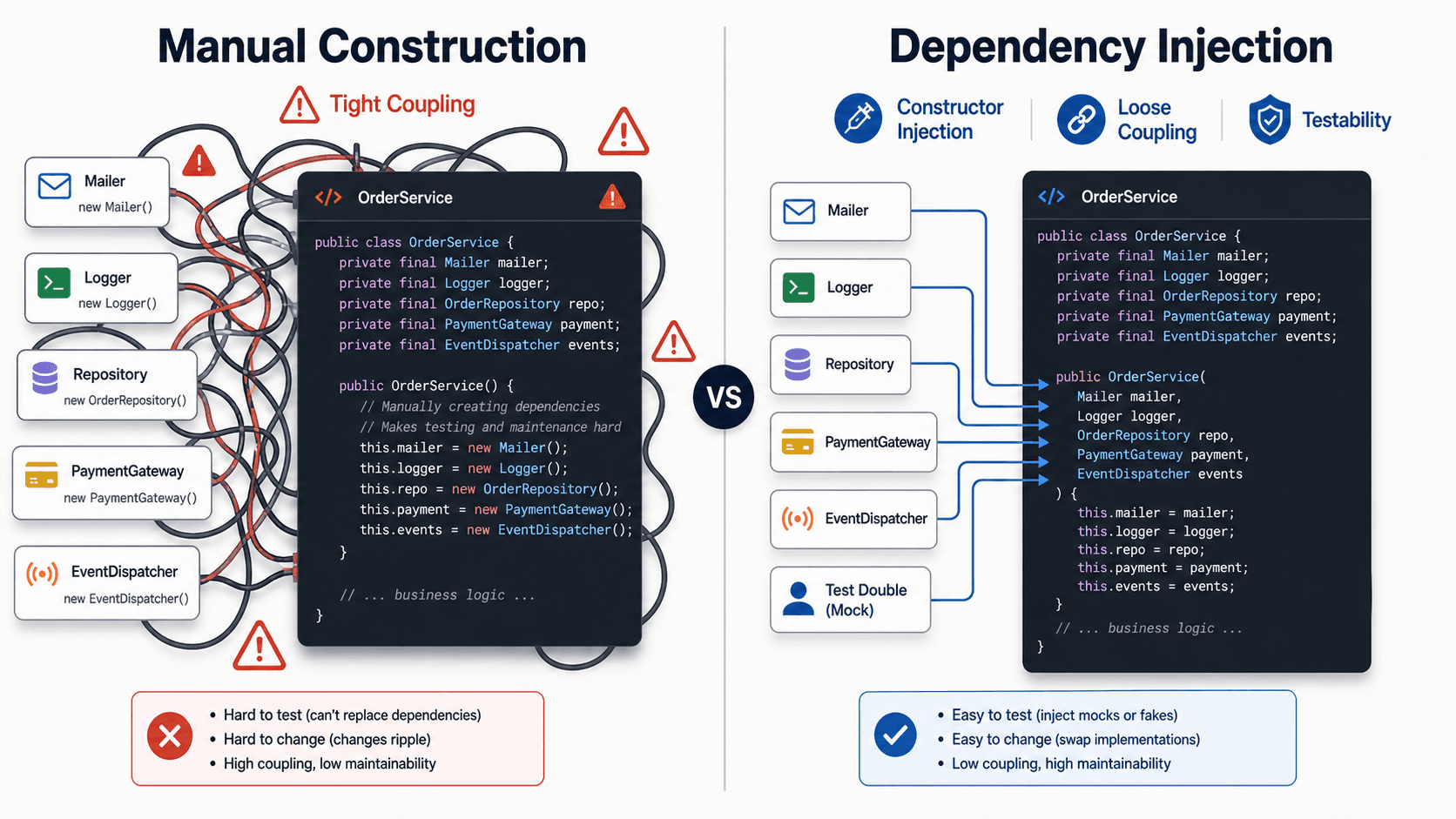
This keeps object construction away from your business logic.
Your service should not know how the entire application container works. It should just receive what it needs.
Symfony Flex And Recipes Make Adoption Cheap
A small thing that pays back across years: Symfony Flex is the Composer plugin that knows how Symfony packages should be installed.
When you composer require symfony/messenger, Flex doesn't just download the library — it runs a recipe. The recipe creates the right config files, registers the bundle, adds environment variables to .env, and wires sensible defaults. You don't manually paste YAML or remember which service tag to add.
composer require symfony/messenger
# → installs the package
# → creates config/packages/messenger.yaml with sane defaults
# → adds MESSENGER_TRANSPORT_DSN to .env
# → registers the bundle in config/bundles.php
The community maintains a recipe repository alongside the official one, so even non-core packages often install cleanly. When recipes update with new defaults, composer recipes:update shows you the diff and lets you apply it like a small migration.
A useful habit: don't fight the recipe. If you find yourself manually editing the config files Flex created, ask whether your structure or your defaults are off. Most of the time, Flex's defaults match the community's collective experience of "what works."
Composer Workspaces For Real Modularity
Once a codebase has several distinct domains, the question stops being "should I use modules?" and starts being "how strict should the boundary be?"
A domain folder (src/Order/, src/Billing/) is a navigation boundary — useful, but PHP doesn't enforce anything. A reviewer might.
A separate Composer package is a real boundary. The package has its own composer.json, declares its own dependencies, and other code can only import what it explicitly exposes.
The pragmatic middle ground in 2026 is Composer's workspaces feature (or path repositories, which have been around longer). You keep all packages in one repo but each has its own composer.json:
my-app/
  composer.json
  packages/
    order/
      composer.json   ← src/Order, requires symfony/messenger
      src/
    billing/
      composer.json   ← src/Billing, requires symfony/http-client
      src/
    shared/
      composer.json   ← shared kernel: value objects, contracts
      src/
  apps/
    web/              ← thin Symfony app that wires the packages
    cli/              ← optional: CLI-only app reusing the same packages
Each package can have its own version, its own tests, and its own CI step. A change in packages/order doesn't accidentally compile against packages/billing's private classes — Composer simply won't autoload them.
When does this earn its keep?
- Multiple teams owning separate domains. Hard boundaries reduce stepping on each other's code.
- Real reuse across apps. A
shared/package used by both the web app and the CLI is a clean reason to extract. - A future extraction is likely. Starting as a package makes "spin this off into a service" almost free.
When it doesn't? Solo projects, MVPs, anything where you change the package structure twice a week. Premature modularization is just folder bureaucracy with extra steps.
Common Modular Design Problems
- Using components without boundaries — A toolbox still needs a blueprint.
- Building a mini-framework accidentally — Sometimes the full Symfony framework is simpler than custom glue.
- Overusing events — Event-driven code can become hard to follow if every step is indirect.
- Serializing entities directly — Use response models or DTOs when output shape matters.
- Skipping tests because components are trusted — Symfony components are tested; your composition still needs tests.
Components make modularity possible, not automatic.
Pro Tips
- Start with the smallest useful component — Add capabilities as the app earns them.
- Keep your core framework-agnostic where practical — Business rules should not always depend on HTTP or console classes.
- Use events for extension points — Not for hiding required execution flow.
- Model inputs and outputs explicitly — DTOs make Validator and Serializer much safer.
- Choose full Symfony when integration matters — If you need routing, DI, security, forms, and HTTP, the framework saves glue code.
Final Tips
Symfony Components are one reason PHP has aged better than many people expected. You can adopt strong pieces gradually instead of rewriting everything overnight.
I like this approach in legacy systems especially: add Console for operational commands, Finder for filesystem jobs, Validator for imports, then slowly improve architecture from the inside.
Modular does not mean tiny. It means replaceable, understandable, and built with seams. Go build with good seams 👊