You've probably seen this before: a framework gets hyped because it looks exciting in a demo, then the real project starts and suddenly everyone is wrestling configuration, upgrades, edge cases, and invisible magic.
Symfony usually doesn't win the "flashiest demo" contest.
And honestly, that's part of its strength.
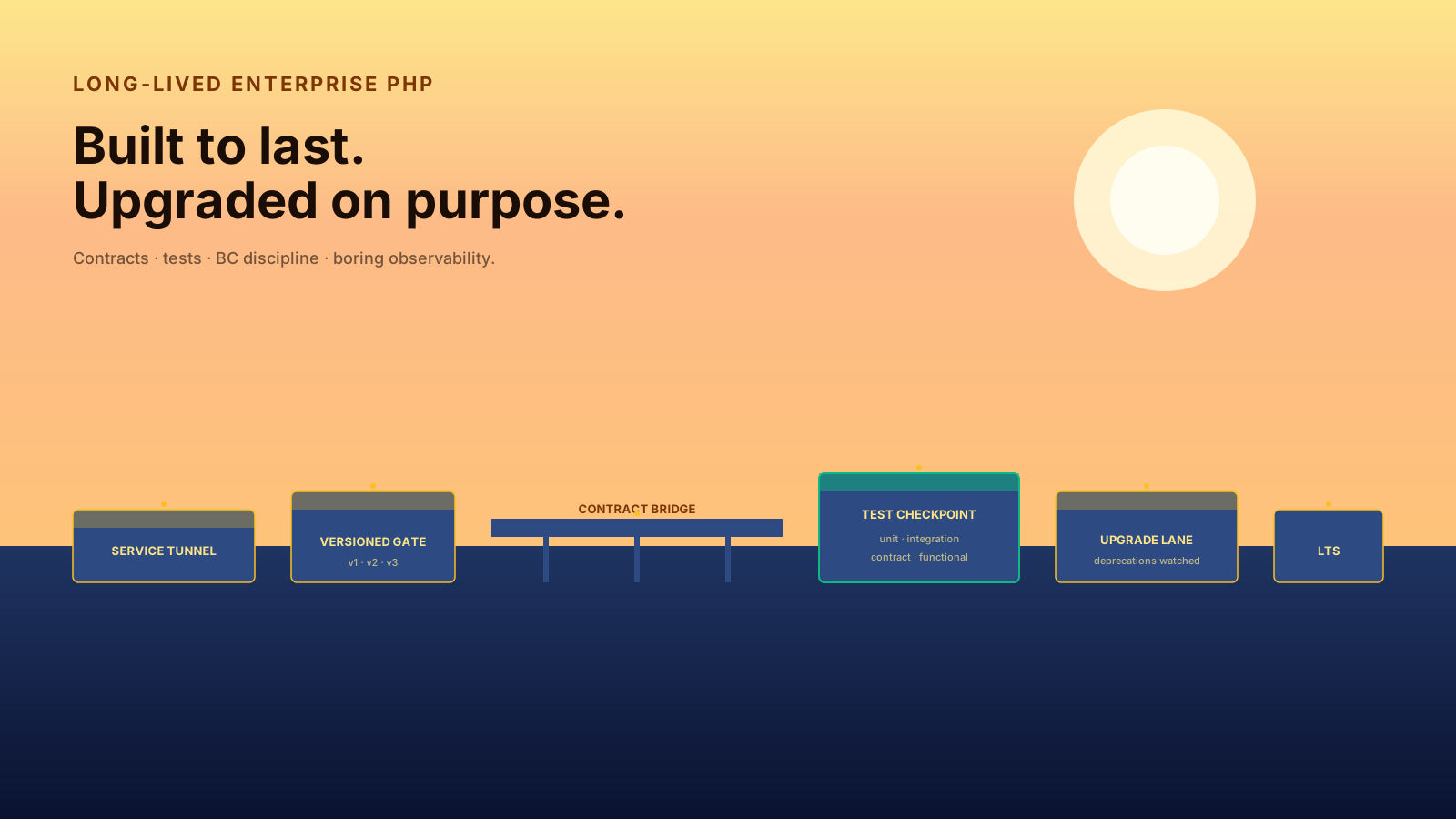
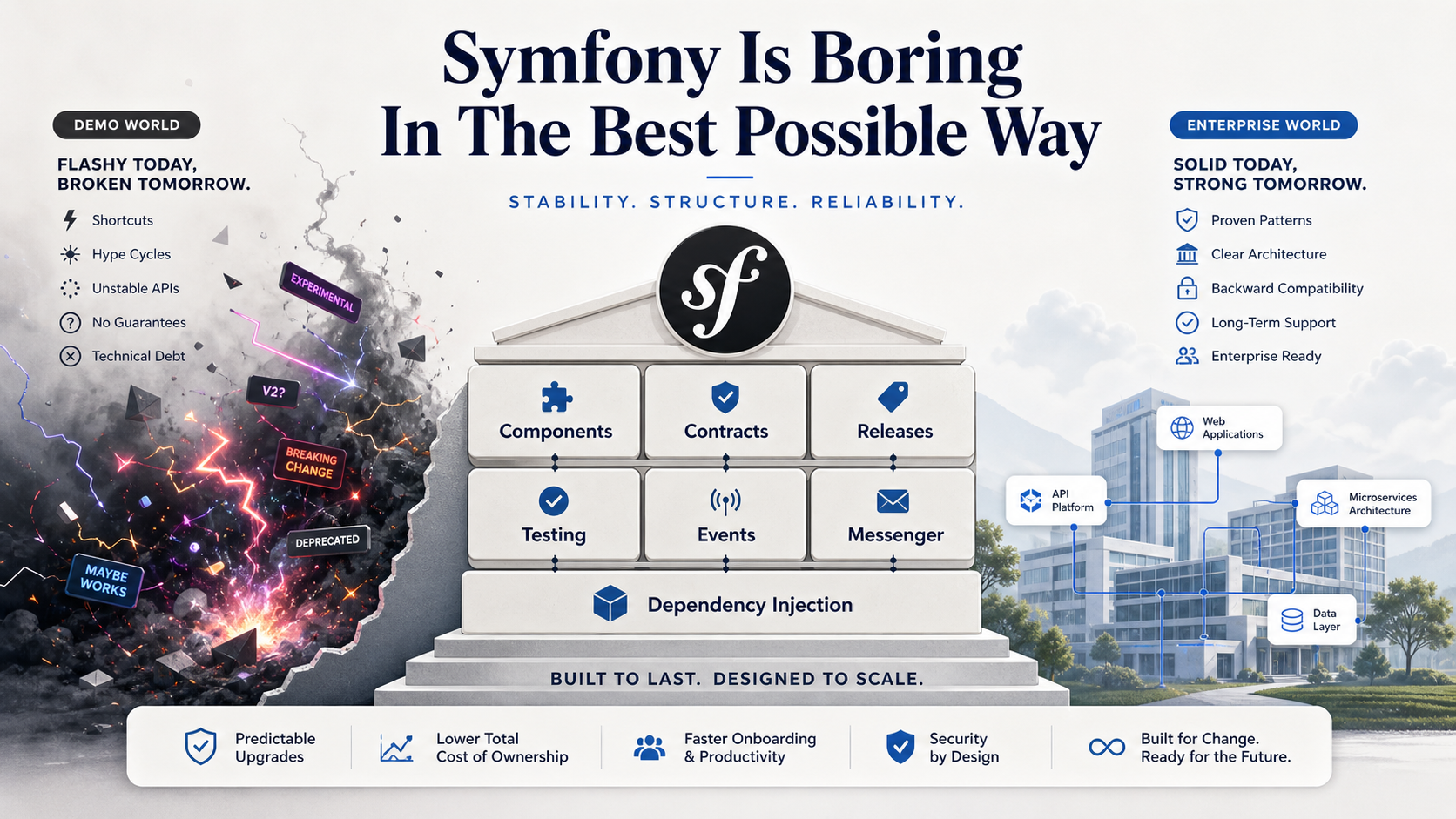
Symfony is boring in the best possible way. It cares about structure, contracts, long-term maintenance, reusable components, explicit configuration, and predictable releases. That's not always exciting on day one, but it's very exciting on year five when the application still has to work.
Boring Software Is Often Mature Software
When people call Symfony boring, they often mean it doesn't constantly chase the loudest trend.
That's not a weakness. Enterprise systems usually reward boring qualities: stability, testability, documentation, upgrade paths, and clear boundaries.
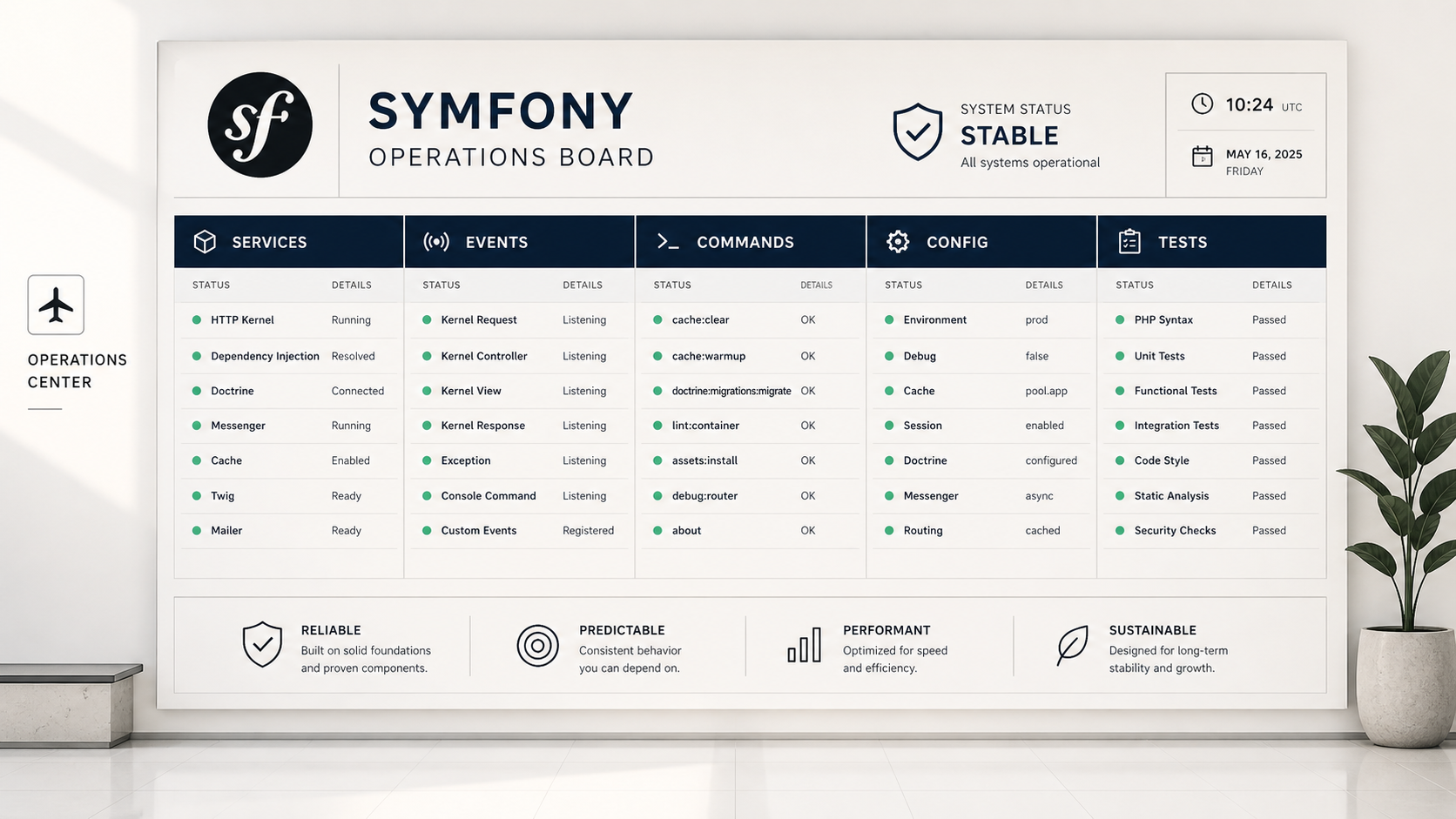
Think of Symfony like a well-run airport. It's not glamorous when everything works. You only notice the value when the luggage goes missing, the gate changes, and the system still keeps moving.
What Symfony Optimizes For
- Predictability. You can usually find where behavior is configured and why it happens.
- Explicit architecture. Services, events, commands, controllers, and config are separated cleanly.
- Reusable components. Many Symfony components can be used outside full Symfony applications.
- Long-term maintenance. Release discipline and deprecation paths matter for teams that maintain software for years.
- Enterprise flexibility. Symfony lets you replace, extend, decorate, and configure almost everything.
Those qualities are not always sexy, but they age well.
Symfony Components Are The Quiet Superpower
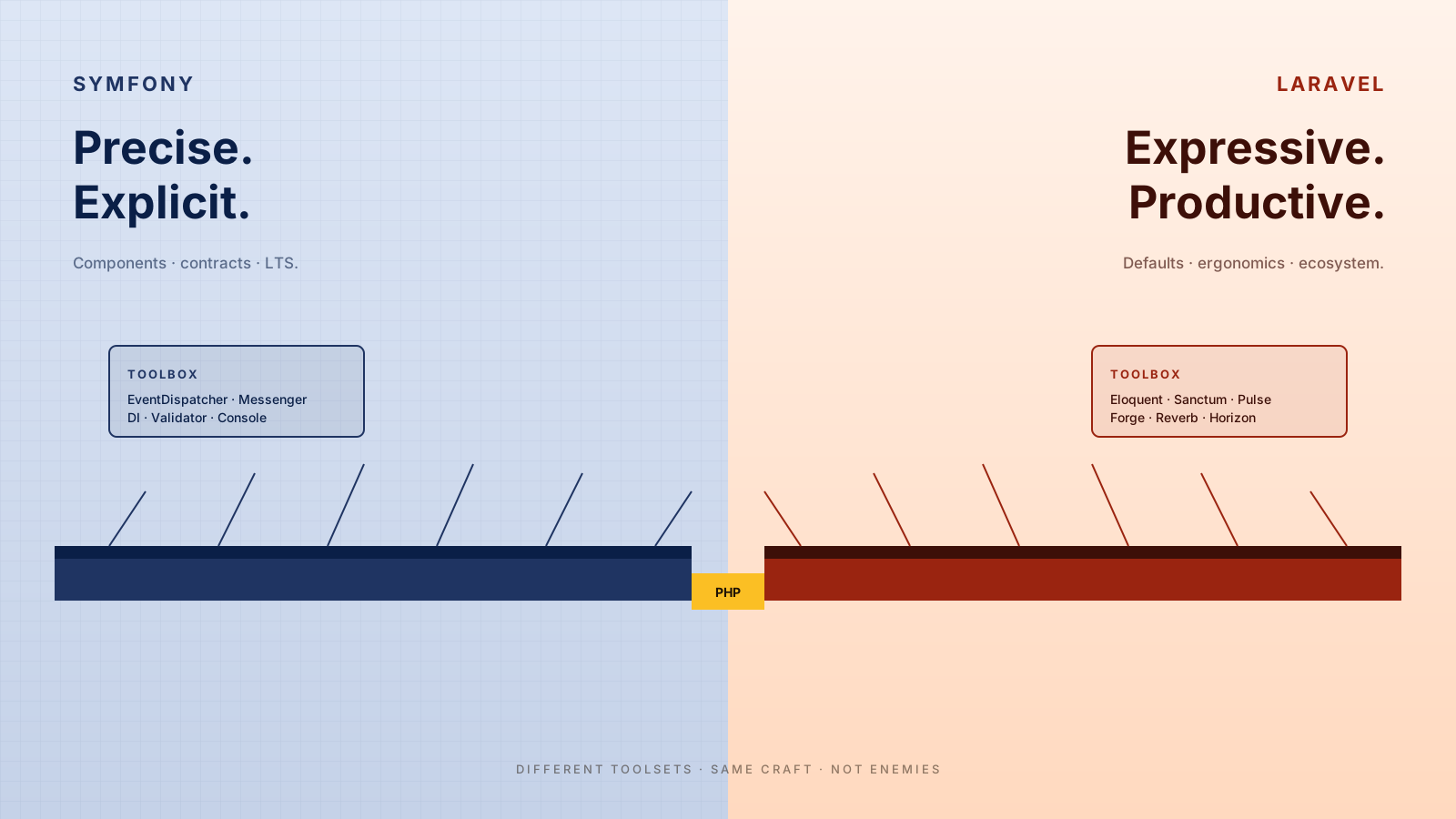
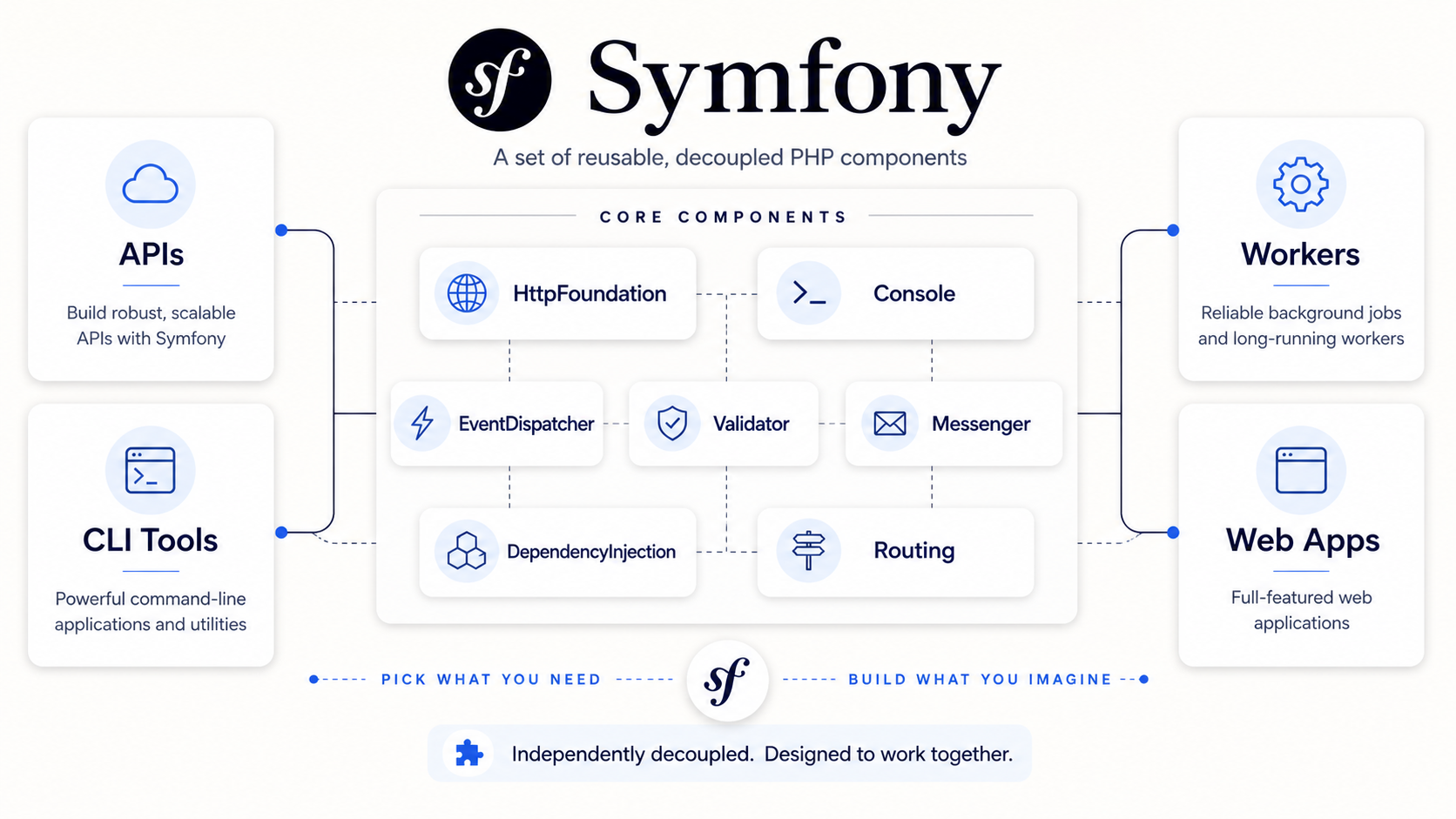
Symfony is not only a full-stack framework. It's also a collection of reusable PHP components.
That distinction matters. You can use parts of Symfony without adopting the entire framework. Routing, Console, HttpFoundation, Messenger, EventDispatcher, DependencyInjection, Validator, Serializer, and many others show up across the PHP ecosystem.
Laravel itself has historically used Symfony components in important areas. That's a pretty strong signal that the component model works.
Components Make Architecture Less Fragile
A component is like a Lego brick. A full framework is the whole Lego set with instructions, theme, and box art. Both are useful, but the brick can travel further.
This is why Symfony fits large organizations well. You don't always need one framework to rule everything. Sometimes you need stable pieces that can power APIs, CLI tools, workers, internal packages, and legacy migrations.
Here's a tiny Console command shape:
#[AsCommand(name: 'app:search:rebuild')]
final class RebuildSearchIndexCommand extends Command
{
    public function __construct(private SearchIndexer $indexer)
    {
        parent::__construct();
    }

    protected function execute(InputInterface $input, OutputInterface $output): int
    {
        $this->indexer->rebuild();
        return Command::SUCCESS;
    }
}
The command is small because the real logic lives in a service. That's the Symfony style when it's done well.
Enterprise Systems Need Clear Boundaries
Enterprise software is not difficult only because of code.
It's difficult because of approvals, audits, integrations, permissions, workflows, data migrations, backward compatibility, and teams changing over time. The codebase becomes a city, not a cabin.
Symfony works well in that environment because it encourages boundaries.
Boundaries Symfony Makes Natural
- Services contain business logic. Controllers don't need to become god objects.
- Configuration is centralized. You can see how dependencies are wired.
- Events decouple side effects. One action can trigger multiple reactions without hardcoding every dependency.
- Messenger separates async work. Commands and messages can move through transports and handlers.
- Interfaces support replacement. You can swap infrastructure details without rewriting business rules.
This is the boring stuff that saves you during rewrites, audits, and onboarding.
Symfony Gives You Control Without Making Everything Manual
There's a myth that Symfony means writing endless XML or YAML until your soul leaves your body.
Modern Symfony is much more ergonomic than that. Autowiring, autoconfiguration, attributes, and sensible defaults reduce boilerplate. But Symfony still gives you the option to be explicit when you need precision.
That's the sweet spot: automation with an escape hatch.
Autowiring Keeps Services Clean
Here's a simple service depending on abstractions:
final class InvoiceIssuer
{
    public function __construct(
        private InvoiceRepository $invoices,
        private PaymentGateway $payments,
        private EventDispatcherInterface $events,
    ) {}

    public function issue(InvoiceId $id): void
    {
        $invoice = $this->invoices->get($id);
        $this->payments->capture($invoice);
        $this->events->dispatch(new InvoicePaid($id));
    }
}
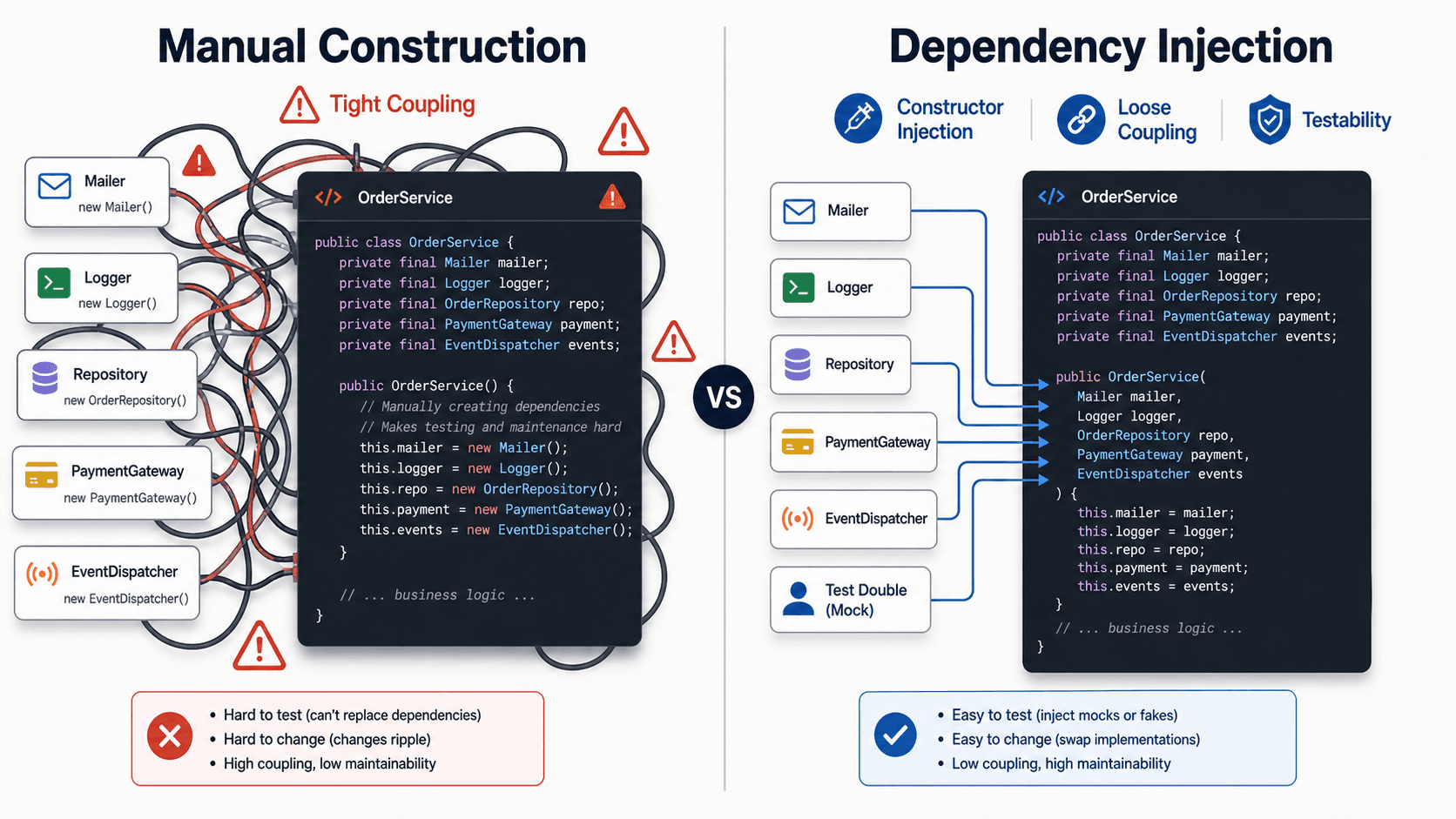
You don't see container calls inside the service. Dependencies are visible, testable, and replaceable.
Symfony's container handles the wiring, but the class still looks like plain PHP. That's a big deal.
Symfony Is Great When You Have Multiple Teams
A small team can sometimes survive with informal conventions. A larger team cannot.
Symfony's structure helps because it creates shared expectations. You know where commands live. You know what a service is. You know how events are dispatched. You know how configuration is loaded. You know how the container is built.
It's like driving in a city with traffic lights. You may not love stopping at red lights, but you really appreciate them when 200 cars enter the same intersection.
Why Teams Benefit
- Onboarding gets easier. New developers can learn framework conventions instead of decoding tribal knowledge.
- Reviews get sharper. Architecture decisions have recognizable patterns.
- Testing improves. Constructor injection makes dependencies obvious.
- Refactoring becomes safer. Explicit services and interfaces make change less mysterious.
- Upgrades are more manageable. Deprecation notices help teams move gradually.
The benefit is not that Symfony prevents bad code. No framework can do that. The benefit is that Symfony gives teams fewer excuses for chaos.
The Trade-Offs Are Real
Symfony is not perfect, and pretending otherwise would be weird.
It can feel heavier than smaller frameworks. It may require more architectural thinking upfront. Some developers find the configuration model intimidating at first. And if your app is a tiny weekend project, Symfony may feel like bringing a forklift to move one chair.
But in larger systems, that same structure becomes useful.
When Symfony Makes A Lot Of Sense
- Long-lived business applications. You expect the codebase to exist for years.
- Complex domain logic. You need clean services, events, commands, and boundaries.
- Enterprise integrations. You deal with authentication, queues, APIs, logs, audits, and internal systems.
- Multiple teams. Consistency matters more than individual preference.
- Reusable packages. You want components that can survive outside one app.
If that sounds like your project, boring may be exactly what you want.
Common Symfony Problems
- Putting business logic in controllers. Symfony gives you services for a reason.
- Overengineering small features. Not every button needs a domain event, command bus, and ceremony parade.
- Ignoring deprecations. Symfony gives early warnings; don't treat them as background noise.
- Hiding everything behind magic. Use autowiring, but keep dependencies obvious.
- Confusing flexibility with randomness. Just because Symfony lets you configure everything doesn't mean every team should configure everything differently.
Symfony rewards thoughtful architecture. It does not reward architecture cosplay.
Pro Tips
- Keep controllers thin. A controller should coordinate HTTP, not run the business.
- Use constructor injection by default. It makes dependencies visible and tests easier.
- Lean on events carefully. Events are great for side effects, but too many invisible reactions can become hard to trace.
- Read deprecation messages early. They are upgrade instructions in disguise.
- Prefer boring conventions. Enterprise codebases need fewer surprises, not more personality.
Final Tips
I've learned to respect boring tools more with time. When you're younger as a developer, flashy syntax feels important. After enough production incidents, predictable behavior starts looking extremely attractive.
Symfony's strength is not that it makes every demo feel magical. Its strength is that it helps serious systems stay understandable after the demo is long forgotten.
So yes, Symfony is boring. That's the compliment. Build something that lasts 👊