PHP has one of the strangest reputations in software engineering.
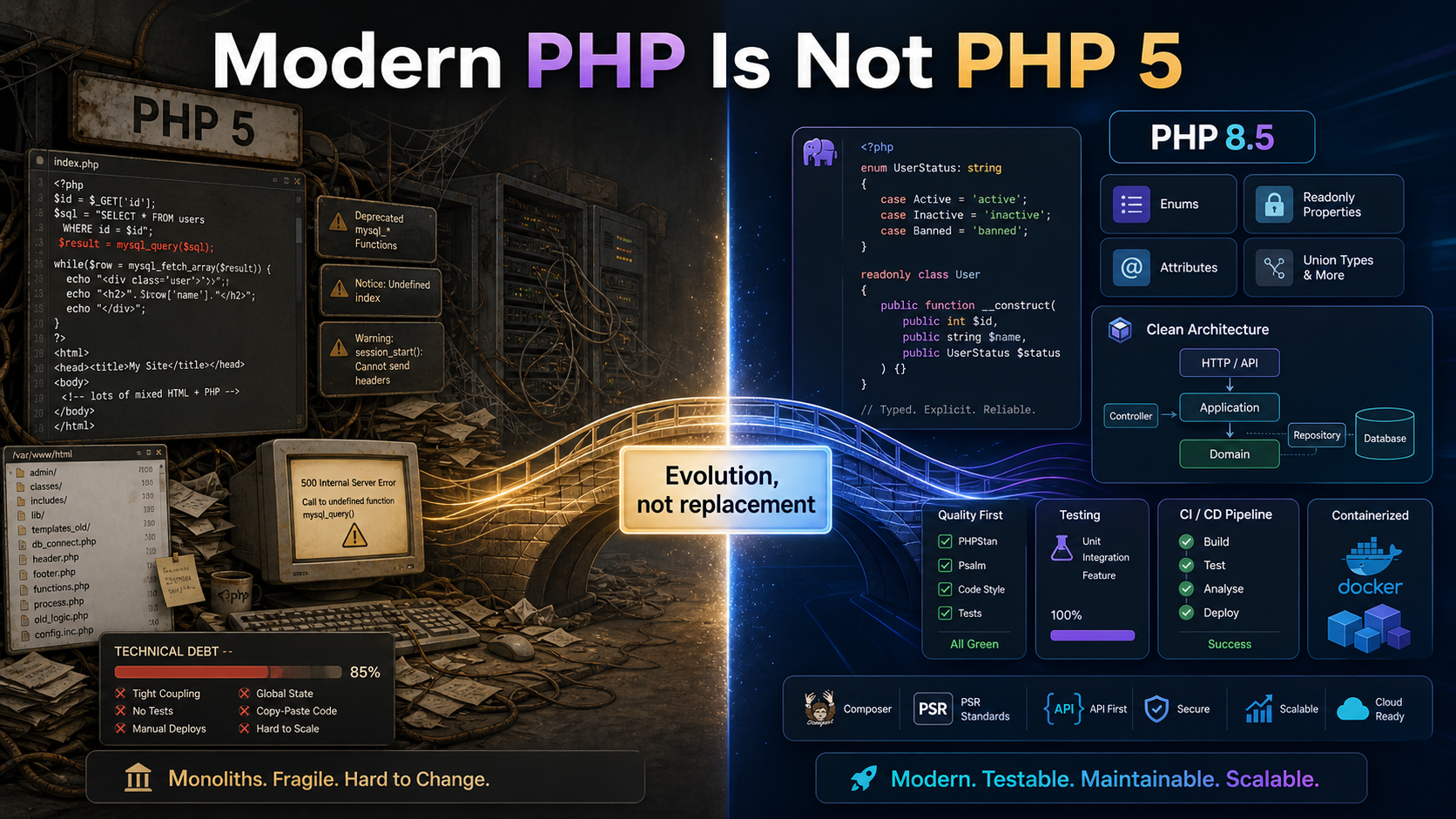
Some developers still judge it by old PHP 5 codebases: global helpers, mixed HTML, weak typing, unclear architecture, and "just make it work" production fixes.
But modern PHP is not that language anymore.
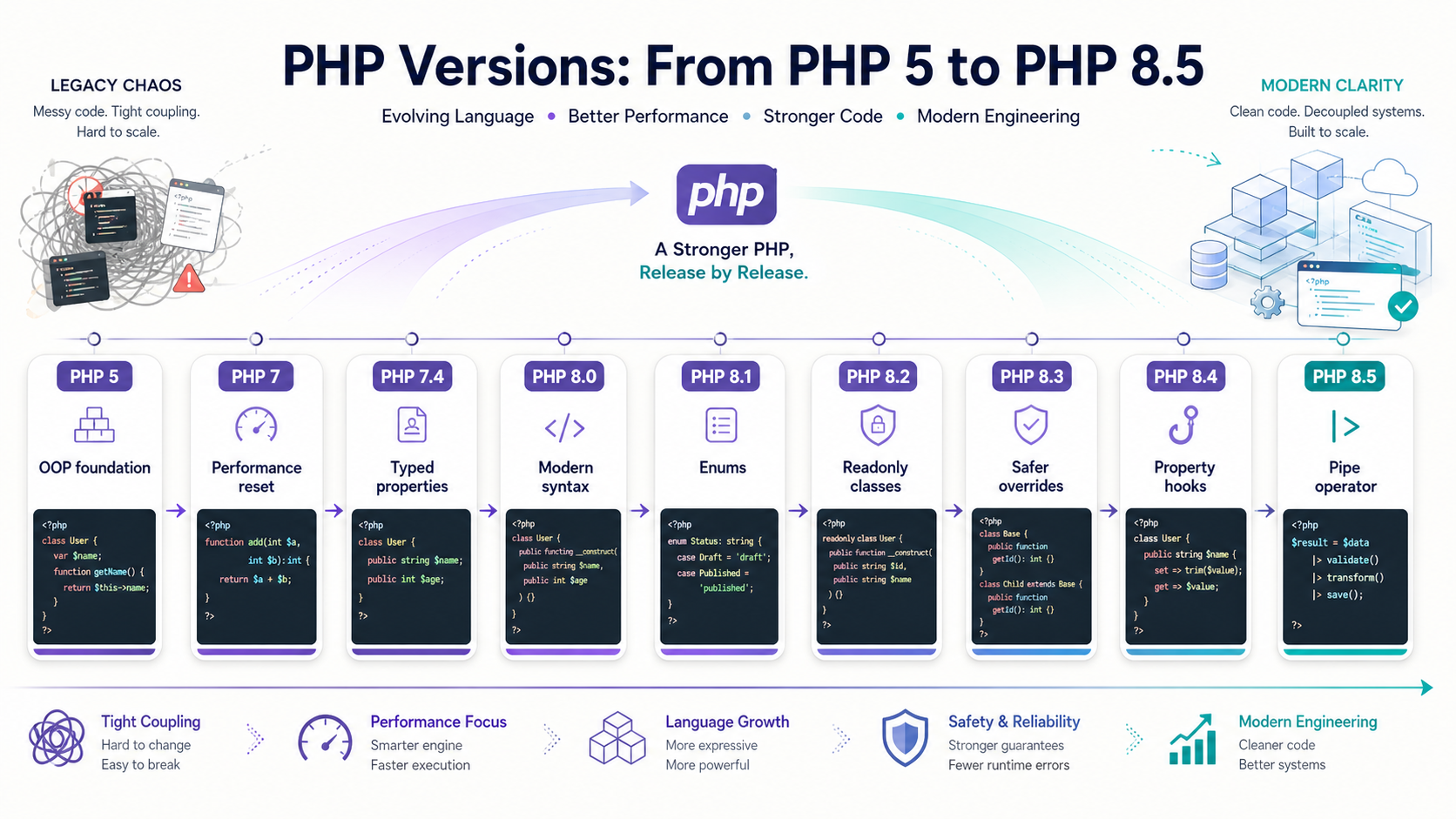
From PHP 5 to PHP 8.5, PHP has moved from a flexible scripting tool into a serious backend platform with strong typing, JIT, attributes, enums, fibers, readonly classes, typed constants, property hooks, asymmetric visibility, and now even cleaner data transformation tools like the pipe operator.
As of May 2026, PHP 8.5 is the latest supported branch. PHP 8.2, 8.3, 8.4, and 8.5 are currently supported; everything older is end-of-life and should be upgraded as soon as possible. PHP branches now receive two years of active support and two additional years of security support.
PHP 5: The Era Of "It Works"
PHP 5 was everywhere.
It powered WordPress, Magento, Drupal, custom CRMs, SaaS dashboards, payment flows, admin panels, and millions of internal business systems.
It gave developers important object-oriented features, better exception handling, interfaces, visibility, abstract classes, and later namespaces in PHP 5.3.
But PHP 5 also allowed a lot of dangerous freedom.
function getUser($id) {
    return mysql_query("SELECT * FROM users WHERE id = " . $id);
}
This kind of code was common: no type safety, unsafe SQL, deprecated extensions, mixed responsibilities, and business logic hidden everywhere.
PHP 5 was productive, but it was easy to create technical debt. The language did not force discipline. Senior engineers had to bring discipline themselves.
PHP 7: The Performance Reset
PHP 7 was the first major moment where many engineers had to admit:
"Okay, PHP is not what I remember."
PHP 7 brought a huge performance improvement, lower memory usage, scalar type declarations, return types, anonymous classes, null coalescing, and better error handling.
function calculateTotal(float $price, int $quantity): float
{
    return $price * $quantity;
}

$username = $_GET['user'] ?? 'guest';
This changed the feel of PHP.
- Code became easier to read.
- APIs became more predictable.
- Large systems became faster without rewriting everything in another language.
PHP 7 was not just an upgrade. It was a reset of PHP's credibility.
PHP 7.4: The Bridge To Modern PHP
PHP 7.4 was one of the most important versions because it prepared developers for the PHP 8 era.
Typed properties changed everyday code.
Before:
class User
{
    private $email;

    public function setEmail($email)
    {
        $this->email = $email;
    }
}
After:
class User
{
    public string $email;
}
Arrow functions also made small transformations cleaner:
$activeUsers = array_filter(
    $users,
    fn (User $user) => $user->isActive()
);
PHP 7.4 felt like a bridge between old PHP and modern PHP. It still looked familiar, but the language was clearly moving toward stronger contracts, cleaner syntax, and better maintainability.
PHP 8.0: The Modern Era Begins
PHP 8.0 was a major milestone.
It introduced named arguments, attributes, constructor property promotion, union types, match expressions, the nullsafe operator, and JIT.
This made PHP code more expressive and less repetitive.
class CreateUserRequest
{
    public function __construct(
        public string $email,
        public string $name,
        public ?string $phone = null,
    ) {}
}
The match expression replaced many fragile switch blocks:
$statusLabel = match ($status) {
    'pending' => 'Waiting',
    'paid' => 'Completed',
    'failed' => 'Payment failed',
    default => 'Unknown',
};
The nullsafe operator removed defensive noise:
$country = $user->profile?->address?->country;PHP 8.0 made PHP feel like a modern backend language. Not perfect. But serious.
PHP 8.1: Enums And Readonly Properties
PHP 8.1 added one of the most useful features for business applications: enums.
Before enums, many codebases used strings everywhere:
if ($paymentStatus === 'completed') {
    // ...
}
That works until someone writes 'complete', 'Completed', or 'COMPLETED' and quietly breaks a comparison.
Enums made business states safer:
enum PaymentStatus: string
{
    case Pending = 'pending';
    case Completed = 'completed';
    case Failed = 'failed';
}
Now the domain model becomes clearer:
if ($payment->status === PaymentStatus::Completed) {
    // ship order
}
Readonly properties also helped build safer DTOs:
class Money
{
    public function __construct(
        public readonly int $amount,
        public readonly string $currency,
    ) {}
}
PHP 8.1 was a big step toward stronger domain modeling.
PHP 8.2: Less Dynamic, More Intentional
PHP 8.2 continued cleaning up the language.
Readonly classes made immutable objects easier:
readonly class Address
{
    public function __construct(
        public string $city,
        public string $country,
    ) {}
}
It also deprecated dynamic properties by default.
Old PHP allowed this:
$user = new User();
$user->emial = 'wrong@example.com'; // typo, but PHP allowed it
Modern PHP pushes you away from that style. That is a good thing.
In large codebases, hidden dynamic behavior is expensive. It creates bugs that static analysis, IDEs, and developers struggle to catch. PHP 8.2 made PHP more explicit.
PHP 8.3: Small Features, Better Daily Work
PHP 8.3 was not as dramatic as PHP 8.0 or 8.1, but it improved the daily developer experience.
Typed class constants became more expressive:
class CacheKey
{
    public const string USER_PROFILE = 'user.profile';
}
The new #[Override] attribute helped catch inheritance mistakes:
class StripePaymentGateway extends PaymentGateway
{
    #[\Override]
    public function charge(Money $money): PaymentResult
    {
        // ...
    }
}
If the parent method changes, PHP can now help catch the mistake.
That may sound small, but in legacy systems with deep inheritance, small safety features matter a lot.
PHP 8.4: Property Hooks And Better Object Design
PHP 8.4 introduced property hooks, one of the most interesting modern PHP features.
They allow logic around property access without manually writing traditional getters and setters everywhere.
class User
{
    public string $email {
        set => strtolower(trim($value));
    }
}
This makes simple normalization cleaner.
PHP 8.4 also introduced asymmetric property visibility, which helps expose values publicly while controlling writes.
class User
{
    public private(set) string $email;

    public function __construct(string $email)
    {
        $this->email = $email;
    }
}
This is very useful for domain objects, DTOs, and API-facing models where you want readable state but controlled mutation.
PHP 8.4 made object design more expressive without forcing heavy boilerplate.
PHP 8.5: Cleaner Data Flow And More Language Maturity
PHP 8.5 is the latest stable PHP branch as of May 2026. It introduced features including the new URI extension, the pipe operator, clone with, #[\NoDiscard], and support for closures, casts, and first-class callables in constant expressions.
The pipe operator is especially interesting because it makes transformation pipelines easier to read.
Instead of deeply nested calls:
$result = trim(strtolower($input));You can express data flow more naturally:
$result = $input
    |> strtolower(...)
    |> trim(...);
This is not just syntax sugar.
Readable data transformation matters in real systems: imports, validation, API normalization, analytics pipelines, and AI-assisted workflows. PHP 8.5 continues the same trend: less magic, stronger intent, cleaner flow.
The Real Comparison
Here is the simple way to think about the PHP evolution:
| Version | Main Character |
|---|---|
| PHP 5 | Flexible, productive, but easy to misuse |
| PHP 7 | Fast, more reliable, better typed |
| PHP 7.4 | Bridge to modern PHP |
| PHP 8.0 | Modern syntax and stronger expressiveness |
| PHP 8.1 | Better domain modeling with enums and readonly |
| PHP 8.2 | More explicit, less dynamic behavior |
| PHP 8.3 | Safer everyday development |
| PHP 8.4 | Better object design and controlled mutation |
| PHP 8.5 | Cleaner data flow and continued modernization |
The Strongest Point
The biggest change in PHP is not one feature. It is the direction.
PHP moved from:
"Trust the developer."
to:
"Help the developer build safer systems."
That is a massive shift.
Modern PHP works very well with static analysis, strict types, IDEs, Composer, Docker, CI/CD, Laravel, Symfony, Rector, PHPStan, Psalm, and automated refactoring tools. The language now supports serious engineering practices.
But there is one catch.
You can write bad PHP 8.5 code. Just like you can write bad Go, bad Java, bad TypeScript, or bad Python. Modern PHP gives you better tools, but architecture is still your responsibility.
Final Thought
PHP did not survive because it was trendy.
PHP survived because it was practical. And now it is not only practical — it is modern.
If your opinion of PHP is still based on PHP 5, you are judging a current language by a very old photograph. The PHP of today is faster, safer, cleaner, and much better suited for serious backend development than many people still realize.
Legacy PHP may still be messy. But modern PHP is not the problem. Bad architecture is. Go ship something modern 👊