Symfony vs Laravel debates often sound like developers arguing over coffee machines.
One person wants precision, configurability, and long-term structure. Another wants speed, elegance, and product momentum. Both are right in the environment they care about.
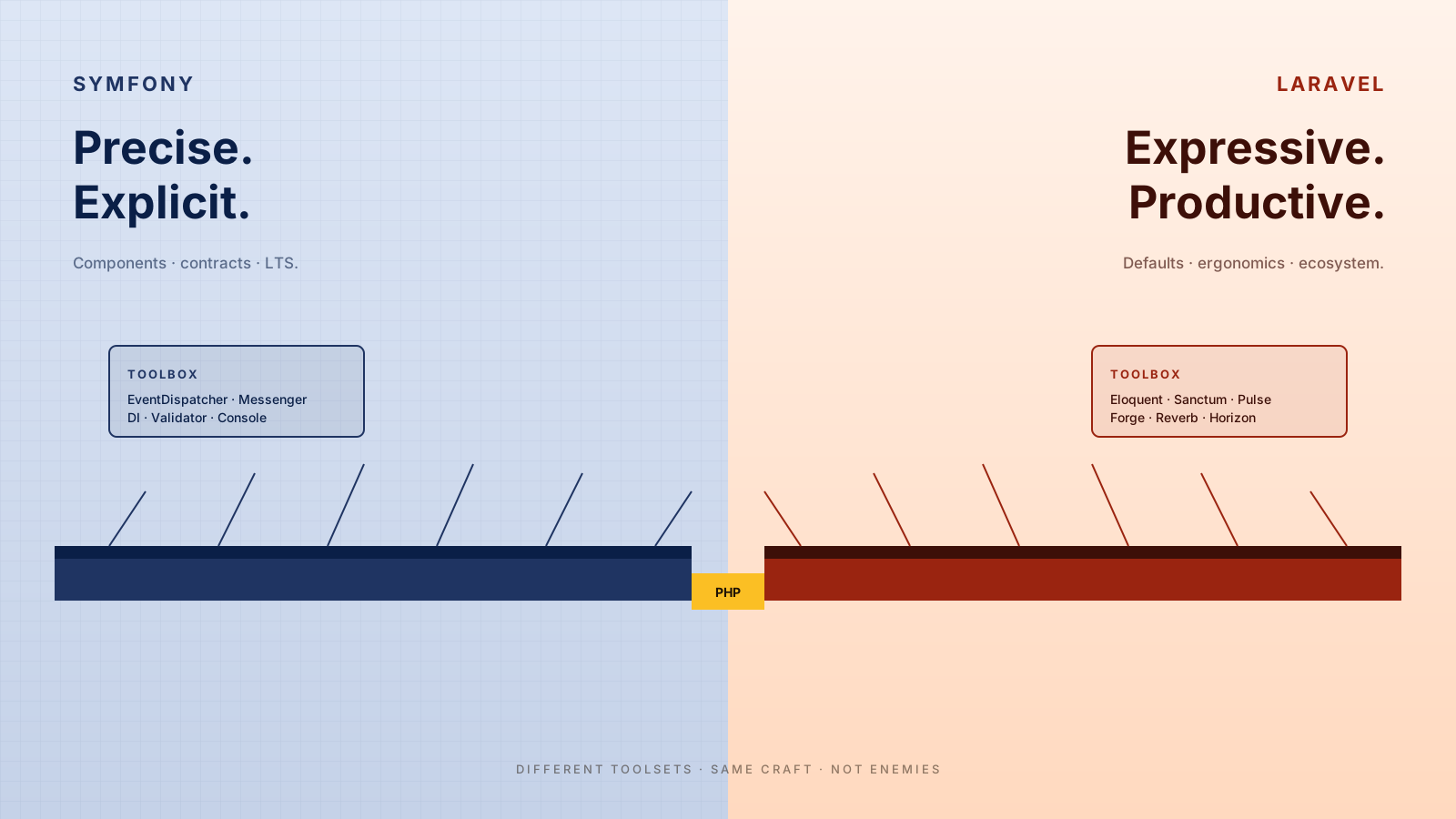
Symfony and Laravel are not enemies. They are two different philosophies for building PHP applications.
And funny enough, Laravel uses many Symfony components under the hood. So when people turn this into a tribal war, it gets a little silly. Right?
Laravel Optimizes For Product Flow
Laravel feels designed around developer momentum.
You can define routes quickly, write expressive Eloquent models, dispatch jobs, validate requests, send notifications, build APIs, and ship features without fighting the framework.
Route::post('/orders', function (CreateOrderRequest $request) {
    $order = Order::create($request->validated());

    SendOrderReceipt::dispatch($order);

    return new OrderResource($order);
});
This is Laravel at its best: readable, fast, and close to the product use case.
Laravel is like a well-designed kitchen. The tools are where you expect them, the workflow feels natural, and you can cook fast.
Symfony Optimizes For Explicit Architecture
Symfony tends to favor explicit wiring, contracts, components, and long-term maintainability.
A Symfony controller often feels more formal, but that formality can be valuable in enterprise systems.
#[Route('/orders', methods: ['POST'])]
final class CreateOrderController
{
    public function __invoke(CreateOrderRequest $request): JsonResponse
    {
        $order = $this->createOrder->handle($request->toCommand());

        return new JsonResponse($this->orders->toArray($order), 201);
    }
}
Symfony is like a professional workshop. The tools may require more setup, but everything has a labeled drawer.
Expressive vs Explicit Is The Real Difference
Laravel often says, "Here is the beautiful default path."
Symfony often says, "Here are the components and contracts; choose deliberately."
Neither is automatically better.
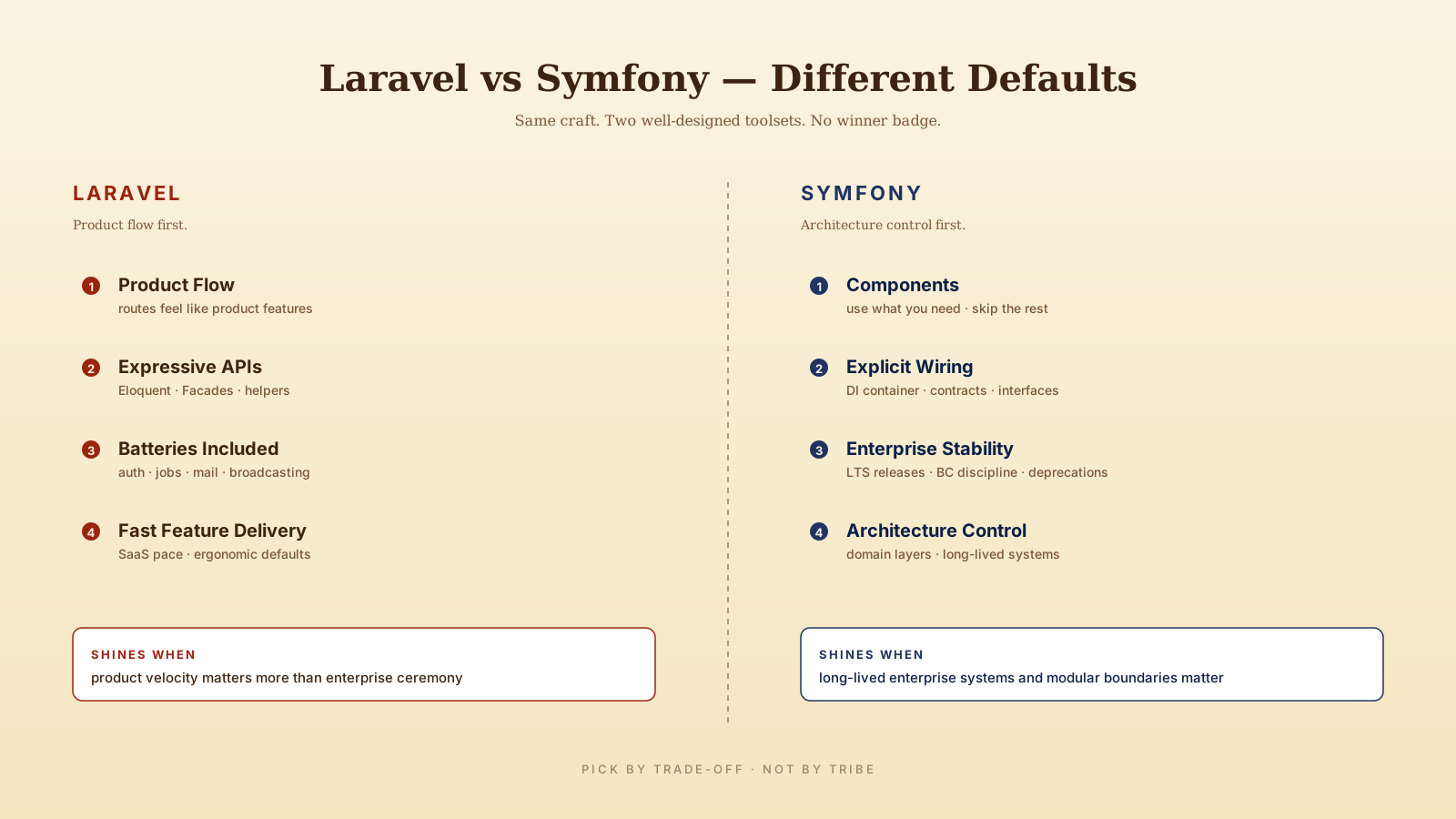
- Laravel shines when product speed matters — SaaS apps, marketplaces, internal tools, dashboards, content systems, and APIs can move very fast.
- Symfony shines when architectural control matters — Enterprise systems, modular platforms, long-lived domains, and heavily integrated systems benefit from explicit seams.
- Laravel hides more by design — That makes common work pleasant but can surprise teams when abstractions leak.
- Symfony exposes more by design — That makes complex systems clearer but can feel verbose for small products.
- Both can be clean or messy — Framework choice does not save you from bad boundaries.
ORM Philosophy Feels Different Too
Laravel's Eloquent is active record. Models are close to database tables and often include persistence methods directly.
$order = Order::query()->create([
    'user_id' => $user->id,
    'total' => $total,
]);
Doctrine, common in Symfony apps, uses a data mapper style. Entities do not usually save themselves; the EntityManager coordinates persistence.
$order = new Order($userId, $total);

$entityManager->persist($order);
$entityManager->flush();
Eloquent feels direct and productive. Doctrine gives you a stronger separation between domain objects and persistence mechanics.
Again, trade-off. Not religion.
Configuration Philosophy Is Different
Laravel often prefers convention and fluent PHP APIs. Symfony often leans into configuration, attributes, service definitions, and explicit contracts.
Laravel might feel easier to start. Symfony might feel easier to standardize across many teams once the architecture is established.
That is like comparing a fast automatic car and a manual transmission built for control. The better choice depends on the road, driver, and trip.
Ecosystem Shape Matters
Laravel has a strong product ecosystem: Forge, Vapor, Nova, Horizon, Sanctum, Cashier, Reverb, Pulse, and more.
Symfony has a strong component and enterprise ecosystem: reusable components, bundles, long-term support releases, API Platform, mature integrations, and a predictable release philosophy.
Laravel often gives you a polished product lane. Symfony often gives you durable building blocks.
Both Frameworks Quietly Borrow From Each Other
This is the part that ends most tribal arguments. Look at the package list of any modern Laravel app and you'll find symfony/console, symfony/finder, symfony/http-foundation, symfony/http-kernel, symfony/process, symfony/routing, symfony/yaml, and several more. Laravel's HTTP layer, Artisan commands, and routing all sit on Symfony components. That's not a flaw — it's a great architectural decision that lets Laravel focus on developer ergonomics while Symfony handles the boring HTTP plumbing both frameworks need.
The borrowing goes both directions on patterns:
- Symfony picked up controller attributes that look very similar to Laravel's expressive routing.
- Laravel picked up service container concepts that look very similar to Symfony's DI patterns.
- Both have form/input validation systems that have converged on attribute-based constraints.
- Both have queue/messenger systems with named messages, retries, and failure handling.
- Both have first-party admin tooling (Nova, EasyAdmin) that solves the same internal-tools problem differently.
So when you read "Laravel beats Symfony" or vice versa, ask: in which decade, in which feature area, and against which version? The honest answer is usually that the gap on any specific feature is smaller than the tribes pretend.
When To Switch Frameworks (Spoiler: Rarely)
Switching frameworks is usually the wrong solution to the right problem.
The right problem is often: "this codebase is hard to work in." Switching frameworks rarely fixes that — what fixes it is better boundaries, better tests, better naming, smaller controllers, real domain layers. A well-organized Laravel app and a well-organized Symfony app feel about the same. A messy Laravel app and a messy Symfony app are equally painful, just in different ways.
A few cases where a framework switch is genuinely justified:
- The framework is unmaintained. Switching from a dead framework to either Symfony or Laravel is correct.
- The team is the wrong size for the framework. If a five-person product team is drowning in Symfony ceremony for a small SaaS, Laravel might match the cadence better. The reverse is also true: a 50-person enterprise team building a long-lived banking system might appreciate Symfony's explicitness.
- Hiring is impossible. If you can't find anyone in your city who knows your framework, a switch may be the cheaper long-term move.
What's almost never a good reason: "I read that the other framework is better." Frameworks improve. Your codebase doesn't switch sides because of a blog post. A rewrite costs months — sometimes years — and rarely solves the actual pain.
The honest advice: before switching frameworks, refactor for one quarter as if you weren't allowed to switch. Most of the time, the codebase improves enough that switching becomes pointless.
Common Debate Problems
- Comparing beginner Laravel to enterprise Symfony — That is not a fair comparison.
- Comparing messy Laravel to ideal Symfony — Also not fair.
- Ignoring team experience — The framework your team understands deeply may outperform the theoretically better one.
- Pretending speed and structure are opposites — Good teams can build structured Laravel and productive Symfony.
- Turning tools into identity — The user does not care which framework won your argument.
The product cares about reliability, maintainability, and delivery.
Pro Tips
- Choose Laravel for fast product iteration — Especially when the framework's defaults match the business shape.
- Choose Symfony for explicit long-term architecture — Especially when modularity, contracts, and enterprise lifecycle matter.
- Borrow ideas across frameworks — Laravel teams can learn from Symfony explicitness; Symfony teams can learn from Laravel ergonomics.
- Evaluate operational ecosystem — Deployment, observability, queues, security, and upgrades matter as much as syntax.
- Do not rewrite because of vibes — A rewrite needs business reasons, not framework envy.
Final Tips
I like both frameworks for different reasons. Laravel feels like momentum. Symfony feels like control. Most senior developers eventually stop asking "which is better?" and start asking "which trade-off fits this product?"
That is the healthier conversation.
Pick the tool that matches your team, your domain, your timeline, and your maintenance horizon. Then build it well 👊