So you ran a benchmark. Same JSON endpoint on Laravel and Lumen, same database, same machine. Lumen wins. Not by 5%. By something that makes you do a double-take and refresh the page. And the obvious next question is the one nobody really answers properly: why is it faster?
If you ask around, you'll hear "it's lighter" and "it has less stuff" and "it's optimized for APIs" and you'll come away knowing roughly nothing. Those phrases are vibes, not mechanics. The actual reasons Lumen is faster than a vanilla Laravel app on PHP-FPM are concrete, and once you know them, you also know exactly when Lumen's advantage disappears, which is just as useful.
Let's open up the hood. We'll look at three places the speed actually comes from: the bootstrap path, the service container, and the caching layers Lumen still depends on. None of them are magic. All of them are "this framework chose to skip a thing Laravel does by default." Add them up and you get the gap.
Bootstrap: The Thing Lumen Doesn't Do
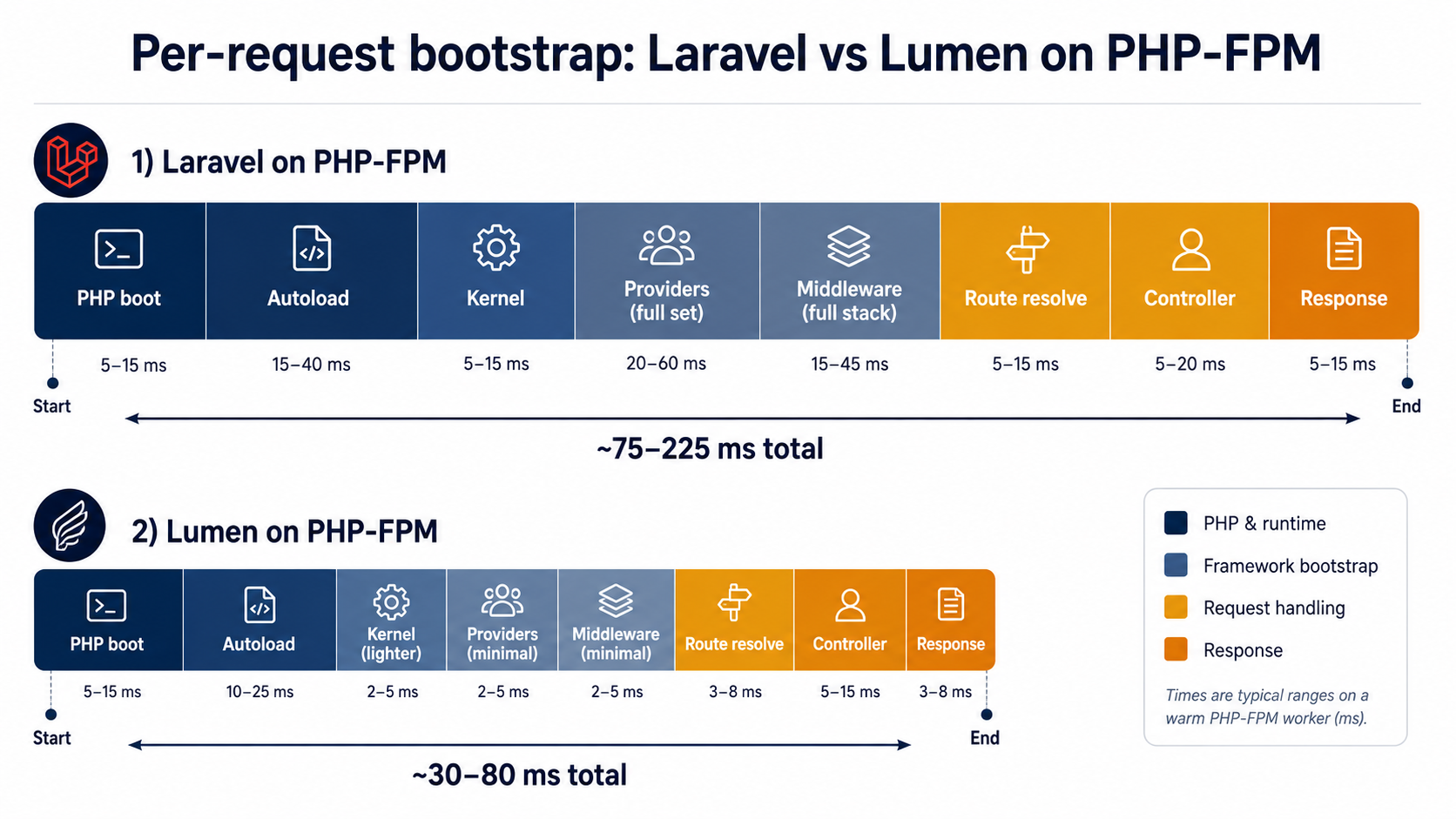
The first and biggest source of Lumen's speed is what happens between "a request hits PHP" and "your controller starts running." On PHP-FPM, every request boots the entire framework from scratch. The interpreter starts, the autoloader wires up, the framework instantiates its kernel, registers providers, builds the container, runs middleware, resolves the route, and hands off to your code. That's a chain of operations that runs on every request. Every. Single. One.
Laravel's default bootstrap chain is built for everything Laravel can do. That's a lot. Even if your endpoint is a one-line "return JSON from the database", the framework still has to be ready for the world where you might use sessions, cookies, the view layer, broadcasting, mail, notifications, queue dashboards, and the rest. The bootstrap path doesn't know your endpoint is small. It boots the full machine just in case.
Lumen's bootstrap is the same idea with most of that ripped out. The kernel is shorter. The default middleware stack is shorter. The service providers it registers eagerly are fewer. Cookies, sessions, encryption middleware, CSRF: none of these are wired up by default in Lumen. If you don't need them (and many APIs don't), you don't pay for them.
You can feel this if you look at the two bootstrap/app.php files side by side. Laravel's recent versions hide most of the wiring behind a clean builder pattern, but the registrations still happen: providers, exception handlers, kernel bindings, console kernel, route loading. Lumen's bootstrap/app.php is genuinely a few dozen lines of explicit setup:
require_once __DIR__.'/../vendor/autoload.php';

(new Laravel\Lumen\Bootstrap\LoadEnvironmentVariables(
    dirname(__DIR__)
))->bootstrap();

$app = new Laravel\Lumen\Application(
    dirname(__DIR__)
);

$app->withFacades();
// $app->withEloquent();              // off by default
// $app->routeMiddleware([ ... ]);    // empty by default
// $app->register(App\Providers\AppServiceProvider::class);

$app->router->group(['namespace' => 'App\Http\Controllers'], function ($router) {
    require __DIR__.'/../routes/web.php';
});

return $app;
The commented lines are the tell. Eloquent is off by default. Route middleware is empty by default. The list of providers you register is whatever you opt into, not whatever the framework decided you might want. If you want sessions, you turn sessions on. If you want auth middleware, you wire auth middleware. The framework's default is no, and you upgrade explicitly.
That's the bootstrap difference in one sentence: Laravel boots ready for anything; Lumen boots ready for what you wrote down.
The size of that gap depends on the request. A heavy controller on either framework will spend most of its time doing the work, and the bootstrap difference fades into noise. A tiny "select-and-serialize" endpoint that finishes in a few milliseconds is where the gap shows up loudly, because the bootstrap is a bigger share of the total. That's exactly the "small API endpoint" workload Lumen was originally pitched for, and it's still the workload where the gap is real.
There is one large asterisk on this whole section: Laravel Octane removes the per-request bootstrap entirely. Octane runs your Laravel app on a long-lived worker (Swoole or RoadRunner), so the framework boots once at worker startup and then handles thousands of requests against the same in-memory app. Once you're on Octane, the bootstrap cost stops being per-request and Lumen's advantage on this axis collapses. The mechanics in this section are about classic PHP-FPM, not Octane.
Fewer Services In The Container
The second place Lumen is faster is in the service container itself. This is subtler than the bootstrap difference, and it matters more than people think.
Laravel's container is a powerhouse. It manages hundreds of bindings, supports contextual binding, tagged services, deferred providers, automatic resolution by type-hint, and a whole tree of singletons that get wired up so the rest of the framework can lean on them. Most of those bindings exist because Laravel has a feature that depends on them: the broadcaster, the mailer, the notification channels, the view factory, the session manager, the cookie jar, the encrypter, the hasher, the password broker, the cache stores, the queue manager, the schedule, the translator, the URL generator. Some of those are deferred (created on first use), but the ones used in the request lifecycle generally aren't.
Lumen's container is the same Illuminate\Container\Container under the hood: same code, same resolution rules. But the list of things bound into it by default is shorter. Sessions don't exist by default. The view factory doesn't bind unless you turn views on. The broadcast manager isn't there. Several mail and notification pieces aren't wired up. The console kernel is a stripped-down version. The result is fewer eager bindings, fewer service providers to walk through at boot, and a smaller surface that needs to be ready before your controller runs.
The practical consequence is two things at the same time. First, the boot cost we talked about above is lower because there are fewer providers to run. Second, when your code does ask the container to resolve something (say, "give me the database manager"), the container has less to walk through and a smaller default graph to traverse. That second effect is small per call, but it adds up across the dozens of resolutions a normal request triggers.
You can see this in how Lumen's Application class is built. It extends the same container, but it knows which services exist and which ones the framework lazily binds the first time you ask:
// Lumen knows that asking for a service that depends on, say,
// the encrypter or the validation factory means it needs to
// register the corresponding provider on demand.
$app['encrypter'];   // registers the encryption provider lazily
$app['validator'];   // registers the validation provider lazily
$app['db'];          // registers the database provider lazily
Laravel doesn't need to do this dance because it registered the providers up front. Lumen avoids the up-front cost by registering on demand, which is faster as long as you don't end up touching every service anyway. Lumen is betting that a typical API request touches a small subset (router, container, db, response) and the rest can stay cold.
The trap, of course, is when you start opting in to more. Once you turn on Eloquent, the database provider gets registered. Once you turn on a session, the session provider, cookie jar, and encryption get registered. Once you wire up a few features Laravel ships by default, your "slim Lumen app" quietly becomes a Laravel-shaped container with extra steps. At that point the cost is back, and the gap shrinks. Lumen is only as light as your honesty about not opting in.
The takeaway: Lumen's container isn't faster: it's the same container with fewer things in it. Speed comes from what's missing, not from clever internals.
Caching: Where The Real Wins Live
Now for the third leg: caching. This is where the "Lumen is fast" story gets honest, because Lumen on its own is fast in a narrow way, but Lumen with caching tuned properly is fast in a way that actually matters.
There are three caching layers that show up in any high-throughput Lumen app, and they pull more weight than the framework choice itself.
1. OPcache
This is PHP-level, not framework-level, and it's the single biggest "my app got faster overnight" knob you can turn. OPcache holds compiled PHP bytecode in shared memory across requests, so the interpreter doesn't reparse every .php file on every request. With OPcache off (which is sometimes the default in dev environments and occasionally misconfigured in prod), every request reads, parses, and compiles every framework file that gets touched. That is a real cost, usually the largest cost in the per-request bootstrap on PHP-FPM.
With OPcache on and warm, the framework code is already compiled and ready. The bootstrap stops being "parse the framework" and becomes "execute the framework." That's the difference between "Lumen is faster than Laravel" and "both frameworks are usable." On a well-tuned host, OPcache often closes more of the Lumen-vs-Laravel gap than the framework choice itself.
A reasonable OPcache configuration in php.ini:
opcache.enable=1
opcache.enable_cli=0
opcache.memory_consumption=256
opcache.interned_strings_buffer=16
opcache.max_accelerated_files=20000
opcache.validate_timestamps=0
opcache.save_comments=1
The line that matters most for production is opcache.validate_timestamps=0. With that off, PHP stops checking whether files changed on disk between requests. You're trusting that a deploy will reset OPcache. That trades convenience for speed, and it's the right trade in production. (Just remember to bust the cache on deploy.)
Lumen's docs have historically called out OPcache as a recommended setup, and the gap people quote in benchmarks is usually measured with OPcache enabled. If your "Lumen is faster" benchmark was run without OPcache, you measured the wrong thing. Turn it on and re-run.
2. Route Resolution
Lumen uses FastRoute (nikic/fast-route) as its router, and FastRoute's design is "compile the route table into a single regex on first use, then dispatch in constant time." That compilation step happens once per process, so on PHP-FPM, technically once per request, since the process serves one request and exits. But the compilation is cheap, and the dispatch is very cheap.
This is also where Lumen and Laravel converge somewhat. Laravel's router uses Illuminate\Routing\Router, which is more featureful (named routes, route model binding, advanced parameter constraints, sub-domain routing) but also heavier per dispatch. Laravel exposes a route:cache command that pre-compiles the routes into a single file you can OPcache, which removes the "build the route tree on each boot" cost. With route:cache warm and OPcache on, Laravel's routing is fast enough that the routing layer rarely dominates.
Lumen doesn't expose a route:cache command in the same shape, partly because its router is already compile-on-use and partly because the framework leans on you to keep your route definitions minimal. The lesson here is: don't try to use a Laravel feature on Lumen and expect it to behave the same way. The frameworks share a lot of code, but the routing layer is one of the genuinely different parts.
If you're squeezing latency on Lumen, the routing optimization isn't "cache the routes": it's "don't define 800 routes." A flat, focused route file is part of the design.
3. Application Cache
This is the layer most engineers reach for first, and it's also the one where Lumen and Laravel are essentially identical. Both frameworks ship with the same cache abstraction (Cache::get, Cache::put, Cache::remember), backed by the same drivers: array, file, database, Redis, Memcached, and (more recently) DynamoDB on Laravel's side. The choice of driver matters far more than the framework. Redis with persistent connections will beat file-cache by a wide margin on any workload that does more than a few cache reads per request.
For an API service, the cache patterns that pay off the most are predictable: cache the result of expensive read queries with a short TTL, cache the result of upstream API calls when the data is reasonably stable, and cache computed responses where the input space is small. A Lumen endpoint that hits the database once per request and serves cached results otherwise will outperform a Laravel endpoint without caching almost regardless of bootstrap differences, because the database round trip is bigger than the framework bootstrap by orders of magnitude.
public function show($id)
{
    $key = "order:{$id}";

    $order = Cache::remember($key, now()->addMinutes(5), function () use ($id) {
        return Order::with('items', 'customer')->findOrFail($id);
    });

    return response()->json($order);
}
If you only do one thing for performance on a Lumen API, do this. Not because Lumen needs it more than Laravel does, but because no framework outruns a cache miss. The framework picks the floor; the cache picks the ceiling.
Putting The Three Together
Bootstrap optimization, fewer services in the container, and tight caching are the three sources of Lumen's real-world speed. The first two are gifts from the framework. The third is something you have to do yourself, and it's the one that matters most in practice. A Lumen app without OPcache and without an application cache is not meaningfully faster than a Laravel app with both. A Lumen app with all three running well is hard to beat on PHP-FPM.
The Honest Punchline
Lumen is faster because it does less. That's the whole story.
It doesn't have a clever runtime, a smarter container algorithm, or a magical route dispatcher. It has the same Illuminate components as Laravel, configured to skip the work that an API doesn't need. The container is the same container. The router is FastRoute, which Laravel also benefits from in spirit (Laravel's router has been heavily optimized over the years, even if it's not literally the same library). The cache abstraction is identical. The database layer is identical. The HTTP request/response handling is the same.
What's different is the defaults. Lumen says no by default. Laravel says yes by default. On PHP-FPM, that "no by default" turns into measurable latency savings per request. On Octane, it doesn't, because the per-request bootstrap is gone either way.
Two things follow from that, and they're worth holding onto.
First: most of the speed you can get on Lumen, you can also get on Laravel: trim the providers, lean on OPcache, configure an application cache, and be honest about what your endpoints actually need. The gap isn't a wall. It's a head start that you can close from the other side.
Second: the way to make a Lumen app actually slow is to opt back into everything. A Lumen app with sessions, cookies, encryption middleware, every Eloquent feature, Telescope-style introspection, and a 200-line route file is just a Laravel app with worse ergonomics. The framework's speed advantage was "do less by default," and once you opt out of "less," there's nothing left.
If you take Lumen seriously as a performance tool, take the discipline that comes with it. Keep the middleware stack small. Keep the providers minimal. Keep the routes focused. Turn on OPcache. Use a real cache backend. Measure the request path, not the framework brand on the box. That's where the speed lives.