Every other LinkedIn post these days is some flavor of "AI agents will replace senior engineers within 18 months." Then somebody who actually maintains a production system reads it, sighs, and goes back to figuring out why the queue worker stopped acknowledging messages after the last deploy.
The hype isn't entirely wrong. AI does change the work. It writes code faster than any human. Agents really can open pull requests, and a few of them are genuinely good. Boilerplate that used to eat an afternoon now takes ten minutes. Pretending otherwise sounds dishonest.
What's harder to see from a LinkedIn post is what AI doesn't do. It doesn't decide what to build. It doesn't notice that the polished diff in front of you quietly weakens an authorization check. It doesn't carry the pager when the new feature meets real traffic. The pieces of the job that actually decide whether software ships safely — those are the pieces that get more valuable when the typing-fast part gets cheap.
Code Is Not The Whole Job
A lot of the panic comes from a category mistake — assuming software engineering means "typing code." It looks that way from outside. The screen has code on it, the PRs have code in them, the output is code. So if AI types code, AI does the job. Right?
Code is the visible artifact. The job is everything around it. Understanding what the user actually meant when they said "we need a notification system." Shaping the requirement before any line gets written, because the wrong requirement turns into the wrong feature regardless of how clean the code looks. Designing boundaries that won't crack two years from now. Reviewing changes for what they don't say. Debugging at 2am during a partial outage when half the stack trace is lying to you. Protecting customer data. Making the system understandable for whoever inherits it after you leave.
Code is bricks. Useful, necessary, real. A pile of bricks isn't a building — and the part that turns bricks into a building is mostly not the bricks.
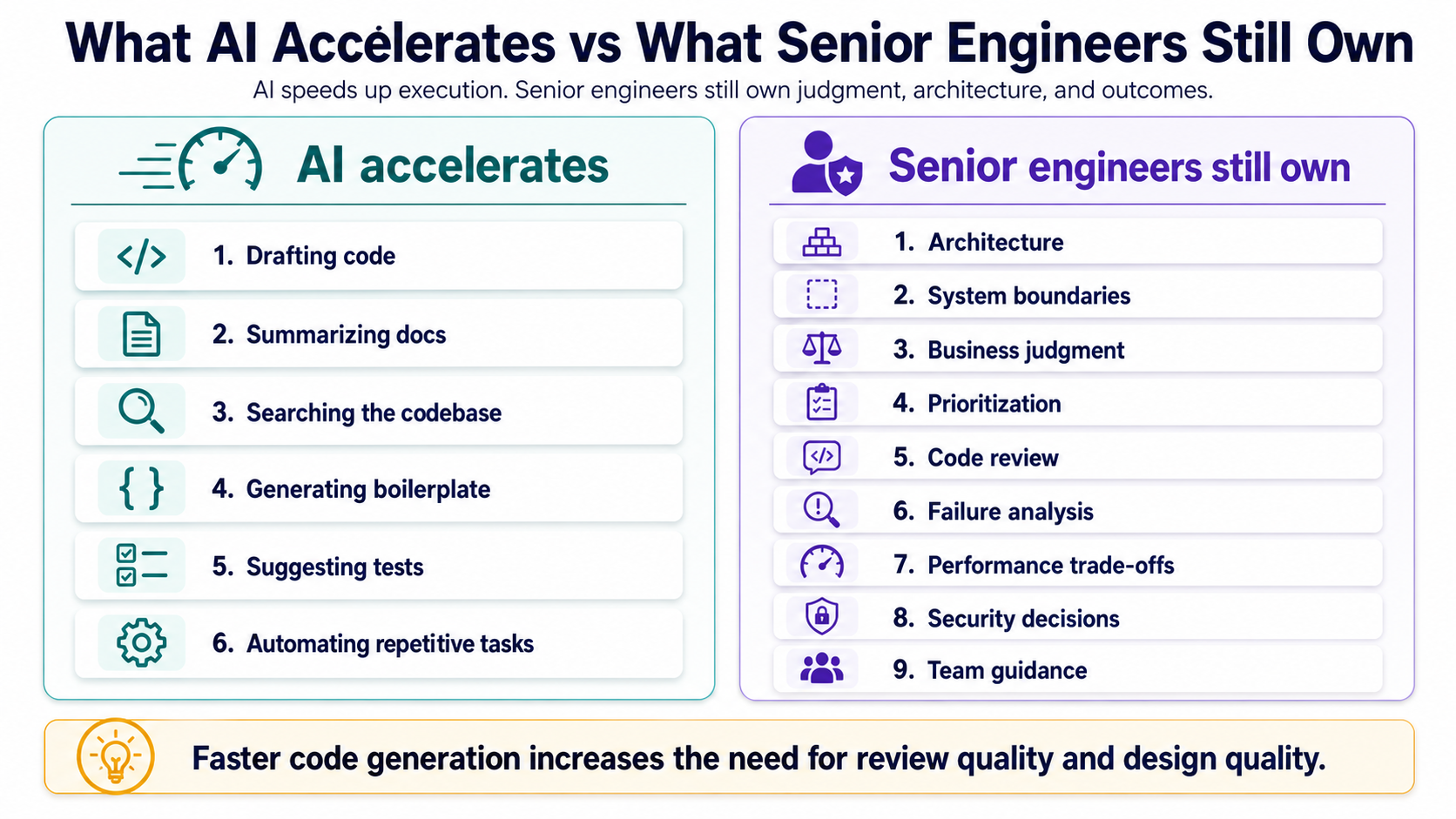
What AI Can Speed Up
- Boilerplate. DTOs, scaffolded tests, throwaway components, doc stubs — the kind of repetitive shape-shifting that used to eat half a sprint. AI usually nails it on the first try.
- Exploration. "Where in this codebase does X happen?" — questions that used to mean an hour of grep + git-blame archaeology. AI gives you a workable map in 30 seconds.
- Drafting. First-pass PR summaries, draft migration notes, the initial sketch of a test file. Anywhere "good-enough first draft" beats "blank page for two days."
- Mechanical refactors. Bulk rename across 80 files. Extract this method into a helper. Reorganize a folder structure. Tedious for humans, trivial for the model.
- Debug assistance. Hand it the logs, the stack trace, the relevant snippet — get back a list of plausible causes and next checks. Often wrong. Often a useful starting point anyway.
That's a real shift. But speed without direction is just faster wandering, and a lot of teams are about to learn this on a deadline.
Judgment Becomes More Important
When the cost of producing code drops, the cost of bad code drops with it — and that's the part the hype misses. You used to ship one questionable design per sprint because writing it took effort. Now you can ship five before lunch. Speed multiplies whatever direction you're already pointed in, including the wrong one.
A senior engineer is the person who knows when not to add another microservice. When not to reach for a queue. When not to chase a perfect abstraction. When the boring obvious solution is actually the safest call, even if it isn't the one the model picked. AI is happy to generate five options in under a minute. Someone still has to look at those five, pick one, and explain the choice to the people who'll have to live with it.
Think of AI as a very fast junior architect with an enormous stack of blueprints. You can request more sketches than you've ever had access to. You still need somebody who knows which walls hold the building up.
Senior Judgment Shows Up In Questions
- What problem are we actually solving? Half the time the user's request is a symptom — they want feature X because process Y is broken, and shipping X just locks Y in. Knowing when to push back instead of building isn't a skill the model has yet.
- What does this look like when it fails? It works on the demo. It works in staging. Then it gets retries, latency spikes, partial outages, a database under load — and every assumption that wasn't tested becomes a 3am page.
- What should stay boring? Not every piece of code deserves its own service, its own event bus, its own agentic workflow. Most code earns its keep by being unremarkable.
- What's the migration path? Production systems almost never allow a clean rewrite. The plan that doesn't account for the existing data, the existing customers, and the existing dependencies isn't a plan — it's a wish.
- What does this cost to operate? Every abstraction pays maintenance rent. Every new dependency invites its own bugs. Total ownership cost of a "small feature" is usually 3-5× the build cost, and that bill arrives over the next two years.
AI is good at answering inside a frame. Seniors earn their pay by deciding which frame is the right one to begin with.
Architecture Is A Trade-Off Machine
Architecture isn't drawing boxes. Architecture is deciding which pain you'd rather live with.
Faster delivery now or stricter boundaries later? Eventual consistency or synchronous simplicity? Shared database that's easy today or service boundaries that help teams scale tomorrow? You don't get to skip the question — you just get to pick which version of the bill comes due, and when.
AI can explain those trade-offs in lucid detail. It will name the technical pros and cons faster than any architect on the team. But it doesn't carry the pager. It doesn't own the roadmap. It doesn't know that the CFO blocked your database migration project last quarter, that a sister team is mid-rewrite of the same module, or that the original author of "that shared utility" still works there and has Opinions. The technical answer is rarely the whole answer in a real organization.
A Simple Example
Picture an AI helpfully suggesting that the welcome email get pushed onto a queue:
public function register(array $data): User
{
    $user = User::create($data);

    SendWelcomeEmail::dispatch($user->id);

    return $user;
}
Technically? Genuinely a reasonable change. The slow operation gets isolated, the signup endpoint stays snappy, the user gets a clean response. Everyone happy.
But a senior engineer reads that diff and starts asking the questions the AI didn't think to surface. What happens if the job fails — does the user get welcomed eventually, or do they sit in limbo forever? Is the welcome email part of the activation flow, or is it cosmetic? If the worker retries, will the user get two emails (because the first one did send before the worker crashed mid-job)? Is the queue actually monitored, or is "send to queue" effectively "send to /dev/null on Sundays"? Does support rely on the email being instant, because they walk new users through it on chat?
The code change is six lines. The operational reality lives in the answers to those six questions, none of which are in the diff.
Review Becomes A Core Skill
Here's the unsettling thing about AI-generated code: it almost always looks right. Variable names sensible. Structure clean. Nothing obvious to push back on at the surface level. And then a week later you find out the change quietly altered behavior nobody intended.
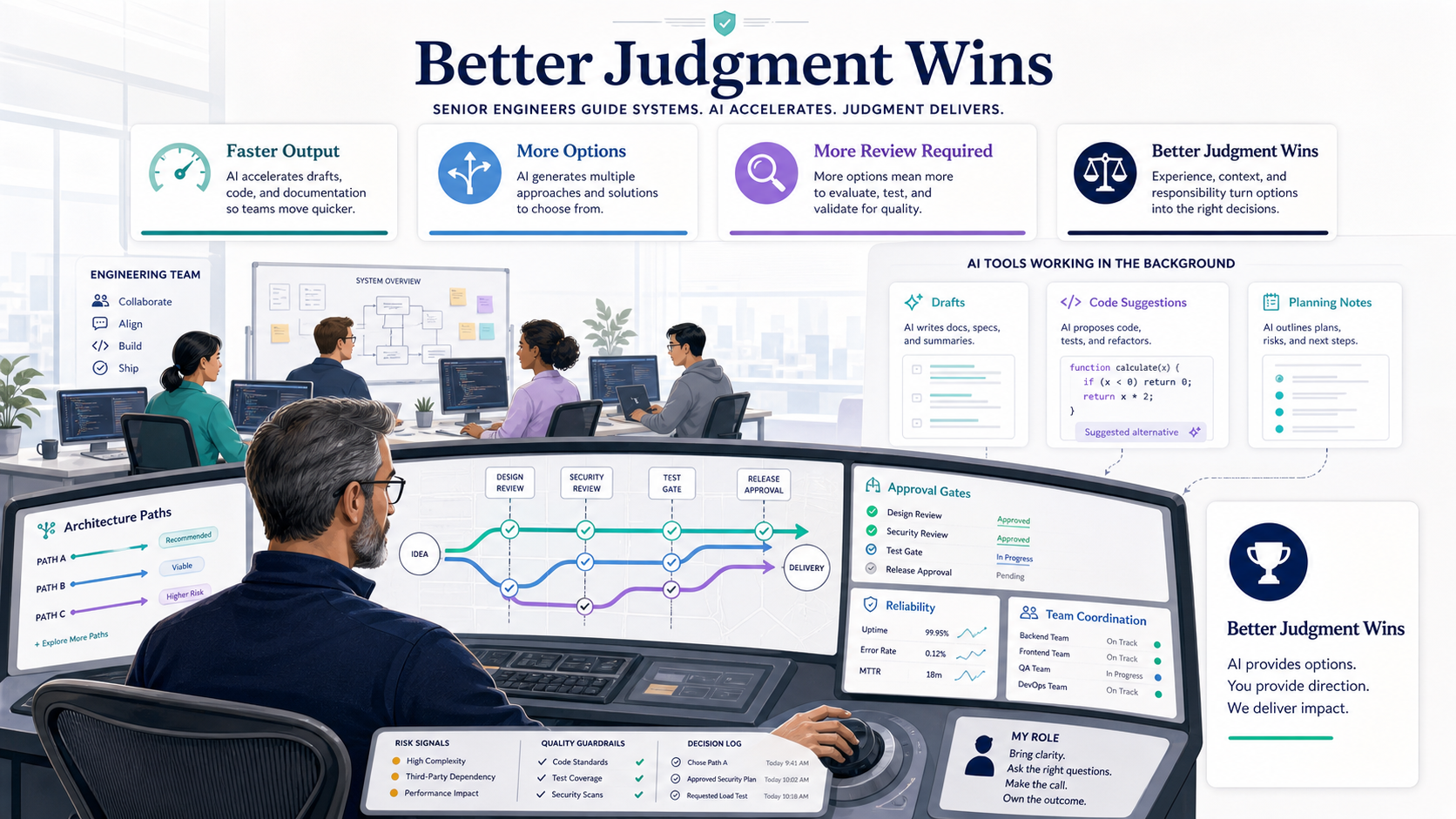
Which means code review gets more important when AI is producing more code, not less. A senior reviewer isn't reading for formatting — that's what linters are for. They're reading for behavior changes, security boundaries, edge cases, data integrity, observability, and whether this change actually fits the system it's joining. The kinds of things AI is structurally bad at noticing in its own output.
Some patterns that show up in PR reviews more often than they should: a beautifully refactored method that silently bypasses an authorization check, because the AI moved the guard into a base class that happens to not get called for that route. Caching added without an invalidation strategy, because nobody specified one. A "fix" for a failing test that quietly changes the production behavior the test was supposed to protect in the first place.
What Senior Review Looks For
- Behavior changes hidden inside refactors. A "rename this variable" PR can also change which branch fires when the input is null. An "extract this method" can swap implicit casting for strict equality. Did the user experience actually change, even if the diff says it shouldn't have?
- Security boundaries. Permissions, secrets, user data, third-party tokens — does this PR move any of those, even slightly? AI doesn't reason about authorization graphs the way humans do; it pattern-matches on what nearby code looks like, which is exactly how middleware quietly gets bypassed.
- Data integrity. Writes that should be atomic, retries that should be idempotent, duplicates that shouldn't be possible. Easy to get wrong on a model-generated diff. Expensive to find out about in production.
- Operational visibility. When this breaks at 3am — and eventually something breaks at 3am — can you debug it from the logs you have, or did the model strip the context that would have told you what failed?
- Maintainability for the next engineer. Will the next person to open this file have any idea why the code exists? AI tends toward locally-clever code that becomes globally-confusing six months later, and the original author isn't around to explain.
A useful review prompt can help, but it doesn't replace review:
Review this diff for:
- authorization issues
- hidden behavior changes
- missing tests
- race conditions
- unsafe retries
- observability gaps
The AI might catch real problems. Great. Then the human reviewer still makes the call.
Seniors Turn AI Into A Team System
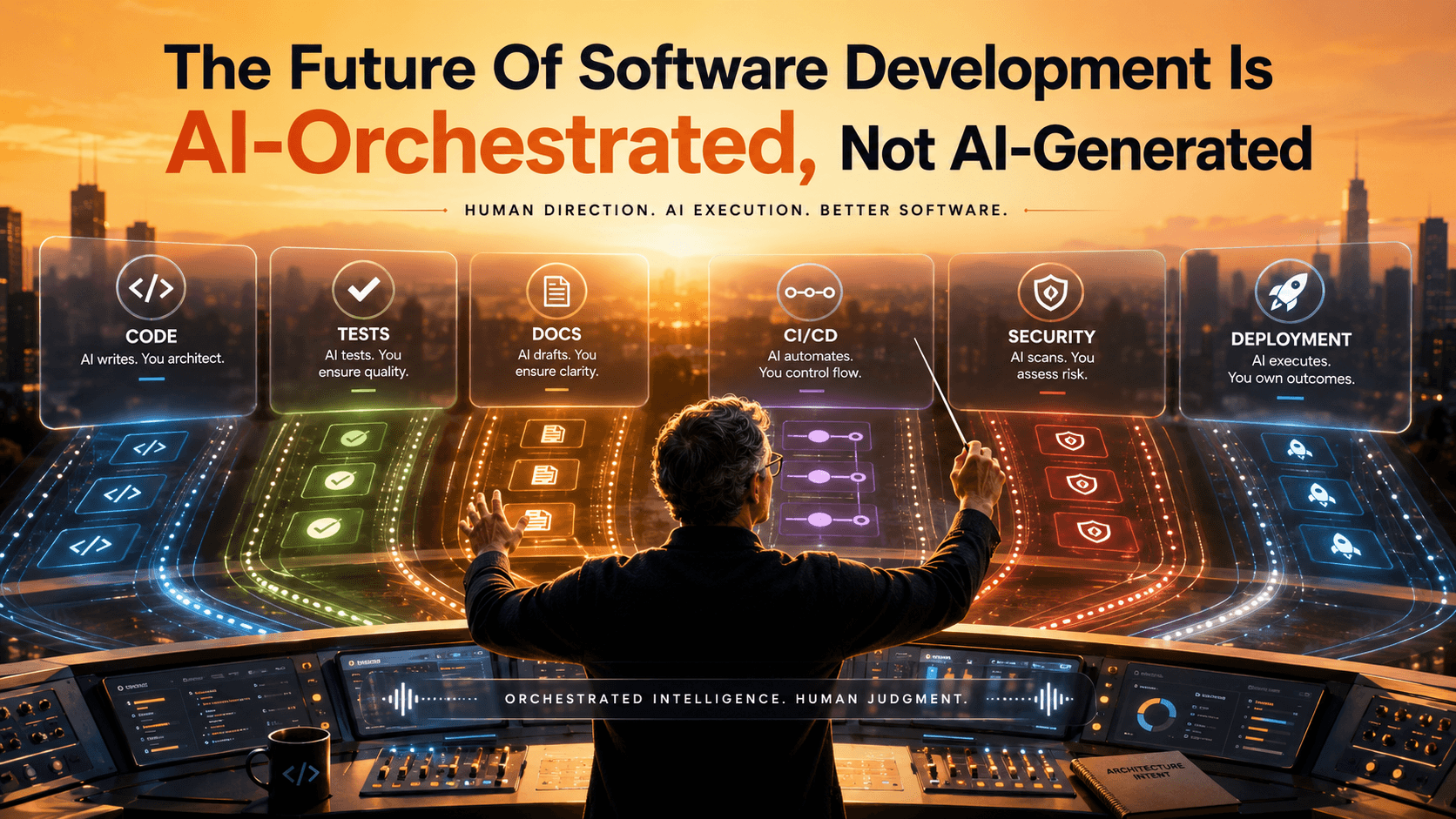
The biggest AI gains over the next few years aren't going to come from one wizard developer with a clever prompt library. They're going to come from teams building the boring infrastructure around AI use — shared rules, context templates, agreed-upon safe commands, review checklists that explicitly call out AI-generated code, test expectations that hold whether a human or a model wrote the change, and permission boundaries the agent isn't allowed to cross.
That's just engineering process applied to a new tool. Boring? Sure. Useful? Enormously. The teams treating AI as a personal productivity hack are going to look amateur next to the teams treating it as a team-level capability with real guardrails around it.
A few things worth investing in early. Project-level AI rules — a CLAUDE.md or AGENTS.md at the repo root that tells agents how the codebase actually works (the conventions that aren't in the docs but every team member knows). Standard verification scripts, so "I tested it" means the same thing whether a human or an agent ran the checks. A bias for small diffs — AI is happy to generate huge changes, but seniors should push for the version that fits in one reviewable pass. Captured decisions — the why behind a trade-off, not just the what of the change, because that's the context the next person (or the next AI session) will be missing. And time spent teaching the team to use AI safely instead of gatekeeping it; nothing produces shadow-IT prompts faster than a senior who refuses to engage with the tool.
A small example of a team rule file:
# Project AI Rules

- Analyze before editing.
- Keep diffs small.
- Do not change authorization logic without approval.
- Add tests for behavior changes.
- Run `composer test` before marking work complete.
This is where senior engineers become force multipliers. They don't just use AI. They design how AI is allowed to participate.
Final Tips
I don't think AI makes senior engineers less valuable. I think it makes shallow seniority a lot easier to spot. If your value was typing speed and pattern recall, AI is uncomfortable pressure — and the gap is going to widen, not close. If your value is judgment, architecture, careful debugging, and the kind of review that catches the subtle stuff, AI is a lever that makes you more effective per hour, not less.
The future senior engineer probably looks less like a code factory and more like a systems thinker who knows how to direct humans and models toward outcomes that ship safely and don't blow up in the night. The job isn't going away. It's just going to demand more of the parts that were always the actual job.
Stay sharp, keep learning, and use the tools without surrendering your judgment 👊