The future of software development is not "AI writes all the code."
That idea is too simple.
Software engineering is not only code generation. It is understanding requirements, making trade-offs, protecting users, designing systems, testing behavior, maintaining old decisions, debugging production, reviewing risk, and communicating with other humans.
AI can help with many of these tasks.
But the most valuable future is not AI-generated software.
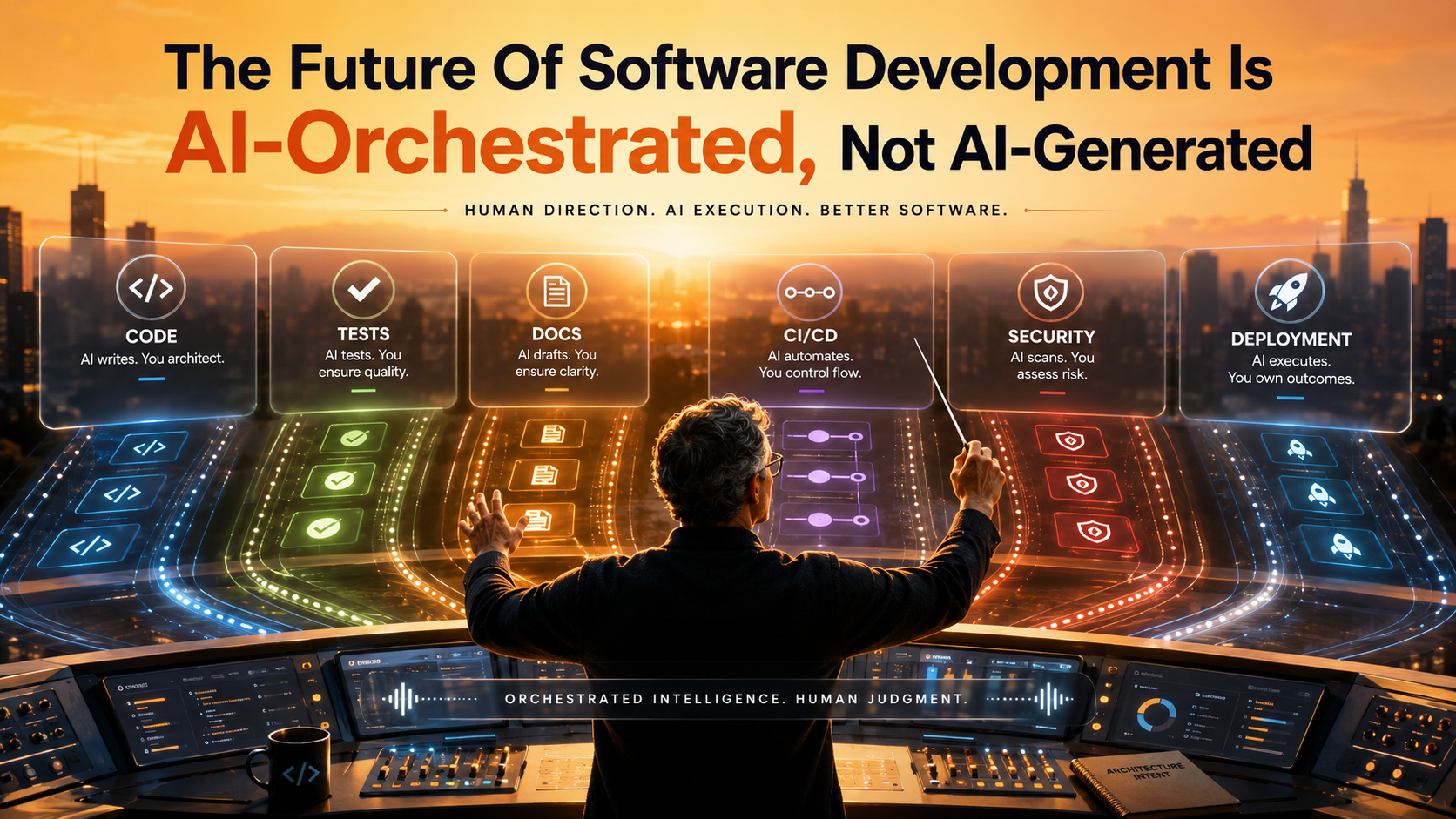
It is AI-orchestrated software development.
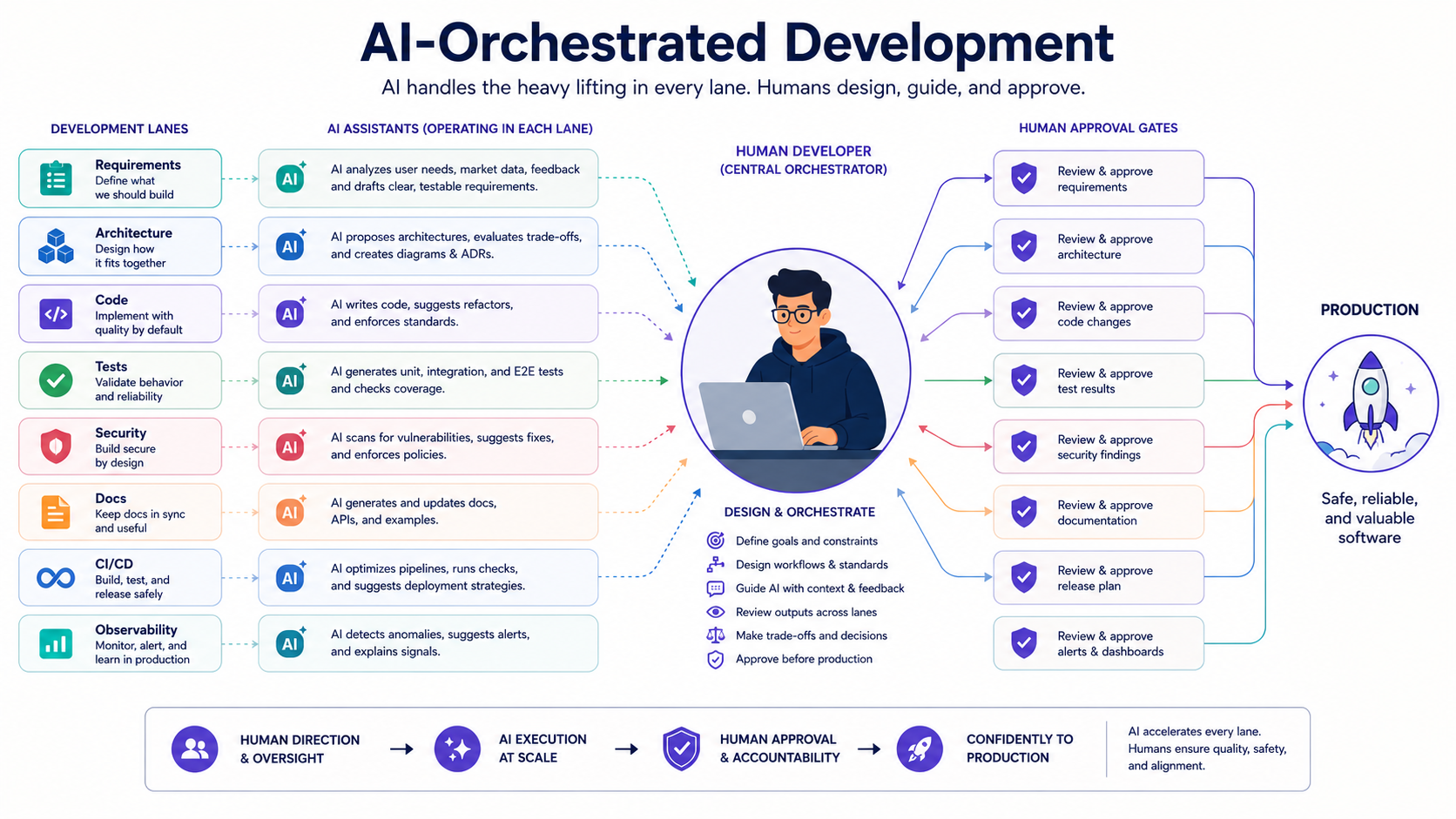
That means developers design workflows where AI can help execute parts of the process, while tests, documentation, CI/CD, observability, and human review keep the system safe.
The developer does not disappear.
The developer becomes more like a workflow designer, systems thinker, and final decision-maker.
That may sound less dramatic than "AI replaces programmers."
It is also much more realistic.
Generated code is only one small part
Code generation is useful.
AI can write a controller, a migration, a test draft, a TypeScript type, a React component, or a CLI command. That is helpful.
But code generation alone does not solve the hard parts.
A generated function does not know whether the business rule is correct.
A generated migration does not know your table size.
A generated API endpoint does not know your authorization model unless you provide it.
A generated test may confirm the implementation instead of the behavior.
A generated summary may sound confident while missing the risky part of the diff.
So the core question changes.
Instead of asking:
Can AI generate this code?Ask:
Can we design a workflow where AI helps safely move this change from idea to production?That is a better engineering question.
Developers become workflow designers
A workflow designer thinks in steps.
For example, a safe feature workflow may look like this:
1. Read ticket
2. Identify affected services
3. Draft implementation plan
4. Review architecture risk
5. Create branch
6. Make small code change
7. Add behavior tests
8. Run static analysis
9. Run security checks
10. Update documentation
11. Create PR summary
12. Human review
13. Merge through CI/CD
14. Monitor production signals
AI can help in many steps. But the workflow defines the boundaries.
A developer can encode those boundaries in prompts, scripts, CI checks, repository instructions, and approval rules.
For example:
ai_workflow:
  task_type: feature
  allowed_steps:
    - analyze_ticket
    - propose_plan
    - edit_code
    - add_tests
    - update_docs
    - open_pull_request
  required_checks:
    - unit_tests
    - static_analysis
    - secret_scan
    - security_review_for_auth_or_billing
  human_approval_required_for:
    - database_migration
    - payment_logic
    - authentication_logic
    - production_deployment
This is not science fiction. It is normal engineering applied to AI.
AI as an execution assistant
The best AI workflows treat AI as an execution assistant, not as an owner.
An execution assistant can:
- summarize a ticket
- identify relevant files
- draft a plan
- suggest tests
- write boilerplate
- explain a failing test
- update documentation
- prepare a PR summary
- compare behavior before and after
But ownership stays with the team.
That distinction matters.
If AI writes a broken authorization rule, the user does not blame the model. They blame the product. They blame the company. And they are right.
The team owns the result.
So AI should be integrated like any other powerful automation: useful, constrained, observable, and reviewable.
Tests become safety rails
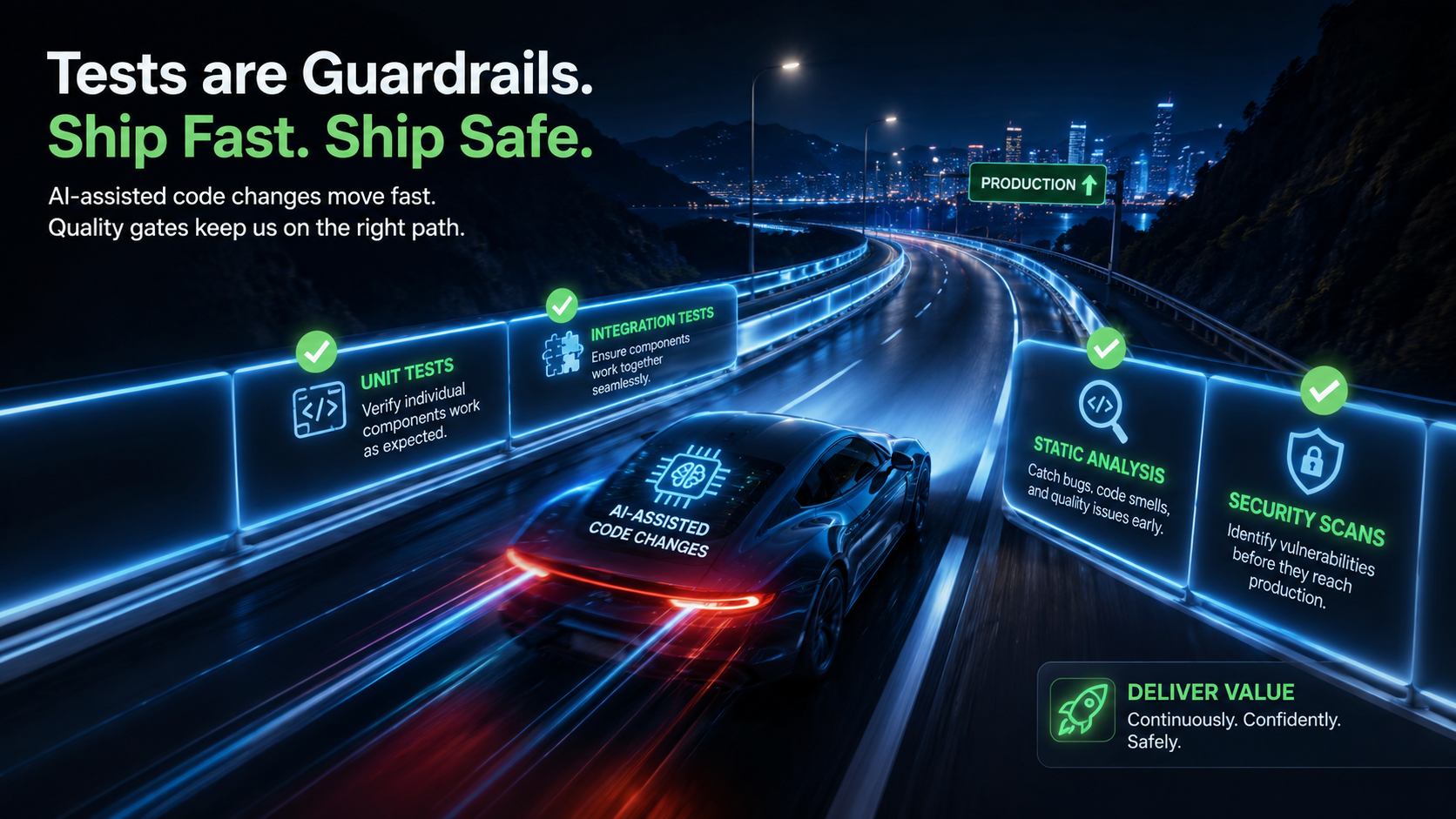
In AI-orchestrated development, tests become even more important.
Why?
Because AI can produce code faster than humans can deeply review it.
Without tests, fast generation becomes fast risk.
A good workflow asks the AI to reason about behavior before implementation:
Before writing code, list the behavior that must be true after this change.
Then list tests that would prove the behavior.
Do not implement until the behavior list is clear.
For example:
Feature: inactive users are logged out after 30 minutes.

Expected behavior:
- Active users remain logged in.
- Inactive users are logged out after 30 minutes.
- Remember-me sessions are not changed.
- API requests receive 401 after timeout.
- Web requests redirect to login after timeout.
Then tests can follow:
public function test_inactive_web_user_is_redirected_to_login(): void
{
    Carbon::setTestNow(now());

    $user = User::factory()->create();

    $this->actingAs($user)
        ->get('/dashboard')
        ->assertOk();

    Carbon::setTestNow(now()->addMinutes(31));

    $this->get('/dashboard')
        ->assertRedirect('/login');
}

public function test_active_user_session_is_extended(): void
{
    Carbon::setTestNow(now());

    $user = User::factory()->create();

    $this->actingAs($user)
        ->get('/dashboard')
        ->assertOk();

    Carbon::setTestNow(now()->addMinutes(20));

    $this->get('/dashboard')
        ->assertOk();
}
These tests protect the workflow.
AI can suggest them. AI can draft them. But the test runner verifies them.
Documentation becomes memory
Software teams forget things.
They forget why a service was split. They forget why a queue has a delay. They forget why a database column cannot be removed. They forget which external API has strange retry behavior.
AI makes documentation more valuable because AI needs context.
If your documentation is outdated, your AI assistant will reason from outdated information.
If your architecture decision records are clear, your AI assistant can follow them.
Good documentation becomes memory for both humans and AI.
For example, an Architecture Decision Record can be simple:
# ADR-014: Use asynchronous payment retries

## Context

Payment gateway timeouts can happen even when the payment eventually succeeds.
Calling the gateway repeatedly during the user request increases latency and can create duplicate attempts.

## Decision

We will enqueue recoverable payment failures and retry them asynchronously.
Hard declines will not be retried.

## Consequences

- Checkout response is faster during gateway instability.
- Payment status may remain pending for a short time.
- Support tools must show retry status.
- Retry jobs must be idempotent.
This document helps humans. It also helps AI.
A Documentation Agent can update docs after a code change, but it should be grounded in the diff and tests. It should not invent design history.
CI/CD becomes enforcement
AI can suggest. CI/CD enforces.
A healthy AI-orchestrated workflow uses CI/CD as the gatekeeper:
name: production-safety

on:
  pull_request:

jobs:
  verify:
    runs-on: ubuntu-latest

    steps:
      - uses: actions/checkout@v4

      - name: Install dependencies
        run: composer install --no-interaction --prefer-dist

      - name: Run tests
        run: php artisan test

      - name: Run static analysis
        run: vendor/bin/phpstan analyse

      - name: Run code style
        run: vendor/bin/pint --test

      - name: Scan secrets
        run: gitleaks detect --source . --no-git
You can add AI-generated explanations on top of this, but the checks remain deterministic.
If tests fail, the PR is not ready.
If static analysis fails, the PR is not ready.
If a secret is detected, the PR is blocked.
AI should not override these gates.
Human review remains final authority
Human review will change, but it will not disappear.
Reviewers may spend less time asking "what changed?" because AI can summarize the diff.
They may spend more time asking better questions:
Does this behavior match the product requirement?
Is this the right abstraction?
Will this be understandable six months from now?
What happens during partial failure?
What happens at scale?
What happens when a user does something unexpected?
AI can help prepare the review. It should not replace accountability.
A good AI PR summary says:
Reviewer focus:
- Confirm the retryable gateway error list matches provider behavior.
- Check that retry jobs are idempotent.
- Verify the new pending status is handled in the support dashboard.
That makes the human reviewer stronger.
Observability closes the loop
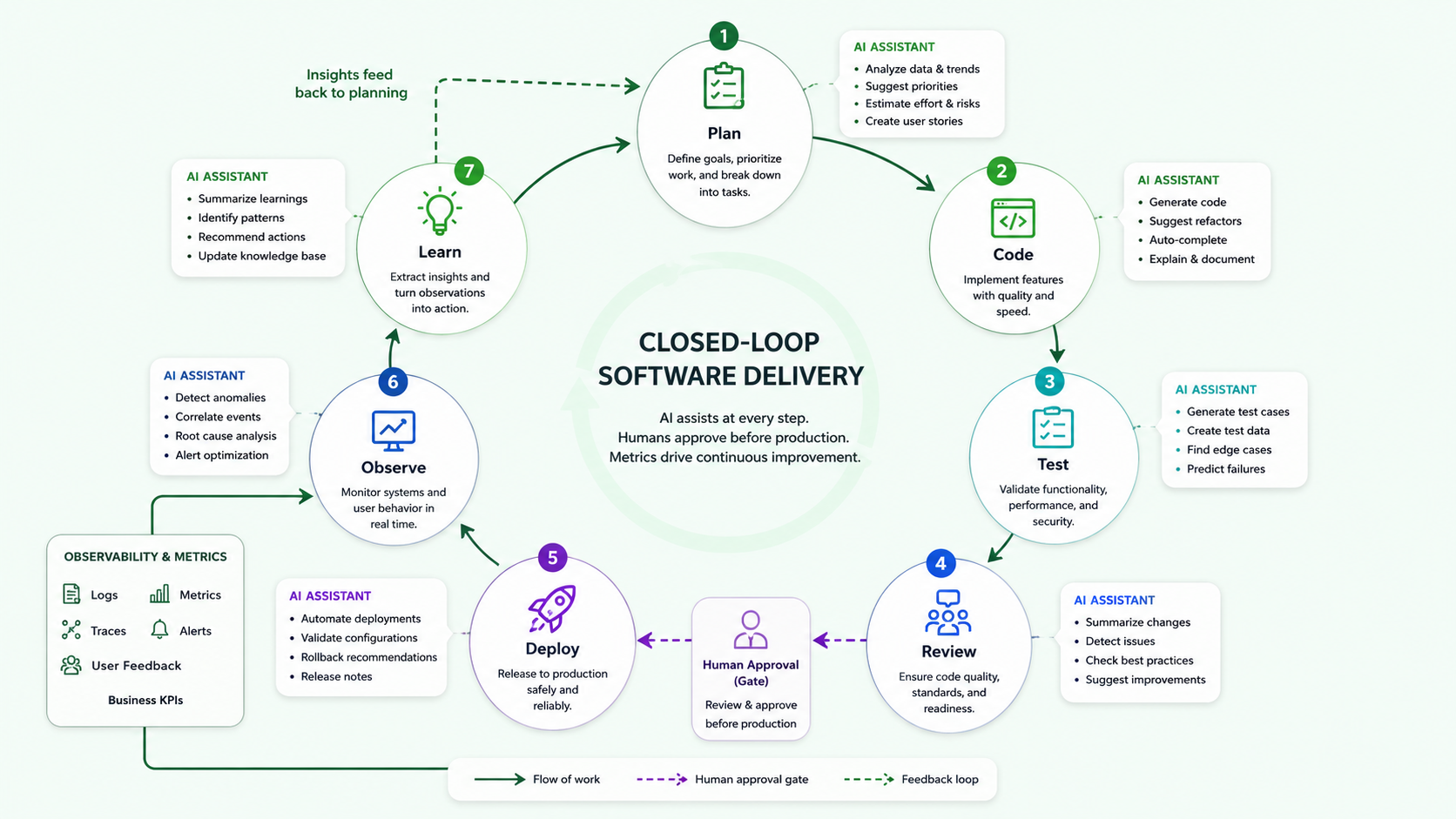
The workflow does not end at merge.
Production tells the truth.
If an AI-assisted change causes more errors, higher latency, failed jobs, or support tickets, the team needs to know.
Track production signals:
type ReleaseSignal = {
  pullRequestId: string;
  deploymentId: string;
  errorRateBefore: number;
  errorRateAfter: number;
  p95LatencyBeforeMs: number;
  p95LatencyAfterMs: number;
  failedJobsAfter: number;
  rollbackRequired: boolean;
};
This helps teams measure whether AI-assisted workflows are actually safe.
If AI-generated PRs have higher rollback rates, slow down.
If AI-assisted test generation reduces escaped bugs, expand it.
Measure reality.
The role of prompts will change
Prompts will become more like configuration and less like casual chat.
Teams will version prompts. They will test prompts. They will review prompt changes. They will document prompt intent.
A prompt file may look like this:
# pr-summary.prompt.md

You are a pull request summary assistant.
Base your answer only on the provided diff, CI results, and repository instructions.
Do not claim tests passed unless CI data says they passed.
Do not say a PR is safe to merge.
Always include:
- changed behavior
- risky files
- tests found
- tests run
- missing tests
- reviewer focus
- unknowns
This prompt should live in the repository.
Changes to it should be reviewed like code.
Why? Because prompts affect production behavior.
The future team shape
Future engineering teams may have new responsibilities:
- AI workflow owner
- prompt reviewer
- evaluation dataset maintainer
- AI observability owner
- security reviewer for tool access
- documentation quality owner
These may not become full-time roles in every company. But the responsibilities will exist.
The teams that benefit most from AI will not be the teams that blindly generate the most code.
They will be the teams that design the best systems around AI.
A practical starting point
You do not need a fully autonomous development system.
Start small:
1. Use AI to explain legacy code.
2. Use AI to draft test cases.
3. Use AI to summarize PRs.
4. Add deterministic CI checks.
5. Add repository-specific AI instructions.
6. Track whether AI output saves review time.
7. Expand only where quality improves.
This is enough.
Do not start with "AI should implement entire Jira tickets."
Start with workflows where AI helps humans make better decisions.
Final thoughts
The future of software development is not a world where developers disappear and AI generates perfect systems from vague tickets.
The future is more practical.
Developers will design workflows. AI will help execute parts of those workflows. Tests will act as safety rails. Documentation will become shared memory. CI/CD will enforce rules. Observability will show what happened. Human review will remain the final authority.
That is AI-orchestrated development.
It is less magical than the hype.
It is also much more powerful.
Because software engineering was never only about typing code.
It was always about building reliable systems with clear thinking, feedback loops, and responsibility.
AI does not remove that.
It makes it more important.
Further reading
- OpenAI Agents SDK tracing: https://openai.github.io/openai-agents-python/tracing/
- OpenTelemetry documentation: https://opentelemetry.io/docs/
- GitHub Copilot documentation: https://docs.github.com/copilot