You've written this form fifteen times. A useState for every field. A useState for the loading flag, another for the error message, another for the success message. A fetch to /api/orders that you have to remember to wrap in a try/catch, with a Content-Type header you almost always forget on the first attempt. A redirect after success that flickers because the cache still shows yesterday's data. A duplicate of the same Zod schema living in two folders, one for the API route, one for the form, and a slowly-building suspicion that one of them is out of date.
Then Server Actions show up, and your form becomes this:
import { createOrder } from './actions';

export default function NewOrderPage() {
  return (
    <form action={createOrder}>
      <input name="customer" required />
      <input name="amount" type="number" required />
      <button>Create order</button>
    </form>
  );
}
No fetch. No useState. No client component at all. The action prop accepts a function, and Next.js wires the form submission through to a server-side handler that lives next to your page. It feels great the first time you do it.
It also feels great the tenth time. Then you start running into the part nobody puts in the demo. Why is this action callable from anywhere? Where did my auth check go? Why does this random click handler also refresh half the dashboard? How do I version this when our mobile app needs the same endpoint?
Server Actions are one of the cleanest features Next.js has shipped in years, and one of the easiest ways to accidentally turn every form on your site into a small RPC framework with implicit cache behavior. This article is the practical version, what they actually are, where they pay rent, and the places they hide complexity instead of removing it.
What A Server Action Actually Is
Strip the marketing away and a Server Action is three things glued together:
- A function with a
'use server'directive that Next.js compiles into a server-side handler. - A POST endpoint at a route Next.js generates for you, identified by an opaque ID.
- A client stub that the React runtime injects when the action is referenced from a client component or a form, it knows how to serialise arguments, post them, and re-render with the result.
You write the function. Next.js does the wiring. The handler runs on the server with access to your database, your secrets, your session cookie, anything else the server has. The form (or button, or hook) talks to it as if it were local.
'use server';

import { db } from '@/lib/db';
import { revalidatePath } from 'next/cache';
import { redirect } from 'next/navigation';

export async function createOrder(formData: FormData) {
  const customer = String(formData.get('customer') ?? '');
  const amount = Number(formData.get('amount') ?? 0);

  await db.orders.insert({ customer, amount });

  revalidatePath('/orders');
  redirect('/orders');
}
The 'use server' directive at the top of the file marks every export as an action. You can also write inline actions inside a server component:
export default function NewOrderPage() {
  async function createOrder(formData: FormData) {
    'use server';
    const customer = String(formData.get('customer') ?? '');
    // …
  }

  return <form action={createOrder}>{/* … */}</form>;
}
Both forms work. The first is more common as soon as the action grows past a couple of lines, because file-scoped actions can be imported into client components, which is where the surface gets interesting.
The function signature is constrained. Arguments must be serialisable across the network, FormData, primitives, plain objects, and certain React types. The return value must be serialisable too. You can't pass a Node Buffer, a class instance with methods, or a closure over a database connection.
That's the contract. Everything else in this article is a consequence of it.
The Cleaner Forms Case
The case for Server Actions starts with what you delete.
The first thing that vanishes is the API route file. A form that used to be three things, app/api/orders/route.ts, the client component with useState and fetch, and the duplicated validation schema, collapses into one. Action lives next to the page that calls it. There's exactly one definition of "how to create an order from the web."
The second thing that vanishes is the manual state ladder. You no longer need useState for pending, error, and success. React's form integration handles submission, and the useFormStatus hook reads the current state from anywhere inside the form:
'use client';

import { useFormStatus } from 'react-dom';

export function SubmitButton() {
  const { pending } = useFormStatus();
  return (
    <button disabled={pending}>
      {pending ? 'Creating…' : 'Create order'}
    </button>
  );
}
The third thing that vanishes is the redirect dance. Inside a Server Action you can call redirect('/orders') directly. Next.js intercepts the response and tells the client to navigate. No useRouter, no manual router.push after a successful response, no race between the navigation and the cache refresh.
What you gain on top of that:
- Type-safe inputs from the page side: when an action takes typed arguments (not just
FormData), TypeScript shows you the same signature whether you call it from a form, a button, or astartTransition. - Free-feeling progressive enhancement: forms submit before JavaScript loads. We'll get to the caveats; the default case really does work.
- Server-side composition: actions can call other actions, share helpers, and live in the same module graph as your data layer. No fetch round-trip between two pieces of code that already live in the same process.
For internal CRUD, admin tools, dashboards, the eighty-percent of forms in any business app, this is a genuine improvement. The amount of boilerplate per form drops by half. The number of places the validation schema lives drops from two to one. The number of failure modes you can think of in the first thirty seconds also drops, because the round-trip is invisible.
That's the honest pitch. Now the bill.
The Hidden Coupling Case
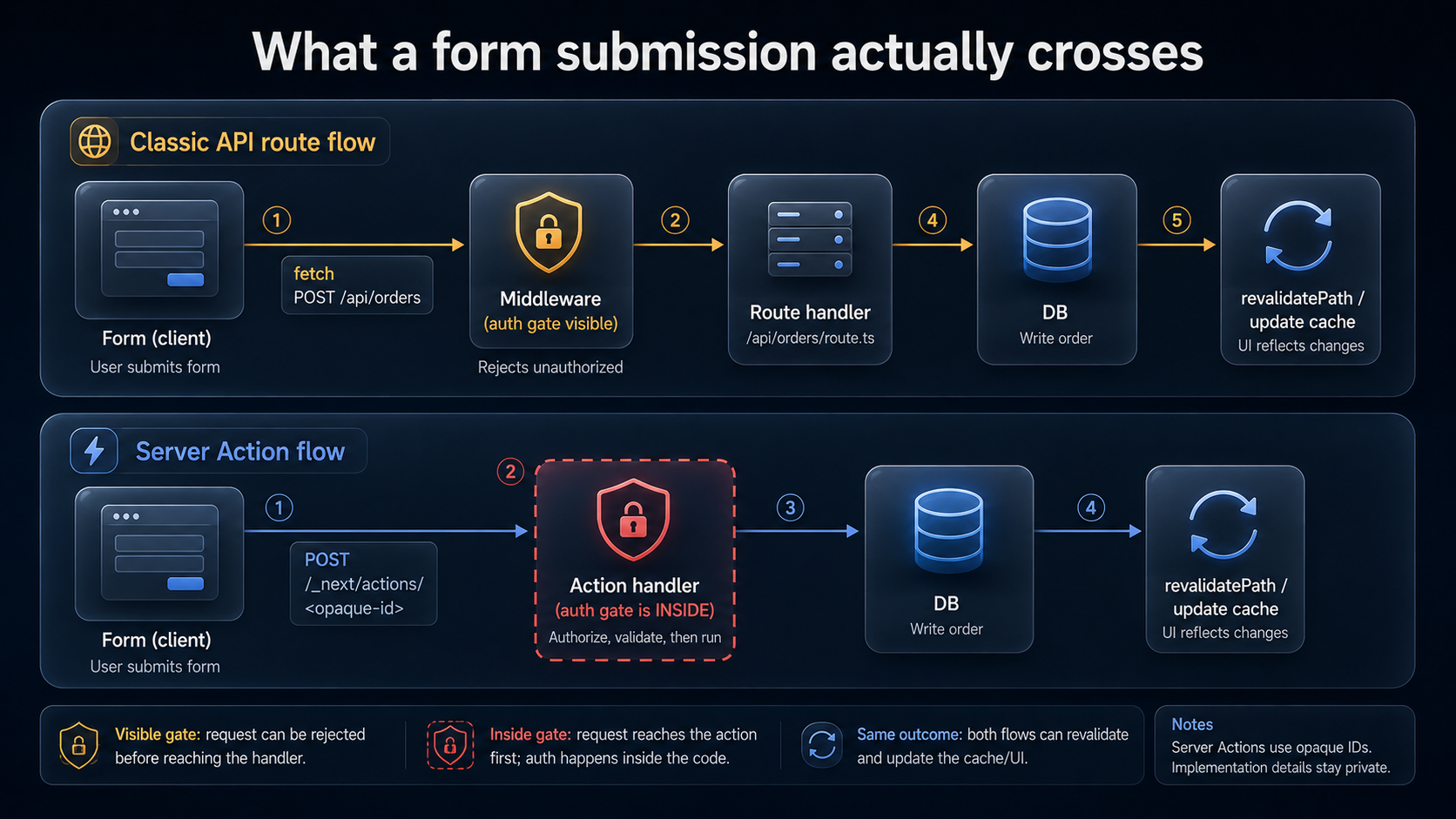
The thing nobody tells you the first week is this: a Server Action is a public POST endpoint. Not metaphorically, literally. Next.js assigns it an obfuscated ID, mounts it under a generated path, and accepts requests from anywhere a request can reach your server. The browser, a script, another origin if your CORS config allows it, an attacker with a curl command and the ID.
This isn't a bug. It's the only way the feature can work. The client needs some URL to POST to, and that URL has to accept requests that look like form submissions. The action being a function in your code doesn't make the endpoint private, it just hides the fact that there is one.
The first place this bites is auth. In an API-route world, you have a tradition: every route handler starts with await requireSession() or a middleware that does it for you. The discipline is visible. You read the file top-to-bottom and see the gate.
In a Server Action world, the discipline lives inside the action, and only inside the action. The form has no idea who's allowed to submit it. The route group it lives in has no idea. The middleware can guard the page, but the action is registered to a different URL than the page; middleware that runs for /orders/new does not necessarily run for the action's POST endpoint, and in practice teams forget to check.
You end up needing to write this at the top of every action:
'use server';

import { auth } from '@/lib/auth';
import { revalidatePath } from 'next/cache';
import { redirect } from 'next/navigation';
import { db } from '@/lib/db';

export async function createOrder(formData: FormData) {
  const session = await auth();
  if (!session) {
    throw new Error('Unauthorised');
  }

  // …actual work
}
It looks fine. It also has to live in every action you write. There's no app/orders/actions.middleware.ts. There's no "wrap this folder's actions in requireSession." If you forget, the action runs unauthenticated and silently does whatever your code did before the check would have caught it.
Teams handle this in two ways. The disciplined version is a wrapper:
type Action<TInput, TOutput> = (input: TInput) => Promise<TOutput>;

export function authedAction<TInput, TOutput>(
  fn: (session: Session, input: TInput) => Promise<TOutput>,
): Action<TInput, TOutput> {
  return async (input) => {
    const session = await auth();
    if (!session) throw new Error('Unauthorised');
    return fn(session, input);
  };
}
Used as:
export const createOrder = authedAction(async (session, formData: FormData) => {
  // session is guaranteed here
});
The undisciplined version is to discover, three months in, that one of the actions never had the check, somebody noticed by accident, and now you're reading commit history to figure out how long the hole has been open.
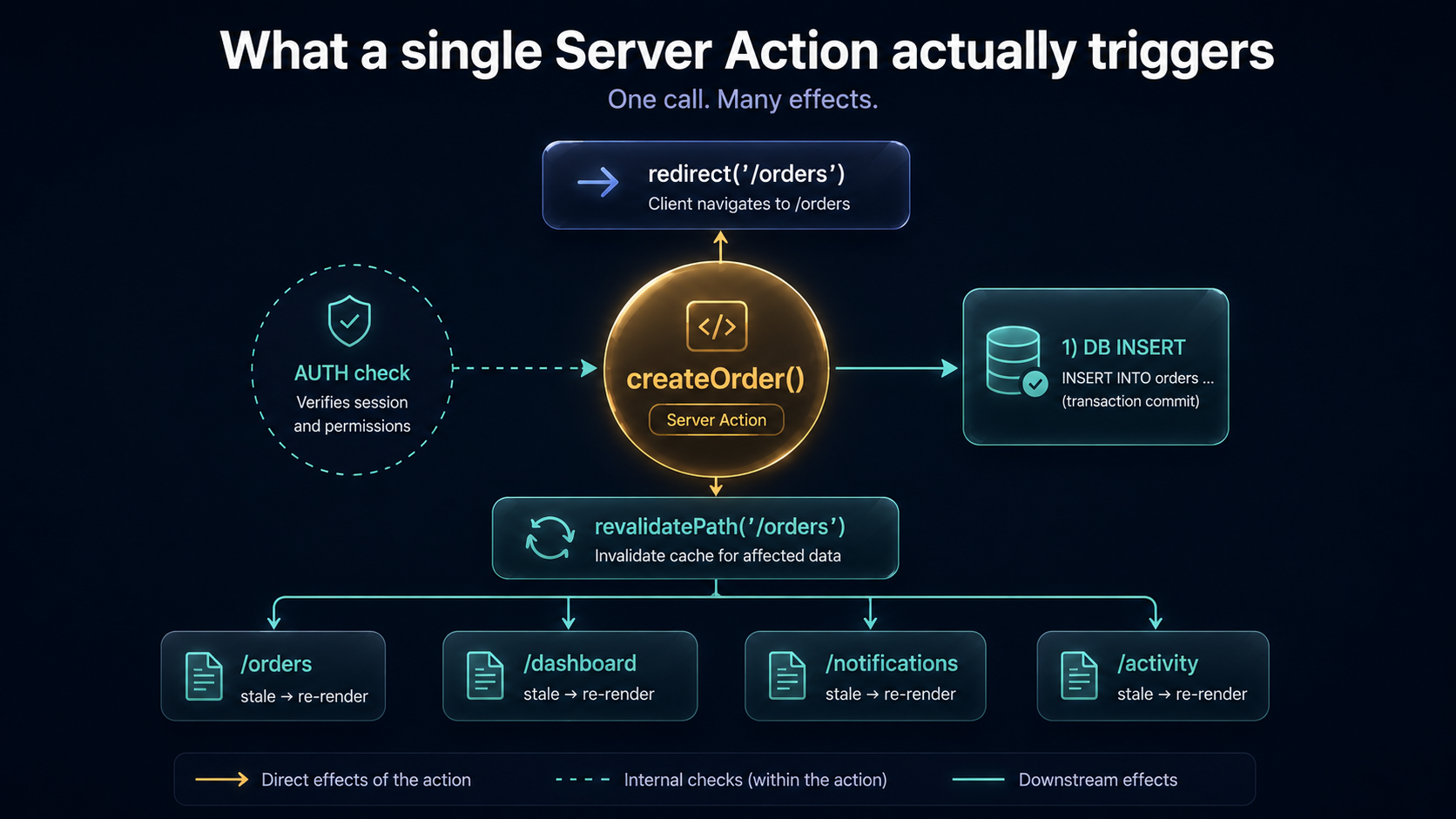
The second place the coupling bites is the cache. Server Actions don't just mutate data, they invalidate it. Most actions end with revalidatePath or revalidateTag, and that line is what makes the dashboard show the new order without a manual reload. It's also what makes a button on one page silently re-fetch a dozen others.
This is fine when the path/tag scheme is small and well-known. It gets less fine in a year-old codebase where someone added revalidateTag('user') to an action four screens away from the page that depends on it. A user clicks "save", and the navbar, the notifications panel, the activity feed, and a stats widget all re-render. The action that caused it is a function call. The cache effect is global.
The third coupling is more subtle. Actions are callable from anywhere a server component or client component can import them. A "delete user" action defined for an admin form is, by default, callable from a tiny <button> somewhere else, by anyone who can import the file. There's no convention that says "this action is only for that form." You have to decide that yourself and enforce it with if (session.role !== 'admin') throw ….
This is the part where "cleaner forms" tips over into "you've built an RPC framework without realising it." The action is convenient because it's just a function. The cost is that nothing else in your codebase treats it like a public endpoint, even though that's exactly what it is.
Validation: Where The Schema Should Live
The cleanest thing about Server Actions, in practice, is that they remove the second copy of the validation schema. There's one schema, in one file, used by exactly one handler.
The catch is that React doesn't validate FormData for you. Every field is a string (or a File, or null). formData.get('amount') is typed FormDataEntryValue | null regardless of what your input said. If you want types and constraints, you write them.
The idiomatic choice is Zod. The pattern looks like this:
'use server';

import { z } from 'zod';
import { auth } from '@/lib/auth';
import { db } from '@/lib/db';
import { revalidatePath } from 'next/cache';
import { redirect } from 'next/navigation';

const CreateOrderInput = z.object({
  customer: z.string().min(1).max(120),
  amount: z.coerce.number().int().positive(),
});

export async function createOrder(formData: FormData) {
  const session = await auth();
  if (!session) throw new Error('Unauthorised');

  const parsed = CreateOrderInput.safeParse({
    customer: formData.get('customer'),
    amount: formData.get('amount'),
  });

  if (!parsed.success) {
    return { ok: false, errors: parsed.error.flatten().fieldErrors };
  }

  await db.orders.insert({ ...parsed.data, ownerId: session.userId });

  revalidatePath('/orders');
  redirect('/orders');
}
A few details worth lingering on.
z.coerce.number() exists for exactly this case, strings coming from FormData. Without coercion you get a "expected number, got string" error on every numeric field, every time.
The action returns a result object when validation fails, instead of throwing. Throwing inside an action shows the user a generic error boundary. Returning a structured response lets the form render field-level errors.
The form on the client side uses useActionState (named useFormState before React 19) to read the action's return value:
'use client';

import { useActionState } from 'react';
import { createOrder } from '../actions';

const initial = { ok: true, errors: {} as Record<string, string[]> };

export default function NewOrderForm() {
  const [state, formAction] = useActionState(createOrder, initial);

  return (
    <form action={formAction}>
      <label>
        Customer
        <input name="customer" />
        {state.errors?.customer && <p>{state.errors.customer[0]}</p>}
      </label>
      <label>
        Amount
        <input name="amount" type="number" />
        {state.errors?.amount && <p>{state.errors.amount[0]}</p>}
      </label>
      <button>Create order</button>
    </form>
  );
}
A small but worth-noting wart: useActionState wraps your action and changes its signature on the client side. The hook's bound action receives (previousState, formData), not just formData. If you want to use the same action from both a plain <form action={createOrder}> and from useActionState, you'll define it with two arguments and ignore the first when called raw, or wrap it differently in each place. It's a wrinkle, not a blocker, but it's one of the first surprises new teams hit.
What you don't get for free: cross-field validation, async validation against the database (uniqueness checks), or anything that depends on the user's session beyond "are they logged in". All of that lives in your action body. Zod gives you the shape; you give it the rules.
Auth: Three Layers, Pick Carefully
There's a tempting picture that auth in a Next.js App Router project happens in middleware. You write a middleware.ts that checks the session cookie and redirects unauthenticated users. Done.
That picture is half right. Middleware runs on every request to a page, and it can guard navigation. But Server Actions are POST requests to action URLs Next.js generates, and the relationship between middleware matching and action routing has historically been a source of confusion. In practice the right mental model is to assume middleware does not protect actions, and to put the check inside the action itself (or its wrapper).
Concretely, you have three layers, and they answer different questions:
Layer 1, Page guards. Server components can call auth() (or your equivalent) and redirect to a login page if the session is missing. This stops unauthenticated users from seeing the page that hosts the form.
import { auth } from '@/lib/auth';
import { redirect } from 'next/navigation';

export default async function NewOrderPage() {
  const session = await auth();
  if (!session) redirect('/login');
  return <NewOrderForm />;
}
This doesn't protect the action. Anyone who knows the action URL can POST to it directly. It just makes the form rendering require a session.
Layer 2, Action body. Every action that mutates anything starts with an auth check. Either inline:
const session = await auth();
if (!session) throw new Error('Unauthorised');
Or via the wrapper pattern from earlier. The benefit of the wrapper is uniformity: every action goes through the same gate, and you can add features (logging, rate-limit keys, audit trails) in one place.
Layer 3, Authorisation. Auth says who, authorisation says what they can do. A logged-in user is not automatically allowed to delete every order. The action has to check the resource:
export async function deleteOrder(orderId: string) {
  const session = await auth();
  if (!session) throw new Error('Unauthorised');

  const order = await db.orders.find(orderId);
  if (order.ownerId !== session.userId && session.role !== 'admin') {
    throw new Error('Forbidden');
  }

  await db.orders.delete(orderId);
  revalidatePath('/orders');
}
The temptation, especially in a hurry, is to skip layer 3 because the page that calls deleteOrder only shows orders the user owns. You see your own orders, so you can only delete your own orders. Right?
Wrong. The action is a function and the function takes an orderId. Whatever the UI shows, the network call accepts any ID. The browser DevTools network tab will tell anyone what the action expects. Treat every action as if a curious attacker has the source.
Progressive Enhancement: Works, With An Asterisk
One of the genuinely lovely things about <form action={serverAction}> is that it submits without JavaScript. A user on a slow connection, or with JS disabled, or on a flaky network where the bundle hasn't loaded yet, can still create an order. The browser does what browsers have always done with forms: POST the data, follow the redirect, render the next page.
This is real. It's not a marketing claim. The action receives a FormData instance whether the submission came from a fully-hydrated client or a barebones browser. Your auth check still runs. Your validation still runs. Your redirect still works.
The asterisk is the parts that don't work without JS:
useFormStatusis a client hook. Pending states, spinners, disabled buttons during submission, all of that is JS-only by definition.useActionStatereturning structured errors works in both modes, but on the no-JS path, the page re-renders from scratch with the new state. You can't show field errors inline without a navigation; you have to render them on the destination page after the server bounces the form back. Practically, this means the no-JS error path needs its own thought, usually aredirect('/orders/new?error=…')or returning the rendered page with the error baked in.- Optimistic UI is JS-only.
useOptimisticis a client hook, and the whole point is to lie to the user about a value while the action runs. Without JS, there's no client to lie from. - File uploads with progress bars are JS-only. The form will submit the file; you just can't show a progress bar.
For a lot of real apps this is fine. Internal tools, e-commerce checkouts, admin panels, the no-JS path being "it works, just less prettily" is exactly the bar. For something where the JS-enabled experience is fundamental (a real-time editor, a drag-and-drop board), progressive enhancement isn't a feature you need, and that's also fine.
The trap is to assume "I'm using Server Actions, so I have progressive enhancement" without checking which parts actually still work. The form submits. The fancy error states don't. Decide which you need.
Mutations And Revalidation: The Invisible Side Effect
The piece of Server Actions that's easiest to miss when you're learning them is also the one most responsible for the "this feels magic" reaction: cache invalidation.
Next.js App Router caches aggressively. A page's fetched data, a route segment, a generated static asset, all cached by default, in some cases for the lifetime of the deployment. The way you tell Next.js to refresh that cache is with revalidatePath or revalidateTag.
A Server Action that mutates data without calling one of these is, from the user's perspective, broken. They submit the form, the page navigates back to /orders, and their new order isn't there. They reload, still not there. They check the database directly and the row exists. The issue isn't the database; the issue is that /orders is serving cached HTML from before the insert.
So actions end with revalidation:
await db.orders.insert({ ... });
revalidatePath('/orders');
Or, more granularly, with tags:
const order = await db.orders.find(orderId);
// in the action that updates it:
revalidateTag(`order:${orderId}`);
The implicit contract is that every page or fetch that depends on a piece of data is tagged accordingly, and every action that mutates that data revalidates the matching tag. When the contract holds, the UX is wonderful. When it doesn't, when someone adds a new page that reads order data but forgets to tag it, or an action that updates orders but forgets to revalidate, the bugs are weird, intermittent, and stale-data-shaped.
There's a second sharp edge here: revalidation is a side effect that's invisible at the call site. The function you import looks like createOrder(formData). You call it. Somewhere inside, a revalidatePath('/orders') runs. Somewhere else, every page that uses /orders's data discards its cached version. From the page that called the action, nothing about the call site tells you that twelve other pages are now stale.
This is the "hidden coupling" the title gestures at. The action's caller doesn't see what the action invalidates. The cache configuration's reader doesn't see which actions invalidate it. They communicate through string-typed path and tag identifiers that nobody compiles. Rename a tag, forget to update an action, and you ship the bug.
The countermeasure most teams land on is fewer, broader tags. Instead of order:1234, order:1235, order:1236, you use orders and revalidate aggressively. You lose some surgical precision in exchange for a much smaller surface to keep in sync. For most apps, this is the right trade, the cost of an occasional unnecessary refresh is less than the cost of a permanent stale-data bug.
Calling Actions From Outside A Form
The marketing examples for Server Actions all show forms. The thing the marketing examples don't dwell on is that actions are functions, and functions can be called from anywhere.
A button outside a form:
'use client';

import { useTransition } from 'react';
import { deleteOrder } from '../actions';

export function DeleteButton({ id }: { id: string }) {
  const [pending, startTransition] = useTransition();

  return (
    <button
      disabled={pending}
      onClick={() => startTransition(() => deleteOrder(id))}
    >
      {pending ? 'Deleting…' : 'Delete'}
    </button>
  );
}
This works exactly as the form version does. The transition gives you a pending state without useFormStatus. The action runs server-side. The revalidation, the auth check, the redirect, all the same.
A keyboard shortcut handler:
useHotkey('cmd+s', () => startTransition(() => saveDocument(doc)));A drag-and-drop callback that fires an update on drop. An optimistic delete that updates local state and then calls the action in the background. A bulk action that calls the same function in parallel for ten selected rows. All fine. All routine.
The reason this matters: once you accept that an action is just a function, the mental model of "it lives in a form" stops mattering. The action is your mutation primitive. It's the thing every UI surface uses to write data. Forms are one caller. Buttons are another. Background tasks are another. The action is the shared centre.
This is good. This is also why the auth and authorisation layers can't live in the form, they have to live in the action. There is no "form" to attach the check to, because the form is just one of many ways the action gets called.
When To Reach For An API Route Instead
Server Actions don't replace API routes. They replace a specific shape of API route, the internal one, used by your own UI, talking to your own server. For other shapes, route handlers are still the right tool.
Anything called by a non-Next.js client. Your mobile app, a third-party integration, a webhook recipient, they need a stable URL, documented contract, and probably versioning. Server Actions are an internal calling convention with obfuscated IDs that Next.js owns. Don't expose them to clients you don't control.
Anything that needs custom HTTP semantics. Caching headers, content negotiation, streaming responses that aren't React, ETag-based revalidation, range requests, actions don't expose the response object enough for any of this. A route handler does.
Public webhooks. A Stripe or GitHub webhook needs a verifiable signature, a known URL, and an HTTP body the sender controls. Actions accept FormData and JSON-ish arguments from the React runtime, not raw bodies from arbitrary senders.
Anything benchmarked or load-tested as a hot path. Actions go through the React server runtime and a serialisation layer. For an endpoint where you're counting microseconds, a high-volume tracking pixel, an autocomplete query hit thousands of times per second, a thin route handler with a hand-written response is leaner.
A simple rule that works in practice: if the caller is your own React UI, write a Server Action. If the caller is anyone else, write a route handler. You'll end up with both in most non-trivial apps, and that's correct.
A Working Pattern
Pulling the rules above into one place, the pattern that holds up in a real codebase looks roughly like this.
Every mutation lives in a Server Action. Forms call them via action={…}. Buttons call them via startTransition. Hooks call them via useActionState when they need a return value rendered in place. There is exactly one definition per mutation, and it lives next to the feature it belongs to.
Every action goes through a wrapper. The wrapper checks auth and, optionally, runs Zod validation against a schema you pass in. If you have feature-level authorisation rules (an admin-only feature, an owner-only feature), the wrapper accepts a predicate too. By the time the action body runs, the session is present, the inputs are typed, and the resource is ownership-checked. The action body is just the business logic.
Validation schemas live in the feature folder, exported once, used by the wrapper. The form references the same schema for client-side hints if it wants them, but the server-side check is what actually matters.
Revalidation uses a small set of named tags, defined as constants, not stringly-typed identifiers. CACHE_TAGS.orders is checked by the compiler when you rename it; 'orders' is not.
API routes exist alongside actions, for the cases above. They live in app/api/, they call into the same data layer that actions call into, and they don't reimplement business logic. The split is at the boundary, not at the logic.
If you draw this on a whiteboard, Server Actions look less like "a way to write forms" and more like "the internal RPC layer between your React UI and your data layer." Which is what they are. Treat them as that, with the discipline that comes with it, and they hold up. Treat them as a syntactic shortcut for fetch, and you'll be hunting a revalidate bug six months from now.
The Honest Answer To The Title
Are Server Actions cleaner forms or hidden coupling? Both. Always both. The trick is that you have to see the coupling to manage it.
The cleaner-forms part is real. Less boilerplate, fewer files, one validation schema, redirect that just works, progressive enhancement that mostly just works. For the eighty-percent case, internal CRUD, dashboards, business apps, the upgrade is genuine.
The hidden-coupling part is also real. Every action is a public POST endpoint. Cache invalidation is a side effect at a distance. Auth and authorisation live inside the function, not around it. The action can be called from anywhere it's imported. None of these are bugs, but all of them are things the demos quietly skip.
The teams that get the most out of Server Actions are the ones that read the bullet above and add three lines to their internal docs: actions are POST endpoints, treat them like that; every action goes through one auth wrapper; revalidation tags are constants, not free strings. That's the rule set. Everything else is the same Next.js you already know.